

Value isn’t set by how well a forecast reproduces the weather. It’s set by whether it changes what someone does next.
I’m not really a Climate Week kind of guy.
My professional focus over the past 30+ years has been on the here and now and soon-to-be impact of the weather (as opposed to climate) on consumers and business … I’m more blue-collar than ivory tower.
But I’ve had my Climate Week moment.
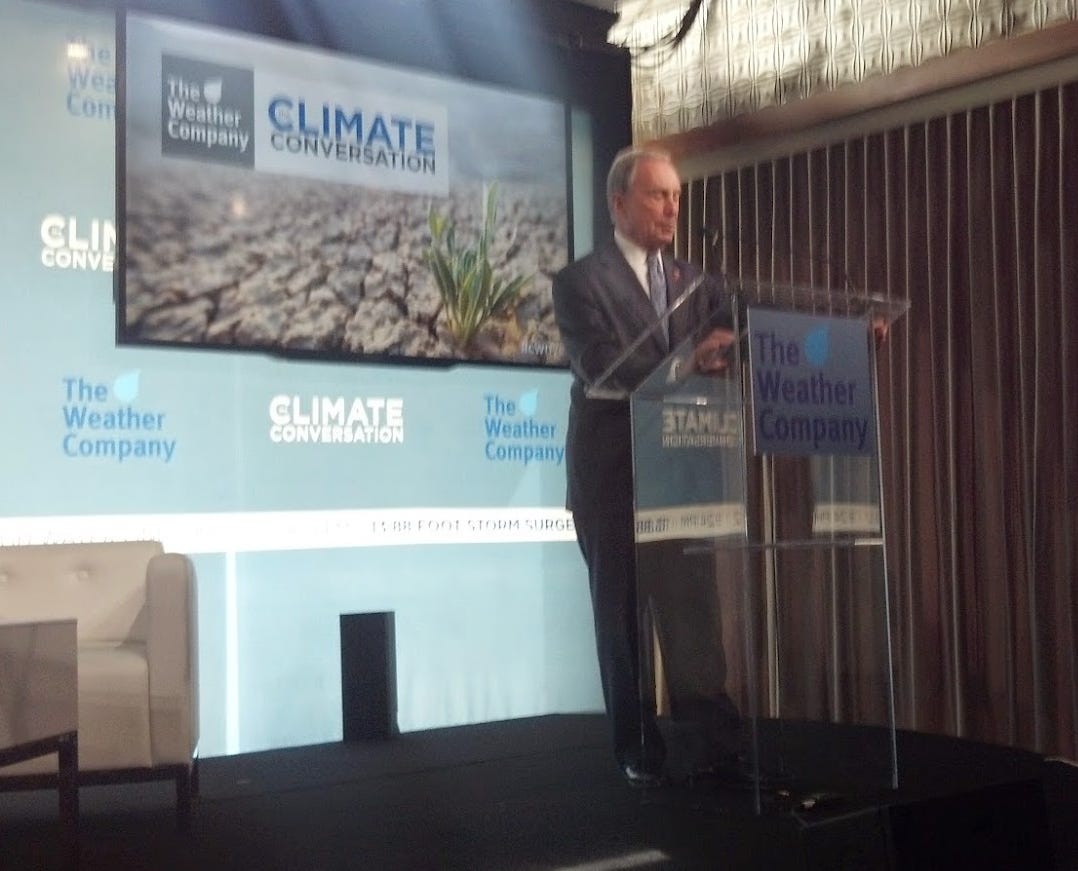
In 2013, while at The Weather Company (IMHO the “golden age” of TWC under the transformational leadership of David Kenny), I had a front-row seat at a tent-pole Climate Week event sponsored by TWC.
It was a big deal, headlined by none other than hizzoner, NYC Mayor Mike Bloomberg.
It felt like I was at the center of something important.
This year, from the outside looking in, Climate Week seemed to be trumped by a parade of horribles: an energy shock driven by the wars in Iran and Ukraine; inflation compounded by arbitrary and reckless tariff policies; growing backlash against data centers; warnings of AI-driven human extinction (yikes!); and, not least, a president who has called climate change a hoax “created by and for the Chinese.”
My friend Andrew Freedman at CNN, covering this year’s event, put a finer point on it: climate change has gone from a future problem to a present-day crisis in just a few years, yet the economic push to build out data centers for AI has “stripped the climate challenge of its sense of urgency.” (CNN)
I’ve always felt that too much of what happens at these events is performative: high-minded panels about saving the world that, however well-intentioned, can drift into pearl-clutching—disconnected from the immediate concerns of people trying to run a business or pay their bills.
Yale and George Mason’s most recent joint survey reinforces the point.
Asked what worries them most, Americans rank government corruption (54%), the cost of living (48%), and the economy (47%) well above climate change. Just 29% say they are “very worried” about it, placing it seventh on the list.
Meanwhile, the effects of weather on consumers, businesses, and the economy are real, immediate, and unfolding on Main Street—not on a stage.
AI-generated forecasts now offer a level of geographic precision and accuracy that didn’t exist just a few years ago. And the execution layer—agentic AI capable of acting on a forecast rather than simply displaying it—is arriving as well.
Climate may no longer be above the fold, but the tools for managing its effects, cutting costs, and protecting margins have never been better.
The climate has changed. It’s time to put as much effort into managing the world we actually live in as we have put into warning about it.
That’s also, almost word for word, the argument made in a recently released report by the University of Chicago’s Institute for Climate and Sustainable Growth.
The core idea.
Weather forecasting has always been supply-driven: build the most accurate forecast the technology allows, publish it, and hope the people who need it find a way to use it.
That model made sense when producing more accurate forecasts required enormous computing resources available to only a handful of well-funded institutions.
AI has dramatically lowered that barrier. Forecasting capabilities that once depended on specialized infrastructure can now run on a laptop in minutes.
That changes what’s possible. Instead of starting with the forecast and pushing it downstream, we can begin with the decision someone actually has to make—and build the forecast around it.
The report calls this demand articulation. Before any model gets built, state the decision, who owns it, what authority and resources they have, and what would actually change if the forecast got better.
Skip that step, and you get a technically excellent forecast nobody acts on.
In one example, 81% of national weather services provide climate information for health, but only 23% of health ministries use it in disease surveillance.
The problem wasn’t the forecast.
The decision it was meant to inform—and who was responsible for acting on it—had never been clearly defined.
ERaaS Health is this framework in operation—not in theory.
I’m an advisor to ERaaS Health, so I’m not a neutral observer. But the example stands on its own.
What ERaaS has built is AI-enabled demand articulation in practice. It didn’t begin with a weather forecast and then search for a healthcare application. It began with a specific decision: high-risk patients need outreach before a heat wave, cold snap, air-quality event, or disease threat arrives.
ERaaS then built backward from that decision.
The result: more than 125,000 ultra-high-risk patients contacted in real time through AI-driven conversations, replacing generic, after-the-fact alerts with proactive outreach.
That is the report’s central argument already operating at scale—not merely being tested in a pilot.
Better forecasts don’t produce better outcomes by themselves.
That brings me back to the Climate Week event The Weather Company sponsored in 2013. Much of the conversation then was about making climate risk visible.
Today, visibility is no longer the primary constraint. Turning that intelligence into action is.
Better outcomes begin with the right decision-first question—whether it’s a retailer planning inventory, a health system preparing for a surge, or a ministry timing a malaria campaign.
The forecast is an input. The decision is where the value gets created.
The analysis and writing here are mine. I use AI as an editor for fact-checking and line edits, not as a source of ideas or content.
© 2026 G2 Weather Intelligence. All rights reserved.