

“We like to think our big decisions are insulated from something as arbitrary as the weather. The research says otherwise. We are permeable. The weather gets in.”
Years ago, my oldest son, Michael, had a decision to make. He'd worked hard, applied to some of the best schools in the country, and found himself with acceptances from two of them — NYU and the University of Michigan. Two great universities. Two very different campus visits. And as it turned out, two very different days of weather.
The NYU visit was mostly indoors. The weather in New York that day was grey and unremarkable — the kind of city day that keeps you moving from lobby to lobby without ever really feeling the place. He was impressed. He wasn’t moved.
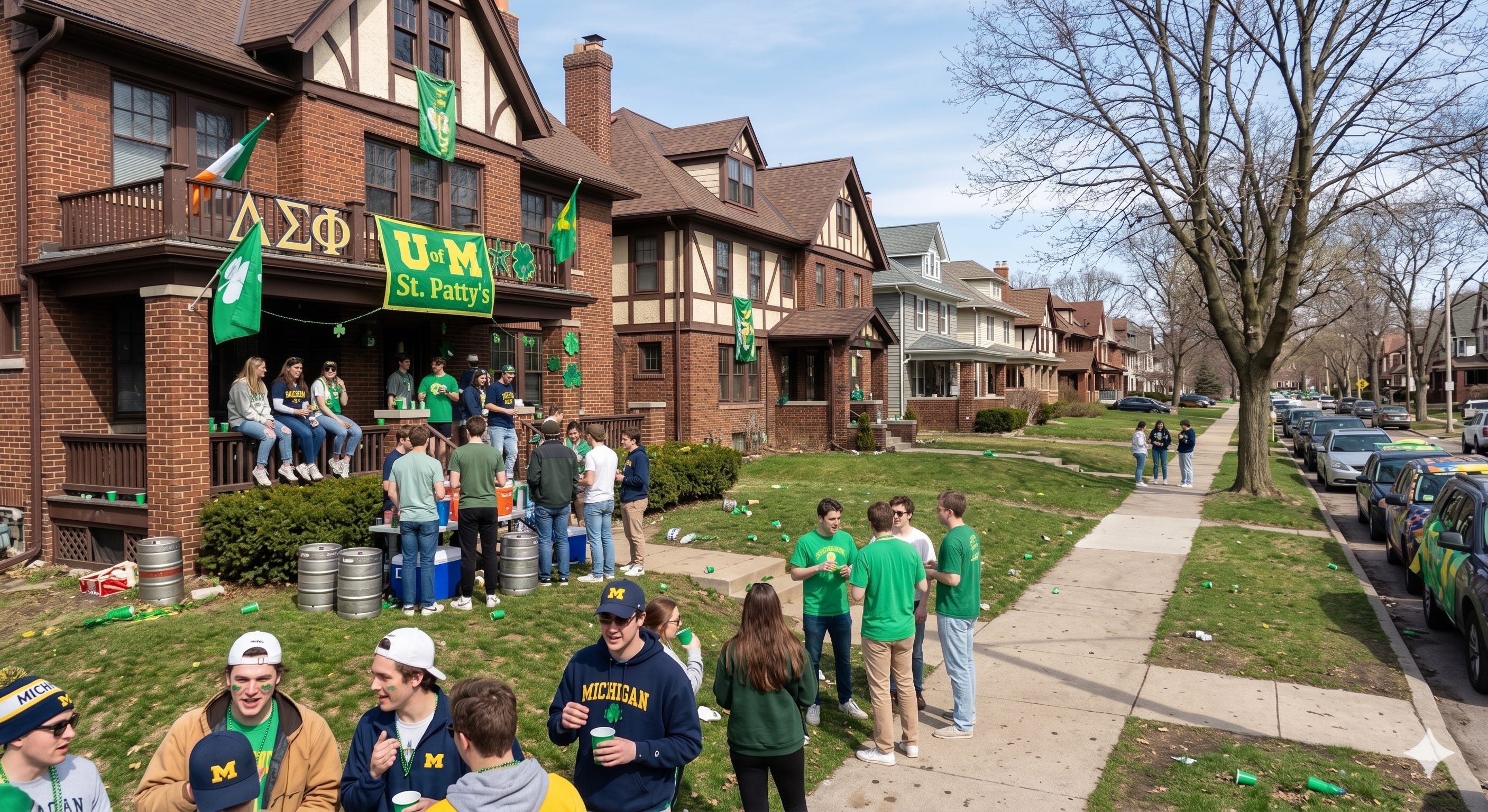
Next, we drove to Ann Arbor to visit Michigan. It was St. Paddy’s Day. One of those early spring afternoons that arrives like a surprise — warm, sunny, and about fifteen degrees warmer than it had any right to be. We walked the campus in shirtsleeves. Students were out everywhere. Frat guys on balconies. There was day drinking happening. The whole campus had the electricity of a great university on a great day.
By the time we got back to the car, the decision was made. He chose Michigan.
What the Research Says
A new study published last month by the National Bureau of Economic Research — and covered today in the Wall Street Journal — puts a number on what I witnessed in Ann Arbor.
Researchers at Amherst College spent eight years matching campus tour attendance records to application logs at a highly selective Northeastern university. They controlled for time of day, month, and season to isolate the effect of weather itself.
What they found is striking:
A hot tour day reduced applications by 10.1% compared to moderate temperatures
A cold tour day reduced applications by 5.9%
Precipitation on tour day reduced applications by 8.3%
Cloudy conditions reduced applications by 4.9%
Students from warmer home states were hit hardest by cold — during a cold spell, they were 14.6% less likely to apply. If you grew up in Florida or Texas and visited a Northeastern campus on a raw March day, the campus didn't stand a chance.
The researchers call it the importance of “feel” — the impression a student forms about whether they will thrive at a school. Olivia Feldman, an Amherst senior and one of the paper’s co-authors, put it plainly:
“This isn’t just a story people tell. It’s actually something that exists and affects one of the most important decisions many people make in their lives.”
The Amherst study focused on pre-application tours — students visiting before deciding where to apply. My son’s experience was different, and probably more common than the researchers’ sample suggests. We toured after he’d already been accepted. The tour wasn’t about whether to apply. It was about where to go.
That’s a higher-stakes weather moment, not a lower one. When a student is standing on a campus in March with an acceptance letter in hand and a decision deadline approaching, the weather isn’t shaping an application. It’s shaping the choice itself.
Weather Gets In
College tours are just the setting. This is really about how the weather shapes what we do … and why.
The economics literature on weather and decision-making is more robust than most people realize. Sunny days measurably increase stock market returns. Good weather drives consumer spending at retail stores. Convertible car sales correlate with warm, sunny days in ways that can’t be explained by rational preference alone. Homes shown on sunny days sell faster and at higher prices.
The weather doesn't announce itself. It just runs through us and shapes what we decide. Mike didn't choose Michigan because of the sunshine. He chose Michigan — and the sunshine was there too, doing its work.
We like to think our big decisions are insulated from something as arbitrary as the weather. The research says otherwise. We are permeable. The weather gets in. It shapes mood, narrows or expands our sense of possibility, and makes a place feel like home or feel foreign. And then it disappears from the story we tell about why we made the choice.
It’s a hidden signal. But hidden doesn’t mean unmeasurable. Weather is one of the few truly predictable inputs into human behavior — forecastable days, sometimes weeks, in advance. The signal is invisible to the people living inside it. It doesn’t have to be invisible to the people planning around it.
What Schools Are Doing About It
To their credit, some institutions are starting to take this seriously.
High Point University in North Carolina ferries visitors around campus in golf carts when temperatures climb. The University of Minnesota leans into the Gopher Way — its elaborate network of tunnels and skyways — as a selling point rather than an apology. The Amherst researchers themselves are considering distributing ice cream sandwiches on hot days, sending pre-tour weather alerts, and even telling prospective students about the study during tours to surface the unconscious bias before it operates.
“Maybe it cracks 90 degrees, and we bring out the ice cream sandwiches,” said Matthew McGann, Amherst’s dean of admission and one of the paper’s co-authors.
Awareness is the first intervention. Once you know the signal exists, you can (and should) proactively plan for it.
The Bigger Implication
If weather shapes one of the most consequential decisions a young adult makes — where to spend four years and (many!) tens of thousands of dollars — what else is it shaping?
The answer, based on the research, is: quite a lot.
Retail purchase decisions. Job offer acceptances. Real estate choices. Investment sentiment. The pattern is consistent across domains. Humans are not the rational, context-independent decision-makers that classical economic theory assumes. We are situated in the weather. It affects us whether or not we account for it.
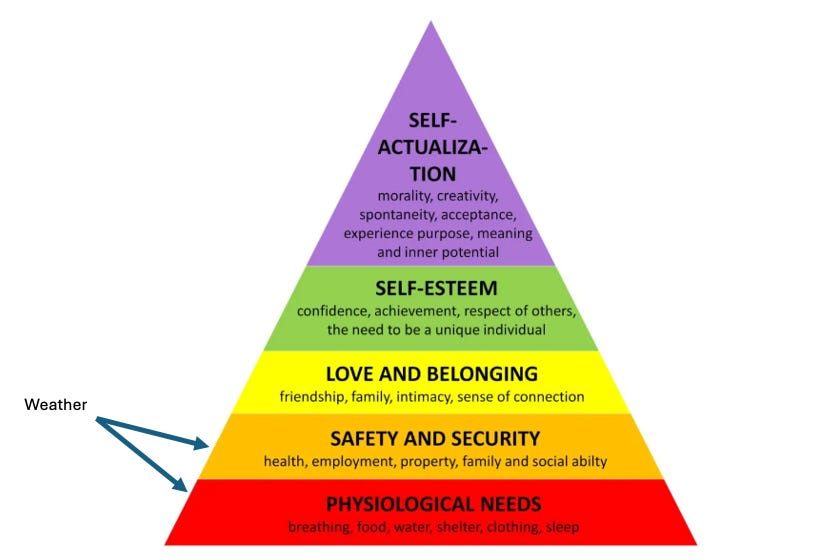
Maslow’s hierarchy of human needs starts at the base for a reason. Physiological needs — breathing, shelter, warmth, sleep. Safety and security — health, protection from the environment. Weather touches both.
It is arguably the most fundamental and most measurable external driver of human behavior, operating at the very foundation of what makes us act, decide, and feel.
Everything above it — belonging, esteem, self-actualization — is built on top of conditions that weather shapes every day. It influences from the outside. It registers on the inside. And unlike almost every other behavioral driver, it is forecastable.
This is the premise underlying G2 Weather Intelligence — that weather is not background noise. It’s a measurable, forecastable signal that runs through consumer behavior, purchase decisions, and demand patterns in ways that most planning processes don’t explicitly model. The Amherst study is a vivid illustration of why that matters.
Back to Ann Arbor
Michael loved Michigan. He graduated with a degree in English, went on to earn his PhD, published two books, and won the 2025 University of Georgia Press poetry prize.

The academics, the culture, the size of the opportunity — he would tell you it was all of those things, and he’d be right. He made a great choice and built on it in ways I couldn't have predicted walking across that campus in the sunshine on that warm St. Patrick's Day.
But I was there. I felt what he felt. I saw the Diag full of students in shirtsleeves on an afternoon that felt like the first real day of spring. The day drinking in front of the frat houses. I watched him take it all in.
He chose Michigan for a hundred good reasons. The weather was not one of them — not consciously, not in any version of the story he tells. But it was there. It set the stage. It tilted the ground just enough.
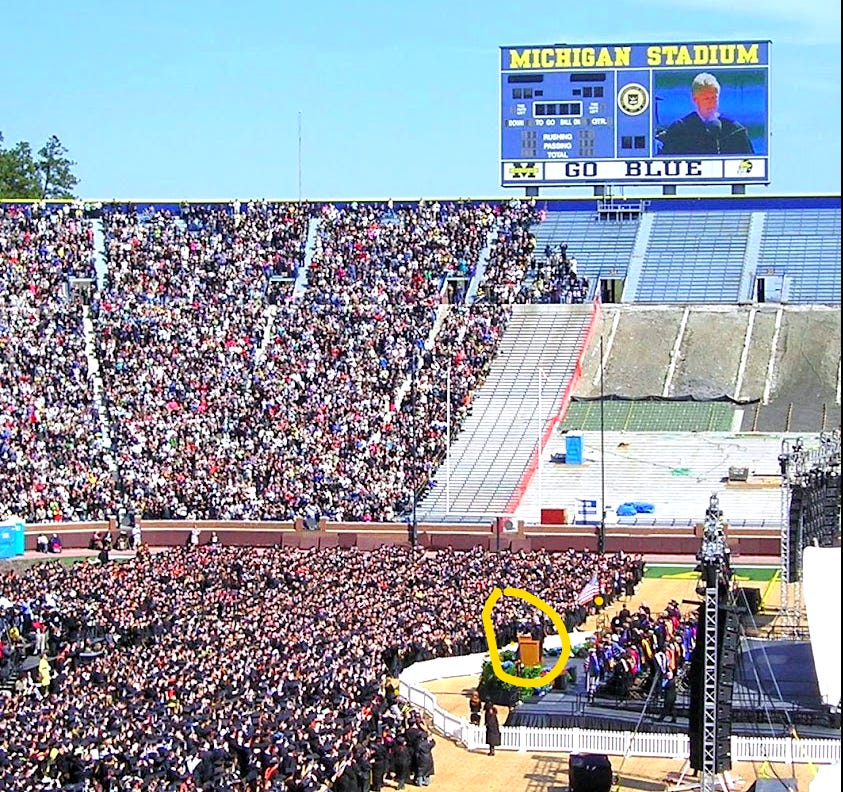
Four years later, Bill Clinton gave the commencement address in the Big House. It was cold — genuinely cold, the kind of May morning in Michigan that reminds you winter still has opinions. We didn’t mind. The mission was complete.
That’s how weather works. It shapes the decision. Then disappears from the story we tell about why we made it.
Musical Coda
Sources: “Feel as a Determinant of College Choice: Evidence from Campus Tour Weather” — Feldman, Hyman, McGann, NBER Working Paper No. 34944, March 2026. Wall Street Journal, Roshan Fernandez, April 19, 2026 (gift link attached). Hirshleifer & Shumway (2003) on weather and stock returns. Murray et al. (2010) on weather and retail spending.
G2 Weather Intelligence™ | g2weather.com | © 2026 G2 Weather Intelligence™. All rights reserved.