

We’re taking the grandkids to a Phillies game on July 2nd. They’re 6 and 4. It’s Kids Run the Bases Day — sponsored by (you can’t make this up) Nemours Children’s Health.
The forecast high at Citizens Bank Park: 104 degrees. (!)
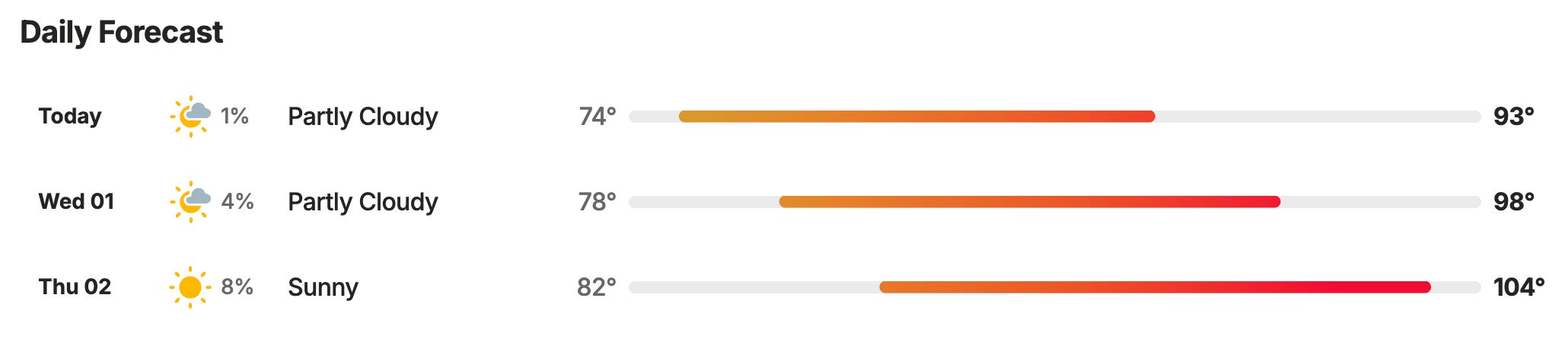
We’ve already purchased hand fans and cooling towels and are hoping the forecast isn’t as dire as it looks. But I’ve spent more than thirty years in the weather forecasting business, and the signal has been unambiguous and persistent for the last week — it’s going to be a Fourth of July scorcher.
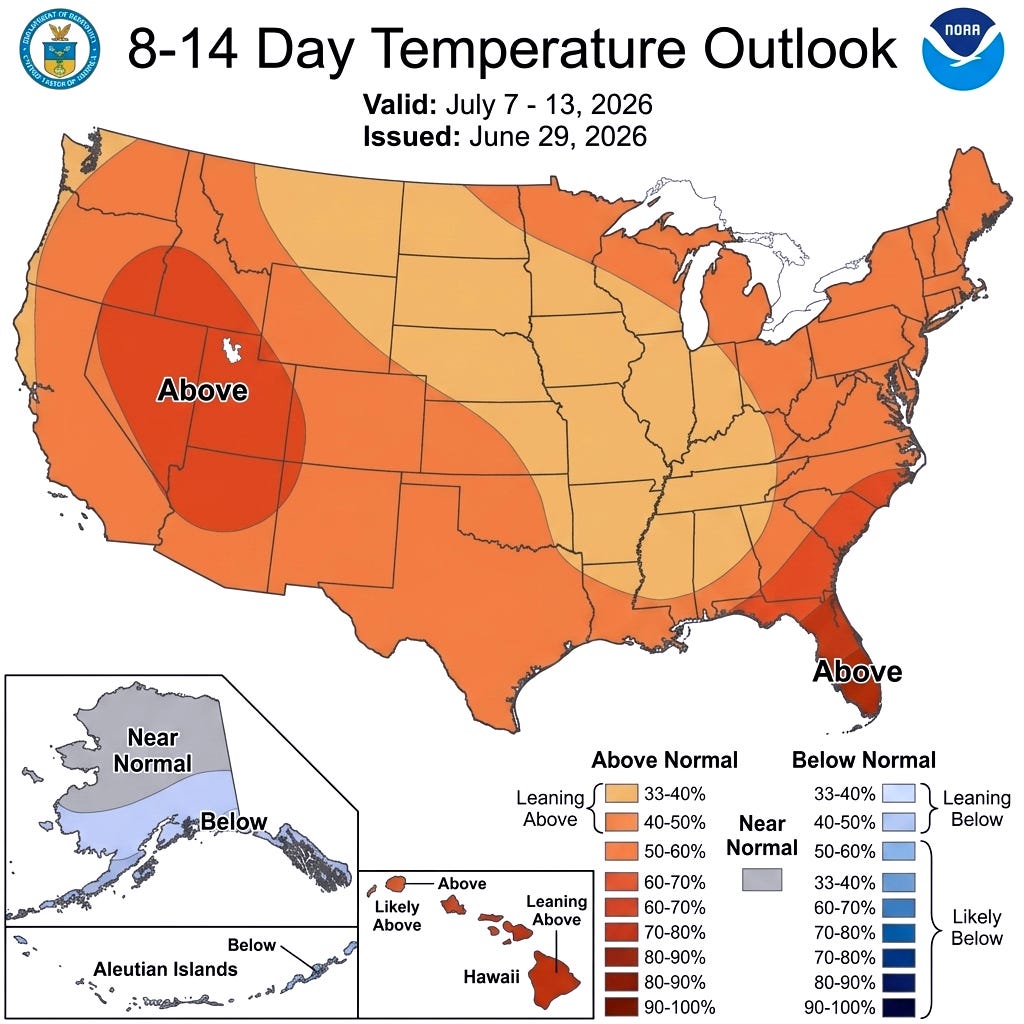
And this is not a one-day event. The 8-14 day outlook extends the above-normal signal through July 13th
The Health Story Comes First
A 104-degree day at a baseball stadium is uncomfortable for a healthy adult. For an elderly person without air conditioning, a very young child, or someone with a chronic health condition, it can be life-threatening.
Last summer’s heat events killed 19 New Yorkers in four days. Most died at home, without air conditioning. The NYC Health Department estimates approximately 500 New Yorkers die from heat-related causes every year — the vast majority quietly, without making the news cycle. NYC experienced four separate heat waves last summer, finishing 2025 as its second-hottest summer on record.
Western Europe is already there. Multiple countries issued red alerts — warnings of “a risk to life for even the healthy population” — as temperatures exceeded 104 degrees Fahrenheit across France, Germany, Switzerland, and Italy. French nuclear power plants cut output by approximately 7% of total demand as high temperatures limited access to cooling water. Rail networks, schools, and working hours were disrupted across the continent.
The same forecast system that is showing 104 degrees at Citizens Bank Park on July 2nd showed those European temperatures weeks in advance. The question is never whether the signal is visible. It is whether the systems are in place to act on it before the emergency room fills up.
AI-First Health Resilience — At the Speed of a Heat Wave
This is exactly the problem that ERaaS Health is built to address. I serve as an advisor to the company, founded by Samrat Kulkarni. ERaaS develops AI-first health intervention tools specifically targeting heat-related illness and mortality risk — working with health insurance companies to identify at-risk members before a heat emergency peaks and intervene proactively.
During last summer’s heat events, ERaaS demonstrated what prevention looks like at the speed of a forecast. The system moved from data to proactive intervention in under 24 hours — identifying at-risk members, initiating outreach through an AI agent, and surfacing escalations to health plan care teams for wellness checks, cooling center referrals, and emergency interventions.
The results among engaged members: a 47% reduction in ER and inpatient admissions. Nine out of ten member call satisfaction. A 5-to-1 estimated return on investment.
As heat events become more frequent and more severe, the ability to move at the speed of the forecast — not the speed of the emergency room — is what separates a preventable death from a statistic.
Investors Are Paying Attention
The financial markets are beginning to price what the forecast has been signaling for years.
CNBC reported last week that investors are actively rethinking portfolio positioning in response to the European heat wave. Stephanie Niven, co-portfolio manager of the Global Sustainable Equity strategy at Ninety One, told CNBC that her team views the rise in extreme weather as “a structural growth opportunity” — seeking companies with products and solutions that “lean into helping people respond and build resilience in a challenging time.”
Her fund’s holdings include insurers such as Aon and Intact Financial — companies that are building more sophisticated climate modeling into their risk systems. And cooling and refrigeration manufacturers like Trane Technologies, which makes the physical infrastructure that keeps people alive during extreme heat.
Morningstar’s chief equity strategist Michael Field identified Johnson Controls and Siemens as major beneficiaries — both operate in the HVAC space where commercial heat pumps that double as cooling devices are seeing structural demand growth. UBS noted that the European heat wave has already pushed spot power prices higher as aging electrical infrastructure struggled to cope with surging cooling demand — identifying ABB, Schneider Electric, and Siemens as key beneficiaries of the grid modernization investment that follows.
The investment thesis is converging on the same signal the weather forecast has been delivering for weeks: extreme heat is no longer a tail risk. It is a structural condition that requires structural solutions.
ERaaS Health is one of those solutions — at the intersection of AI, health insurance, and climate resilience. The market is beginning to understand what that’s worth.
What the Heat Means for Consumer Demand
For retailers, the Fourth of July heat signal is the demand catalyst that the first three weeks of June didn’t deliver.
Cooling categories are the immediate beneficiary — air conditioners, fans, portable cooling units. The current signal is strong enough to drive meaningful category lift across the Eastern US through July 13th.
Home center retail is where the weather impact is most apparent in July. The same heat that suppresses outdoor project activity in the short term drives purchases of cooling equipment, irrigation, and lawn recovery as consumers respond to the stress on their homes, yards, and vehicles.
One important caveat: electricity prices are elevated — driven by the Iran conflict and structural demand from AI data centers competing for the same grid capacity.
A heat wave that drives around-the-clock air conditioning use is not just a demand driver for cooling products. It is a direct wallet squeeze on an already financially stressed consumer. Every dollar going to the electricity bill is a dollar not going to discretionary retail.
Heat plus high electricity costs is a consumer squeeze, not a clean demand driver.
Why the Heat Moderates in the Second Half of July
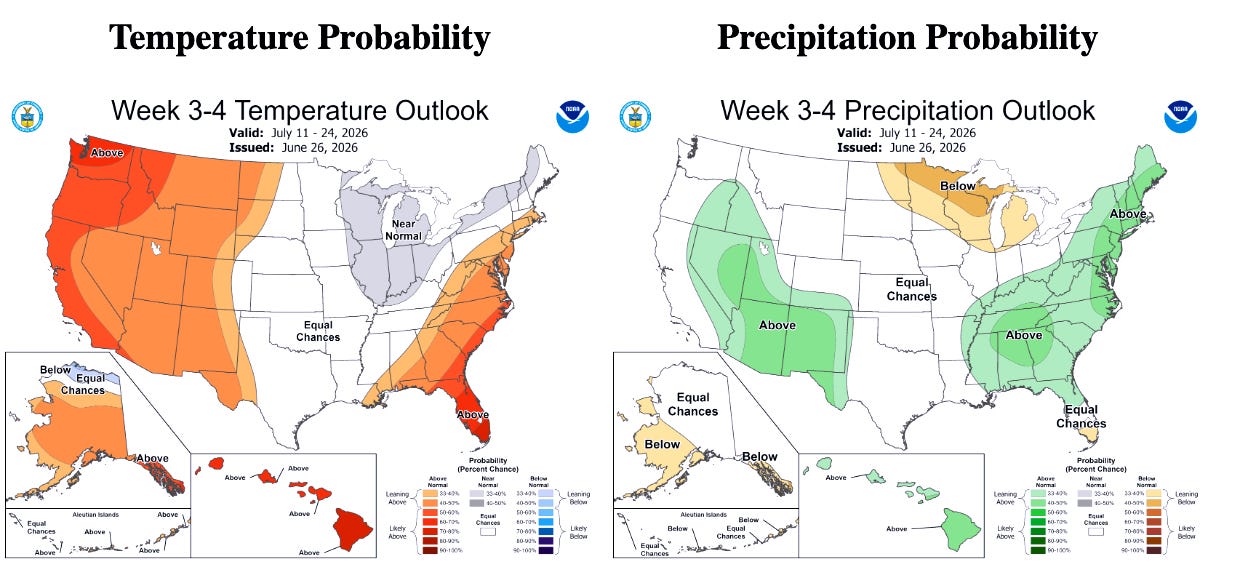
The forecasters at NOAA’s Climate Prediction Center explain the science in their weekly technical discussion.
Here’s the plain-language version —
Two large-scale weather patterns are competing for control of the US atmosphere in mid-July. A ridge of high pressure — a dome of warm sinking air — is building strongly over the Western US. That is what keeps the West hot.
To the east, a trough — a dip in the upper-level wind pattern that allows cooler air to push southward — is expected to develop near the Great Lakes. That trough moderates heat in the Central and Eastern US during the second half of July.
The western ridge is clear across all forecast models — high confidence. The eastern trough is where the uncertainty lives. The models disagree on exactly where it sets up and how deep it goes. When models disagree at two to three weeks’ range, NOAA’s forecasters hedge — which is why the Central Plains and Great Lakes show Equal Chances in the Week 3-4 outlook rather than a strong temperature signal.
The same trough that moderates the heat also generates precipitation. Troughs are associated with rising air, clouds, and storm systems. The above-normal precipitation signal returning to the Northeast and Mid-Atlantic in the second half of July is a direct consequence of the troughing pattern expected to develop over the Great Lakes.
The bottom line: the Fourth of July heat event is real and building. The atmospheric setup driving it is not forecast to persist through mid-July. One strong demand week does not replicate last summer’s sustained heat pattern. The second half of July looks more like a normal summer — and normal after last July’s historic heat is a headwind, not a tailwind.
The G2 Weather Intelligence Signal
The Fourth of July window is delivering what the forecast promised weeks ago. Cooling categories and home center retail stand to benefit from a strong heat signal across the Eastern US through July 13th.
Watch the precipitation outlook as the holiday weekend comes into the short-range forecast. Rain is the swing variable — and the Week 3-4 maps show it returning to the Northeast and Mid-Atlantic in the back half of the month.
One more thing: I’ll report back on the hand fans and cooling fans. Wish us luck.
© 2026 G2 Weather Intelligence. All rights reserved.