

It never rains in California
But girl, don’t they warn ya?
It pours, man, it pours
—Albert Hammond
Signal Summary
Three-Speed Economy: Weather is driving a split demand environment—winter holds in the Northeast, spring accelerates in the central U.S., and the West resets to cold and wet.
Necessity vs. Discretionary: Cold and precipitation are consolidating spend into essential, delivery, and repair-driven categories, while discretionary and traffic-dependent formats face pressure.
Early Spring Pull-Forward: Record warmth across the central and southern U.S. is accelerating outdoor, home improvement, and dining demand ahead of the retail calendar.
Persistence Drives Outcomes: The extended outlook reinforces the divide—clean, demand-supportive conditions in the South vs. ongoing disruption risk in the Northwest. Subscribe to Premium for the 4-week outlook and full signal set.
The Setup
The pattern isn’t transitioning. It’s splitting.
Winter is still fully intact across the Northeast, where cold remains anchored and continues to shape demand like it’s January, not mid-February.
At the same time, the center of the country has flipped, with record warmth pushing early-season activity forward and accelerating the shift into spring categories.
Out West, the signal resets again. A return to colder, wetter conditions increases friction—slowing traffic, consolidating trips, and reducing discretionary demand.
This isn’t a clean seasonal handoff. It’s a three-speed economy, driven by weather.
Last Week Actual — Week Ending February 14, 2026
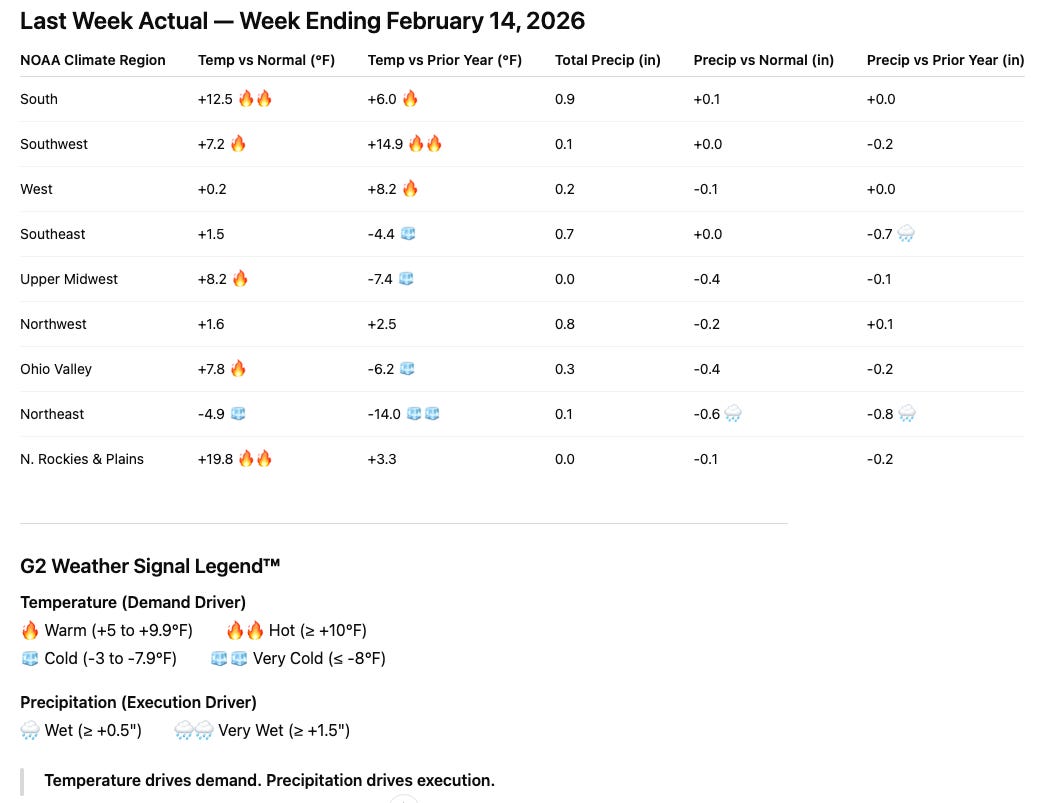
The mid-month period produced a clear temperature-driven split between necessity and discretionary demand.
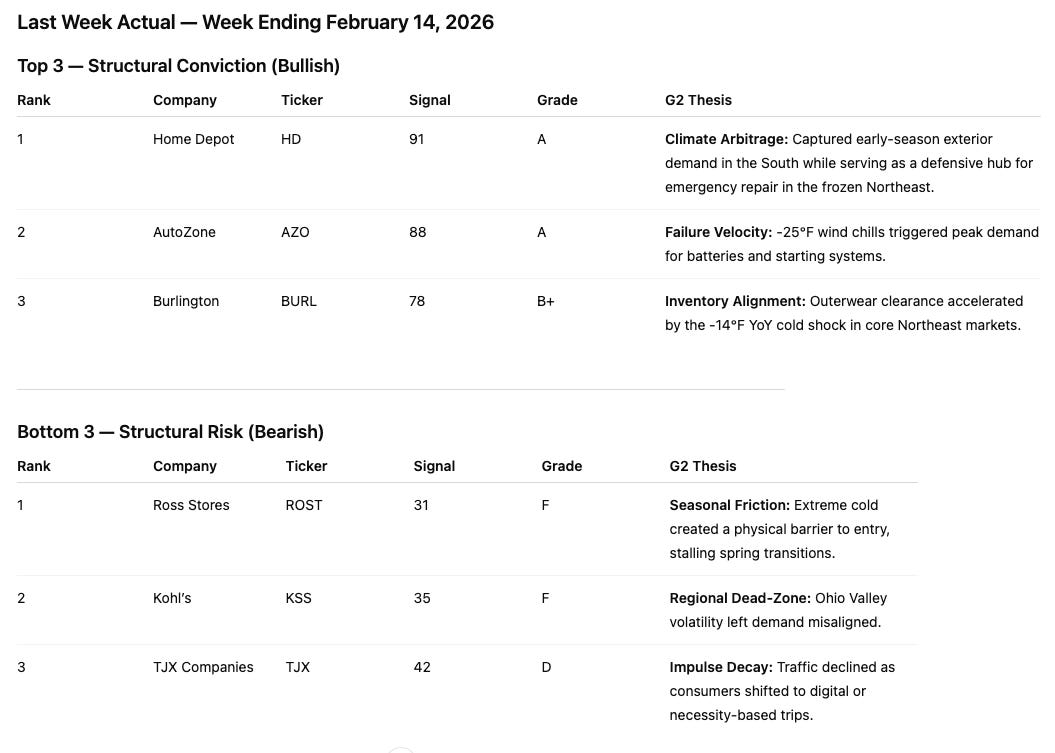
Cold across the Northeast and Upper Midwest extended winter-driven demand, supporting categories tied to repair, auto, and essentials—benefiting names like Home Depot (HD), AutoZone (AZO), and Kroger (KR).
At the same time, extreme cold created a physical barrier to store traffic, pressuring discretionary and impulse-driven retailers such as Ross Stores (ROST), Kohl’s (KSS), and TJX Companies (TJX), whose demand depends on foot traffic and timing.
Conversely, record warmth across the South and Rockies pulled forward early-season demand, supporting outdoor projects, maintenance, and patio activity.
Weather didn’t reduce demand—it redistributed it.
This Week Forecast — Week Ending February 21, 2026
This week is defined by a West Coast washout and the trip consolidation dynamic that comes with it.
As precipitation moves into the West and Northwest, demand doesn’t disappear—it compresses. Trips become more purposeful, shifting toward essentials and delivery, while discretionary stops and destination-based visits fall off.
In this setup, the weather isn’t reducing demand. It’s forcing consumers to prioritize, creating a clear advantage for necessity-driven and delivery-oriented models, while traffic-dependent formats face a direct physical headwind.
This is where the signal moves from narrative to earnings impact.
