


Like more than 100 million people, I watched the Super Bowl last night.
And as I’ve done every Super Bowl Sunday since 2015—ironically, the year the Seahawks lost to the Patriots—I shared with my now-adult kids my brief, accidental appearance in a Super Bowl commercial, a tradition they tolerate exactly once a year.

Here’s the backstory: at the time, I was VP of Weather Analytics at The Weather Company (TWC), with a side gig as an on-air “expert” translating weather into consumer and business behavior on The Weather Channel.
TWC was partially owned by NBC at the time, and we had a small studio at 30 Rock, where I did frequent appearances.
One afternoon in early January 2015, walking from the TWC offices to 30 Rock, I passed the Today Show cast moving quickly, smiling, hamming it up, cameras rolling. They were clearly filming something, but I barely gave it a thought.
Fast forward to Super Bowl Sunday. I’m half-watching—mostly for the commercials (Eagles / 49ers guy here)—when the Today Show cast pops on screen.
Same scene. Same moment. And then—spit take—I catch a glimpse of myself … in a Super Bowl ad!
Granted, this is a bit off topic for the weekly signal report, but come on, how many people have photo-bombed a Super Bowl commercial?
Anyway, on to business … but if you’re really curious, below is the full commercial (extra credit if you can actually see me) —
Signal Summary
January’s Arctic cold is easing, but weather volatility remains earnings-relevant, especially through timing and regional mix.
Last Week: Defined by deep Southeast and Northeast cold, offset by anomalous warmth across the West and Plains.
This Week: Flips the script with broad national warmth except for a still-cold Northeast—a reset week for traffic and demand.
Next Week: Introduces a material precipitation signal in the West, Ohio Valley, and Northeast, shifting the risk from temperature to disruption and timing.
Last Week Actual — Week Ending Feb 7, 2026
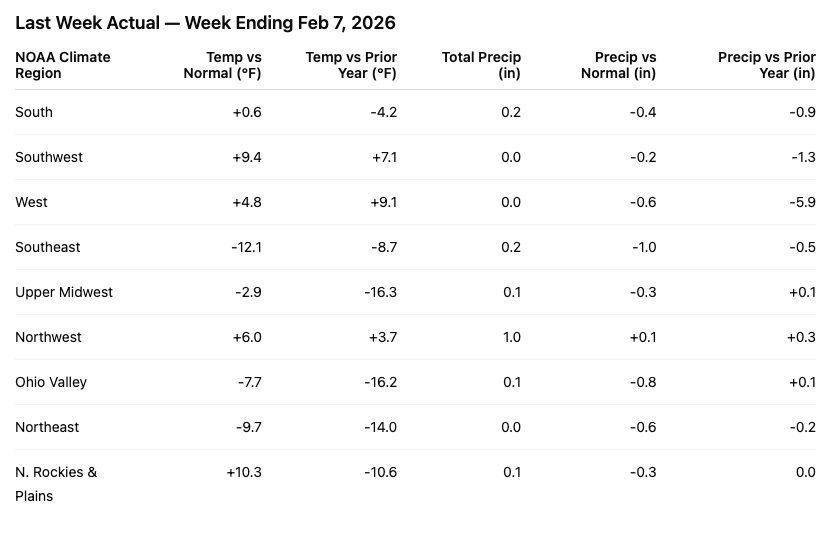
Last week’s weather story wasn’t national — it was regional, and it unfolded at a critical moment in the spring selling season.
Much of the Southeast and Northeast stayed locked in colder-than-normal conditions, with temperatures running 7–12°F below seasonal norms. That cold didn’t erase demand, but it did slow it, keeping shoppers indoors and delaying the early-spring transition.
Meanwhile, the West and Southwest moved in the opposite direction. Temperatures there ran 5–10°F above normal, creating usable weather that allowed seasonal demand to surface earlier than expected.
That contrast set the tone.
Where the Weather Helped
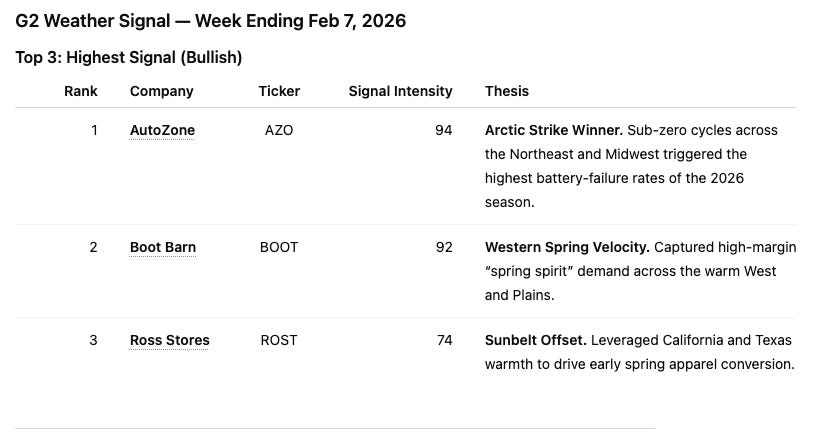
AutoZone (AZO) was the most direct beneficiary of last week’s Arctic setup. Sub-zero cycles across the Northeast and Midwest drove the highest battery and starter failure rates of the season, pulling forward high-margin “failure item” demand. This was not discretionary spend — it was weather-forced replacement.
Boot Barn (BOOT) was the clearest spring-side winner. Warmer conditions across the Plains and West pulled forward demand for workwear and western boots — categories that don’t require optimism to sell, just the ability to get outside.
Ross Stores (ROST) benefited from the same regional offset. California and Texas carried the load, with early spring apparel converting faster than it could in colder regions. This wasn’t about consumer confidence; it was about the weather finally cooperating.
Where the Weather Got in the Way
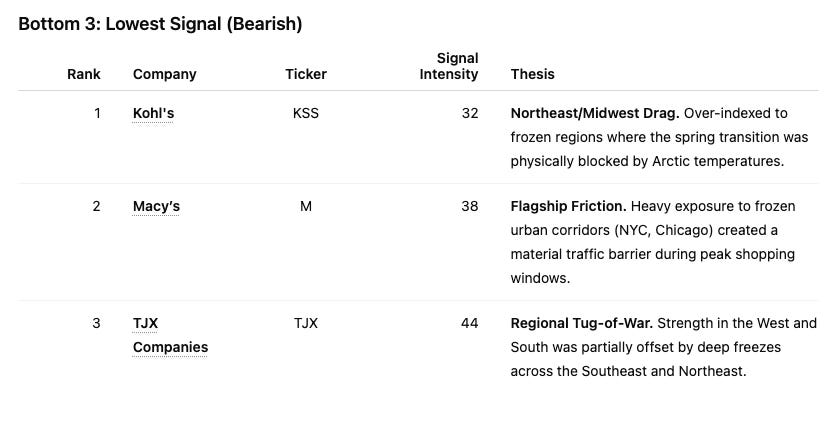
For Kohl’s (KSS), the setup was tougher. Heavy exposure to the Northeast and Midwest effectively stalled the spring transition.
Macy’s (M) faced the same challenge, magnified by its concentration in large urban markets where cold and ice create real friction for foot traffic.
TJX (TJX) was caught between the two. Strength in the West helped, but it wasn’t enough to fully offset the drag from colder regions elsewhere.
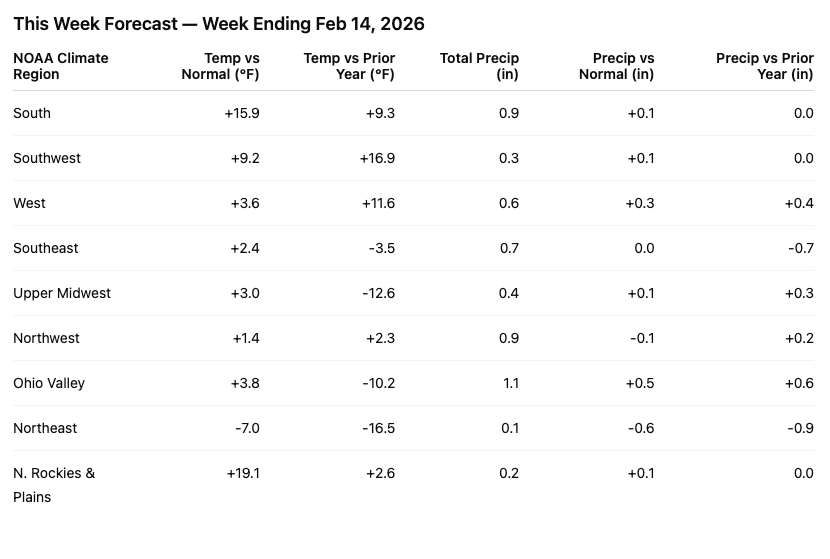
This Week Forecast — Week Ending Feb 14, 2026
This week marks a clear shift in the weather pattern — not everywhere, but where it matters most.
A broad warming trend is taking hold across the South, Southeast, and Plains, with temperature anomalies running 10–20°F above normal in several key regions. After weeks of volatility and disruption, the weather is finally becoming usable.
That matters less for what it removes than for what it unlocks: mobility, outdoor activity, and the psychological turn toward spring.
The timing is notable. This is the week leading into Valentine’s Day, when seasonal warmth in the South tends to amplify dining, gifting, and discretionary trips. Warm, dry conditions don’t just support demand — they pull it forward.
The Northeast remains the outlier. Temperatures there are still running meaningfully below normal, keeping the seasonal handoff uneven. But from a population-weighted perspective, demand is now tilting toward the south and west.
That sets up a very different week than the one we just lived through.
Where the Weather Helps
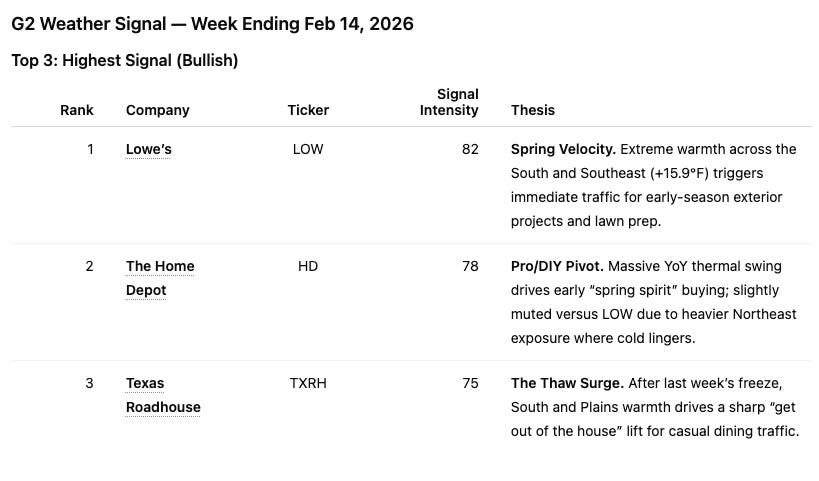
Lowe’s (LOW) sits at the center of this shift. Extreme warmth across the South and Southeast accelerates early-season exterior projects, lawn prep, and weekend traffic. This is the first sustained stretch of weather that allows spring demand to actually express itself.
Home Depot (HD) benefits from the same dynamic, particularly on the Pro side, where weather-driven scheduling matters more than sentiment. The signal is slightly muted versus Lowe’s due to heavier Northeast exposure, but the YoY thermal swing is still meaningful.
Texas Roadhouse (TXRH) is the clearest consumer-facing beneficiary. After last week’s freeze-driven confinement, warmer conditions across the South and Plains create a classic “thaw” effect — people getting back out, eating out, and normalizing routines.
Where the Signal Fades
At the other end, BJ’s Wholesale Club (BJ) faces a tougher setup. Last week’s Arctic urgency pulled demand forward. As temperatures normalize, that pantry-loading impulse fades quickly, creating a post-storm hangover.
Kohl’s (KSS) remains stuck in the seasonal gap. Warmth in the South undermines winter clearance, while lingering cold in the Northeast delays spring apparel. The result is poor timing on both sides of the ledger.
For AutoZone (AZO), the weather impulse has likely peaked. The failure-item surge tied to sub-zero temperatures doesn’t persist once conditions moderate, and demand begins to mean-revert.
Next Week Outlook — Week Ending Feb 21, 2026
Next week’s weather setup is less about direction and more about behavioral sorting.
