

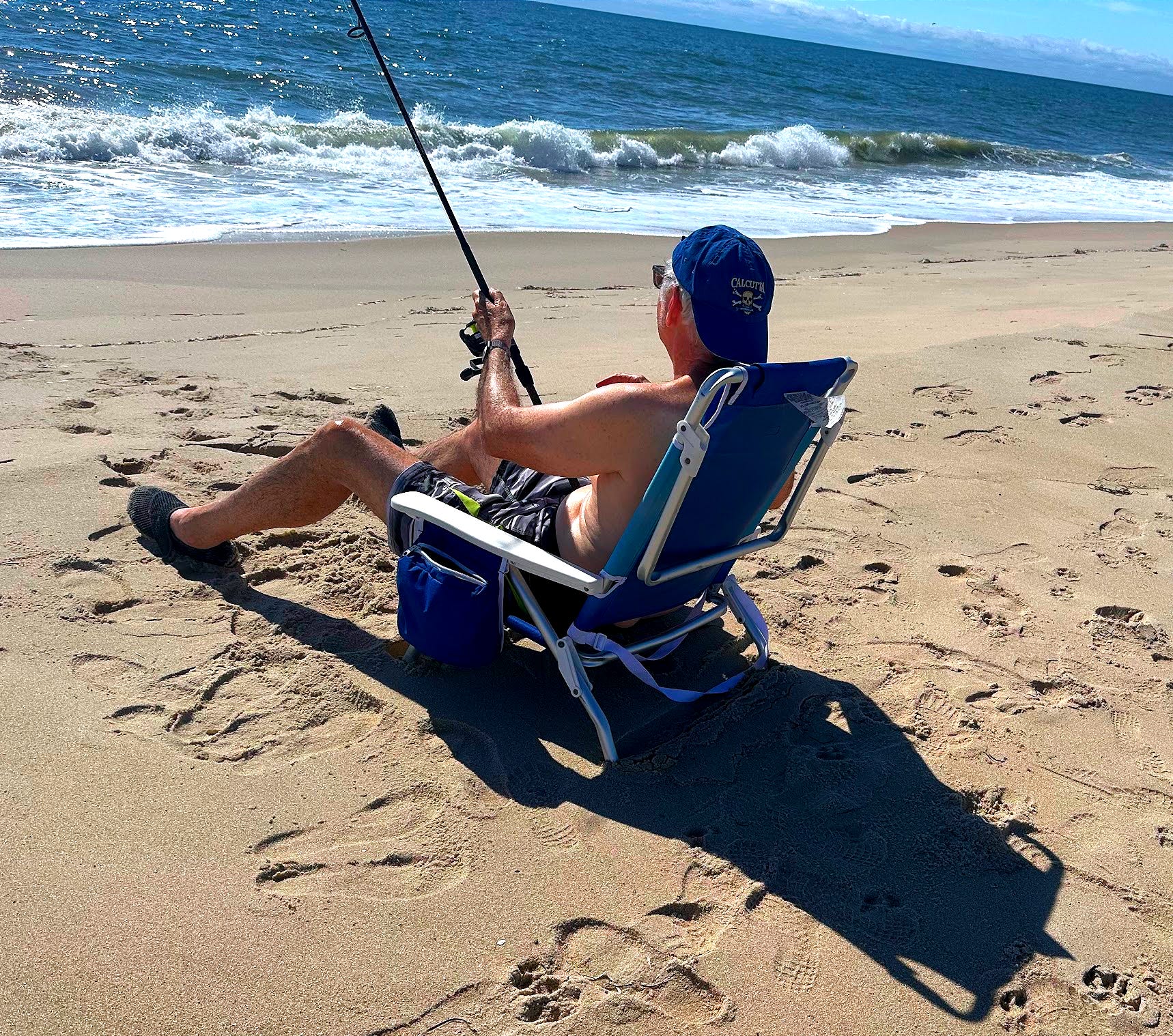
We’ve been spending a lot of time at our cottage on the Delaware shore this summer — fishing, walking the dog, cutting grass, and generally enjoying the kind of schedule that comes with being editor-in-chief of your own independent publication.
Which is to say, I make my own schedule, and lately the schedule has called for more time with a rod in the sand and less time in front of a screen.
I'll be honest — I've thought about pulling an Irish goodbye on the Substack. Just quietly disappearing into the summer.
But somewhere along the way this publication found an audience of over 700 subscribers and followers who actually show up for it, and that feels like an obligation worth honoring even when the fishing is good, and the heat index in Philadelphia is making the Delaware shore look like the smartest real estate decision I ever made.
The Weather Didn’t Take a Vacation
Late June and July are when extreme heat has its biggest impact on consumer spending and, more importantly, on public health — and this summer delivered on both fronts while I was gone.
The weather didn’t take a vacation just because I did.
The July 4th heat dome delivered exactly what the forecast had been showing for more than a week.
Philadelphia’s Fourth of July parade was canceled. Washington’s Independence Day parade was canceled. Two of the most iconic American holiday traditions, in two of the most historically significant cities in the country, were shut down by the same weather system the models had been tracking since late June.
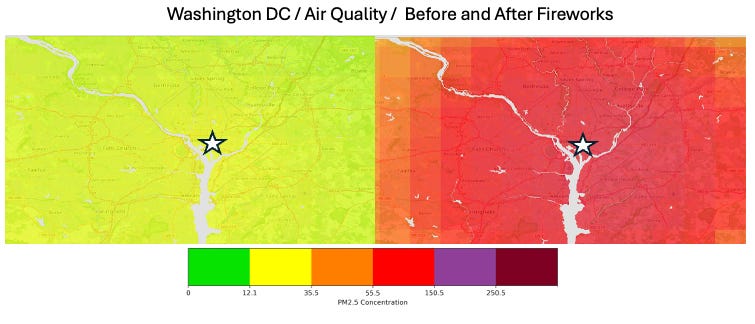
The National Mall fireworks went ahead anyway — 850,000 pyrotechnics over forty minutes, the largest display in history according to the organizers. Under the stagnant atmospheric conditions that had been baking the capital for days, the smoke had nowhere to go.
According to air quality data provided by Ambee — a climate intelligence platform that turns environmental data into actionable business intelligence — PM2.5 levels peaked at more than six times normal, crossed the EPA threshold for “unhealthy” air, and lingered for hours after the display ended, drifting as far as fifteen miles downwind into neighborhoods still recovering from the heat.
Airborne magnesium — used to create bright white flashes in fireworks and capable of irritating skin and lungs — increased by more than 9,000 percent.
Before the show, the National Park Service had conducted its own analysis projecting "hazardous" air quality near the National Mall during and after the display, and "very unhealthy" conditions in downtown Washington, Capitol Hill, and across the Potomac in Arlington.
That analysis was not released to the public — an omission that current and former Park Service employees called … unusual.
Heat Doesn’t Go to the Hospital. People Do.
Most people think about extreme heat the way a TV meteorologist presents it — it’s going to be hot, stay hydrated, find air conditioning. Healthcare systems think about it very differently, because the heat itself is never the patient.
The person suffering heat stroke is the patient. The person arriving dehydrated and in cardiac stress is the patient. The COPD patient whose symptoms worsened after breathing six times normal PM2.5 levels at 5 AM on July 5th is the patient. The elderly resident in a north Washington neighborhood who couldn’t get a wellness check in time is the patient.
The heat didn’t go to the hospital. The people the heat hurt did.
Weather changes how many people need care, what they present with, and when they arrive — in a sequence that the forecast makes visible well in advance of any of it happening.
That is not a meteorological observation. It is an operational one, and it changes everything about how a health plan, a hospital system, or an employer with outdoor workers should be thinking about the next heat event that is already showing up in this week’s forecast.
The Tools Being Built for This Moment
This is exactly the problem that ERaaS Health is built to address. I serve as an advisor to the company, founded by Samrat Kulkarni, which gives me a close view of what proactive weather-informed health intervention looks like in practice.
ERaaS provides the intelligence layer — identifying at-risk members before the event peaks, triggering proactive outreach, and surfacing escalations to health plan care teams for wellness checks, cooling center referrals, and emergency interventions.
The deployment layer is Hippocratic.ai — an AI agent platform purpose-built for healthcare outreach at scale. ERaaS’s weather-informed risk intelligence combined with Hippocratic.ai’s deployment infrastructure is what makes proactive intervention possible across thousands of members simultaneously, at the speed the forecast window requires rather than the speed of the emergency room intake queue.
During last summer’s heat events, the system demonstrated what that looks like in practice — moving from data to proactive intervention in under twenty-four hours, identifying at-risk members, initiating outreach through an AI agent, and surfacing escalations to care teams for targeted support.
The results among engaged members were striking: a 47% reduction in ER and inpatient admissions, nine out of ten member call satisfaction, and an estimated 5-to-1 return on investment.
Not a pilot. A deployed system. Running at the speed of the forecast.
While I Was Fishing, Rachel Was Working
I came back from the shore rested and slightly sunburned, with a healthy appreciation for what a near-normal temperature pattern feels like when the alternative is a 110-degree heat index ninety miles to the north — only to find another heat event already building across the Eastern US this week.
The atmosphere runs on its own schedule.
It doesn't care that organizations are still recovering from the July 4th heat event. The signal has been visible for more than a week — above-normal temperatures forecast across the Mid-Atlantic and Southeast, another round of elevated heat index values, another predictable sequence of health and demand impacts building in the pipeline.
The heat didn’t take a vacation. The signal didn’t either. While I was packing up the cottage, ERaaS Health’s AI agent Rachel was already hard at work — reaching out proactively to vulnerable members in New York City ahead of this week’s heat event. Not waiting for the emergency room to fill up. Acting on the forecast.
Weather is a predictable driver of population health risk, yet most healthcare organizations still aren’t acting on it proactively at scale. ERaaS and Hippocratic.ai are built to change that.
Actionable intelligence that saves lives. That’s the mission we share.
© 2026 G2 Weather Intelligence. All rights reserved.