

"The further back you can look, the further forward you are likely to see." — Sir Winston Churchill
Lately, I find myself with more time on my hands than I've had in over thirty years — and I absolutely love it. Doing my own thing while being accountable to no one (outside of my own house, of course) is the best job I've ever had — and I've had some good ones.
And it’s given me the time to read more history than I have in decades. Lately, I’ve been absorbed by Timothy Egan’s account of the Dust Bowl and Andrew Ross Sorkin’s reconstruction of the 1929 crash.
They both cover the same general era — two different catastrophes, one environmental and one financial — and yet if you blur your eyes, the patterns are remarkably similar. Warning signs that were visible and ignored. Systems that worked brilliantly until they didn’t. Decision-makers who planned for the continuation of what they already knew rather than the probability of what was actually coming.
The farmers of the High Plains kept plowing because the late 1920s had been unusually wet. The weather had been favorable long enough that they stopped asking whether it would continue. The Wall Street titans of 1929 kept buying because the market had risen long enough that the possibility of a different outcome had become professionally inconvenient to consider.
Both groups were planning from the rearview mirror. Both paid for it.
The parallel to retail and CPG planning is uncomfortably close. The merchant who plans next year’s outerwear buy based on last year’s sales results is doing exactly what the Plains farmers did — extrapolating from recent experience without stopping to ask whether the conditions that produced those results are likely to persist.
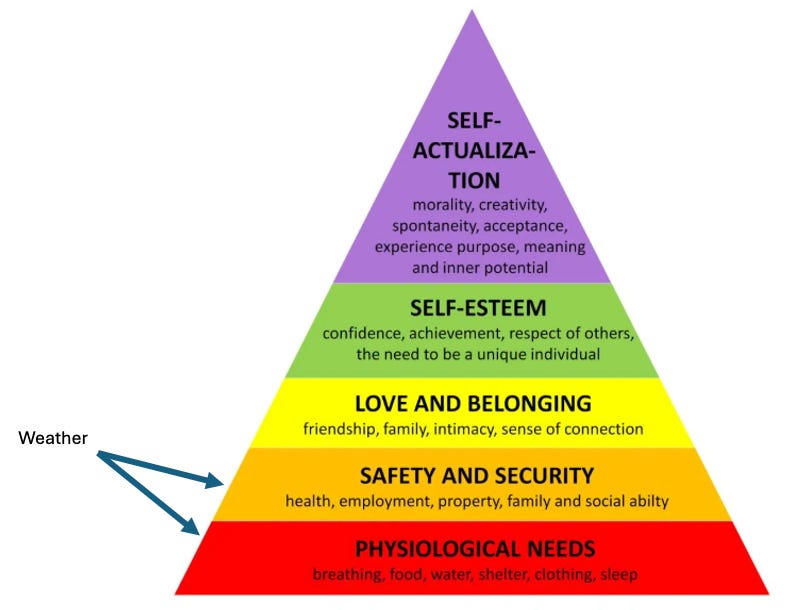
Weather is not the only variable that shaped last year’s results. But it is one of the most fundamental — and one of the least systematically measured. The data exists, much of it free. The question most merchants ask instinctively but often don’t have the tools to answer precisely: how much of what my business did last year was driven by the weather — and is that weather likely to repeat?
Consider what that distortion actually looks like in practice —
A cold November and December that drove strong outerwear sell-through looks like proof of a healthy category — until the merchant builds next year’s buy around that performance, the season opens warm, sell-through stalls, and the markdowns start in January.
That’s a weather event wearing the clothes of a trend. And the institutional knowledge to recognize it — built over years of hard experience — is transitory. It walks out the door when the people who carry it do.
Here’s how to strip out the weather distortion and build a forward plan. The framework is simpler than most merchants expect. It doesn’t require a data science team or a five (or six)-figure recurring weather data contract. It requires five steps, a willingness to ask the question, and access to data that NOAA has been publishing for free for more than a century.
Step 1 — Measure
What did last year’s weather actually look like — precisely, not qualitatively. NOAA’s nClimDiv database ranks every region’s temperature and precipitation going back to 1895. When last November through January ranked 44th coldest out of 131 years in the Northeast, that is a quantified statement about the conditions that shaped your results. Pull that number for every region where you do meaningful business.
Step 2 — Establish the Relationship
Now compare that historical weather record against historical sales. How did your business actually respond to warm Octobers, wet Memorial Day weekends, or cold Januaries — over time and across regions?
This is where the analysis moves beyond instinct.
Machine learning finds the non-linear relationships that human analysts miss — the pull-forward effect of a warm March on April sales, the saturation point where additional heat stops driving air conditioner demand, the sequence effects where a cold April following a warm March suppresses demand more severely than a cold April following a cold March. The patterns exist in the data. The technology finds them, weighs them, and automatically builds them into the forward model.
Step 3 — Establish the Baseline Shift
The 30-year climatological normal is your forward forecast until proven otherwise. It’s the best estimate of what is likely to happen in the absence of a stronger signal. Compare it against last year’s actual ranked conditions using NOAA’s nClimDiv data.
Where last year was significantly warmer, colder, wetter, or drier than the 30-year normal, your plan needs to reflect that shift. Last year’s results were built on conditions that may not repeat. The relationship you established in Step 2 tells you how much that shift matters — and for which categories.
Step 4 — Identify High-Opportunity and High-Risk Windows
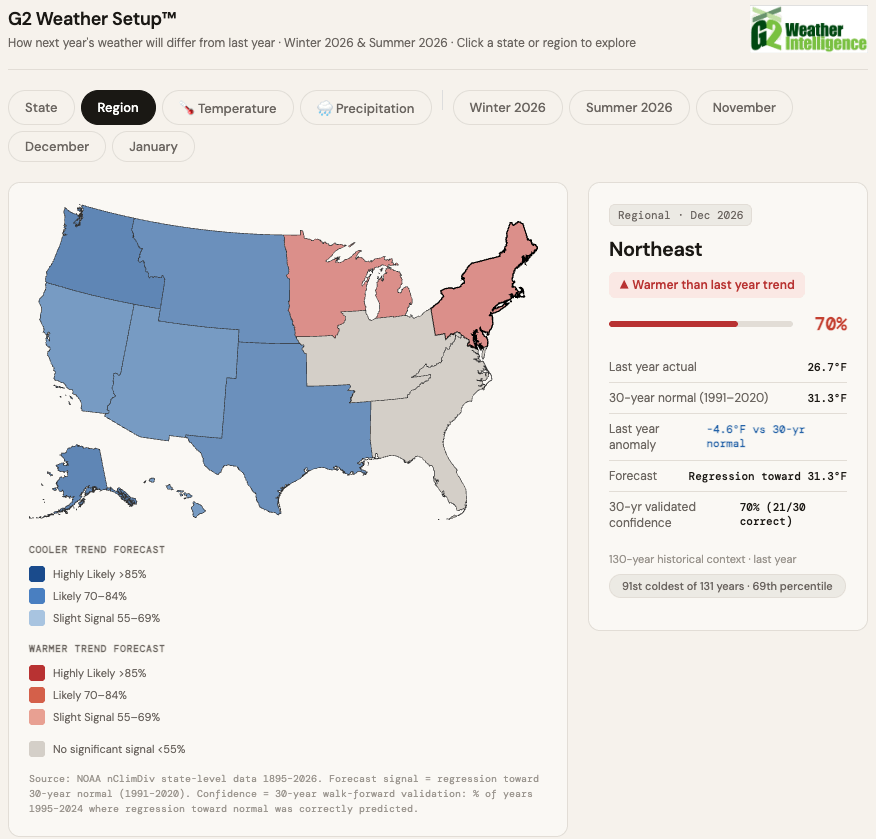
Overlay the probability signal against the year-over-year change from Step 3. Where last year was an outlier, and the probability is shifting in the opposite direction, you have a high-risk window.
Here is a live example—
Last December ranked 91st coldest in the Northeast over the past 131 years — well below the 30-year normal. When a season runs that far from the historical average, the odds strongly favor a return toward normal the following year. Using the 30-year average as the forward predictor, that correction has proven correct 70% of the time over the historical record.
For a merchant planning cold-weather categories — outerwear, heating equipment, winter seasonal hardlines — that is a high-risk window. Last December’s strong sell-through was driven in part by conditions the data suggest are unlikely to recur. The long-term warming trend makes that even less likely. A buy built around last December’s performance is a buy built against a 70% probability.
Those intersections — filtered through the weather-to-sales relationships established in Step 2 — are where the plan gets adjusted up or down with conviction.
Step 5 — Update Monthly
The plan is not set once and forgotten. NOAA publishes updated probability outlooks monthly. As the season approaches and the signal sharpens, the plan updates with it. A probability that was 40% in June may be 60% by August.
The merchant who updates monthly is always working with the best available signal. The one who set the plan in May and never looked again is the Plains farmer.
These five steps are the foundation. The data is free — you’ve already paid for it through your taxes. The methodology is sound. A motivated analyst with access to NOAA’s tools can build this framework manually — and some do.
But data without action is just a better-informed version of the same problem.
The steps I’ve outlined tell you what the weather did, what the baseline says, and where the probability is shifting. They don’t automatically reprice a promotion, adjust an open-to-buy, or flag a regional inventory risk before it becomes a markdown.
That connection — from signal to decision — is where most organizations still have a gap. That’s the gap AI closes.
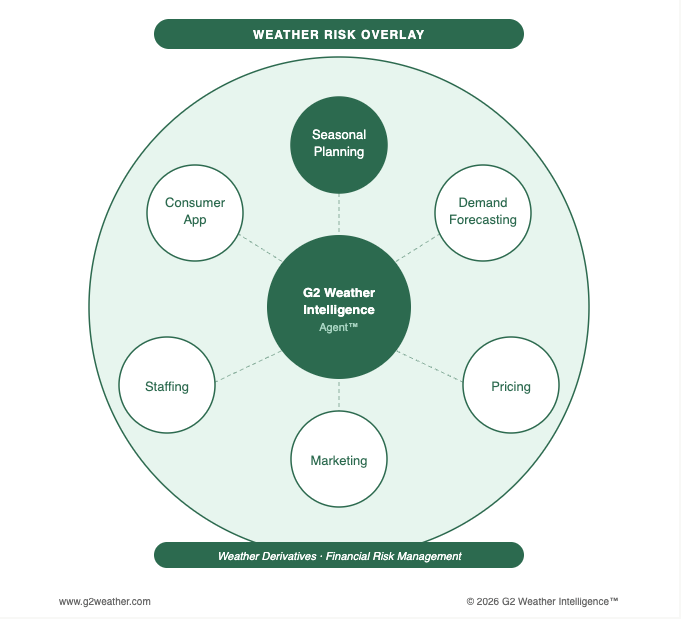
Agentic systems tied to a systematic weather intelligence strategy are poised to transform how the best retailers and CPG companies manage seasonal demand — reducing inventory risk, improving margins, and cutting waste.
More profitable and more sustainable. The definition of doing well while doing good.
This is the second in my nine-part Brainstorm Series on how weather intelligence transforms consumer-facing businesses. Next up: demand forecasting.
© 2026 G2 Weather Intelligence. All rights reserved.