

The frog never feels the doubling. It only feels today.
In 2007, I took a huge leap of faith, left my job, and joined an early-stage, venture-backed weather risk start-up in New York City called Storm Exchange. I was hired as Chief Strategy Officer, along with my (now long-time) pal Jarvis Cromwell, who came in as Chief Marketing Officer.
We had very strong early traction; our CEO/founder was very good at fundraising, and we closed a $7M Series B soon after Jarvis and I joined. We were on a roll and moved into nice office space in midtown Manhattan, hired a great team, and built a talented, growing development team in, of all places, Kyiv.
And then came 2008 and the great financial crisis. Our strong pipeline and early partnerships followed the stock market down; our investors pulled out, and we were forced to shut the doors.
For the first time in my career (since joining the US Air Force at 17), I didn’t have a job … this is when G2 Weather Intelligence first took shape.
I started consulting on weather strategy, and that work put me on stages and in front of rooms around the country, talking about climate and weather risk and the critical need to purposely plan for what was coming.
It was my argument for action …
Almost twenty years later, I was digging through old files for something else entirely, and found this presentation from that time … 20 years is a long time to sit in water that's been quietly getting warmer.
I presented this version at St. Mark’s Episcopal Church, in New Canaan, Connecticut. Not a boardroom. Jarvis’s church. As I recall, the rector was Reverend Peter Walsh (no known relation, but you never know).
My message then (as now) wasn’t built to sell anyone on weather data. It was meant to make a case for thinking differently about weather and climate risk, and the business case followed from that, not the other way around.
The presentation opened with my then mission statement, which is largely the same today: helping businesses and investors increase profits by building greater resilience in the face of increasingly volatile weather and climate … rather than reacting after the fact.
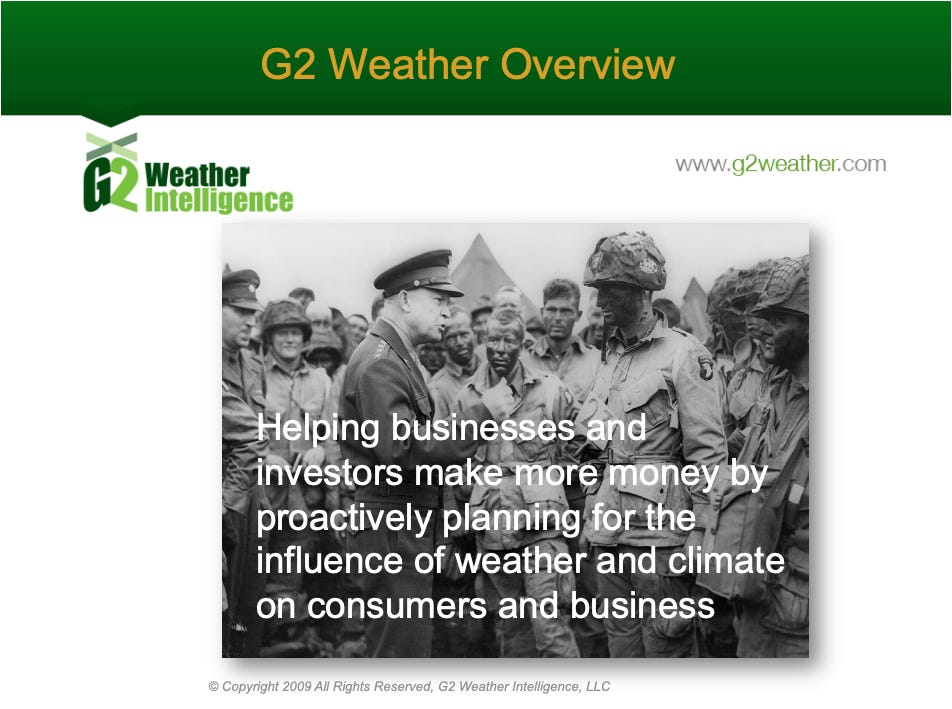
It included a photo of Eisenhower speaking to 101st Airborne “Screaming Eagle” paratroopers just prior to the D-Day invasion. Not subtle, but the point holds: the invasion was timed based on a weather forecast, not a hunch. Strategy built ahead of the weather beats heroics improvised inside it.
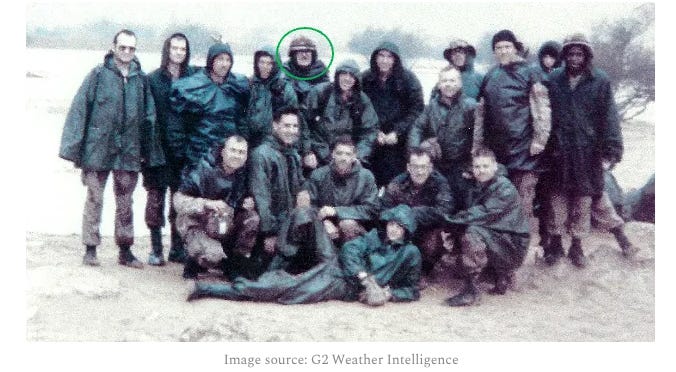
The photo has a personal edge, too. I was chief of weather operations for the 101st during Operation Desert Storm. You can read that story here —
The Wager Itself
The core of my talk borrowed from Blaise Pascal, who argued that even though God’s existence can’t be settled by reason alone, a rational person should live as though it’s true — because the believer who’s wrong loses nothing, and the skeptic who’s wrong loses everything.
Tim O’Reilly had made the case a year or two earlier that even if catastrophic warming turns out not to happen, the steps taken to avert it are still worthwhile — cleaner energy, new industry, less exposure to foreign oil, fewer of the hidden costs pollution leaves off the books.
My message framed it as a straight comparison: what’s the greater risk, acting on climate change and being wrong, or doing nothing and being right?
Stated that way, it isn’t really a climate question. It’s a decision-theory question. And decision theory doesn’t require consensus on the underlying science to produce a clear answer.
Cope and Avoid, Anticipate and Exploit
This wasn't a business insight first. I learned it supporting warfighters in the Air Force and Army, where the stakes make the distinction obvious: "cope and avoid" gets people hurt. "Anticipate and exploit" — like the weather call behind D-Day — wins the day.
Cope and Avoid: ignore the forecast. Absorb the losses. Blame the weather when the numbers miss. Keep running the business exactly as before.
Anticipate and Exploit: build the forecast into the plan. Build probabilistic weather forecast scenarios into the plan. Minimize the downside. Take the upside the Cope and Avoid businesses leave on the table.
Eighteen Years Later, the Bill Comes Due
Which brings me to why I went looking for that presentation in the first place.
I’d just read a New York Times piece — “Heat, Fire, Smoke and Storms Are Wreaking Havoc on the Economy“ — and it reminded me of the message I’ve been preaching for two decades. In fact, it reads like the invoice for the wager I described in 2009.
A Chicago bakery owner loses 500 ice cream bars and nearly $30,000 in cakes to a storm-driven power outage, saved only by $1,700 of dry ice and a frantic round of calls to every favor she’d ever banked.
A Los Angeles day care operator watches her electricity bill double from heat and smoke, some days deciding hour by hour whether the toddlers stay inside.
Allianz Research estimates the most exposed developed economies could run 5 to 7 percent below their growth trajectory by 2030 if the next five years look like the hottest five of the last decade.
None of this is a new argument. It's the old argument, compounding.
Most businesses don't lack the ability to predict the weather. They lack the system to act on it — one that turns a forecast into a decision before the loss happens, not a phone call after.
What I Got Wrong, and Why It Doesn’t Undercut the Point
One thing I haven't mentioned about that talk: certainty wasn't the argument.
I wasn’t preaching inevitability. I was making a probabilistic argument — trust the signal, verify against the data, hedge accordingly. That’s the part I’d underline hardest today.
The wager was never "climate catastrophe is certain, so act." It was that acting makes sense whether or not you're convinced — because the cost of being wrong isn't the same in both directions.
That distinction is the whole discipline this newsletter is built on now. Weather and climate as a probability to be managed, not a belief to be argued.
Government Won’t Save Us
Here’s the part I’d say more bluntly now than I did from a church podium in 2009: waiting on government to manage this risk for you isn’t a plan (to put it mildly).
Public policy runs on electoral cycles measured in years. Weather risk runs on planning cycles measured in weeks and seasons. Those clocks don’t synchronize, and waiting for them to align is itself a decision, usually the expensive one.
That mismatch isn’t closing anytime soon. If anything, current policy is trending away from resilience, not toward it.
The wager was always a private-sector bet, because it had to be. It still is.
The Frog Doesn’t Know
The frog part of the metaphor is fiction. The part where nobody notices until it’s too late isn’t.
The temperature moves slower than the attention span of the business trying to track it. Nobody experiences 2009 turning into 2026 as a single dramatic jump. They experience it as one summer, then another, then a bakery owner explaining to a reporter that cake isn’t built for extreme weather.
When I gave that talk, the planet was running about a degree Fahrenheit warmer than normal. It’s now running over two degrees warmer. More than double, in the time it took a slide deck to become an archive file.
The frog never feels the doubling. It only feels today.
The analysis and writing here are mine. I use Claude as an editor — for fact-checking and line edits — not as a source of ideas or content.
© 2026 G2 Weather Intelligence. All rights reserved.