

The house started shaking before I understood what I was hearing.
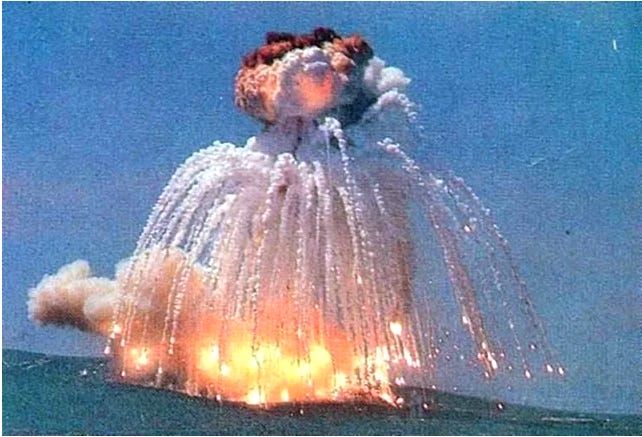
It wasn’t the sound of a launch. I’d heard plenty of those. This was different — a low rumble that built into something physical, something you felt in your chest before your brain caught up. I looked out the window and saw it: a red mushroom cloud rising over Vandenberg, expanding upward and outward against the California sky.
Red meant nitrogen tetroxide. N2O4. One of the most toxic substances used in rocket propellant. And it was moving.
I was off duty. My wife was there. Our newborn son was there. And somewhere on base, the duty forecaster I had trained and certified was watching the same cloud and running the numbers on a Texas Instruments calculator — determining whether the toxic corridor was heading toward Lompoc, California, or out to sea.
It went west. Offshore. Lompoc was safe.
The forecast had called it. The launch was a go precisely because the toxic corridor model predicted the plume would move offshore — and it did. A Texas Instruments calculator running a program on a plastic memory chip had just protected a civilian community from a catastrophic rocket explosion.
To understand why that forecast mattered, you need to understand what I was doing at Vandenberg in 1986.
I was a newly minted operational weather forecaster, two years out of the Air Force weather forecasting school at Chanute Air Force Base in Illinois, assigned to my first operational posting.
Vandenberg Air Force Base sits on the central California coast, about 150 miles north of Los Angeles.
It was — and still is — the primary West Coast launch facility for the Department of Defense. My job was direct support of space and missile launches: intelligence satellites, early GPS birds, and ICBMs pulled off nuclear alert and fired downrange to Kwajalein Atoll to make sure they still worked. The stakes were not abstract.
The toxic corridor forecast was one of the most critical products we produced. Rocket propellant — nitrogen tetroxide, N2O4 — is extraordinarily hazardous. Before every launch, the duty forecaster would key weather parameters into a TI-99 calculator — a plastic memory chip inserted each time you ran the model — and generate a prediction of where the plume would travel in the event of a launch anomaly. If the model said the corridor tracked east toward Lompoc, the launch was scrubbed. Every time, without exception.
It always felt a little sketchy to me. Not because I doubted the people running it — I was one of them. But because the weight of what that output represented never quite matched the modesty of the machine producing it.
That assignment was the first of many where the forecast carried more weight than anyone outside the room ever knew.
I joined the Air Force at seventeen, straight out of high school. By the time I left, I had been present at the edges of history more times than I can fully account for.
I was the on-duty weather observer at McGuire Air Force Base the night planeloads of gold bullion were flown to secure the release of the American hostages in Iran. I watched from the flight line as aircraft loaded with something that wasn’t being discussed departed into the dark. You don’t ask questions. You file your observation and you move on.
Vandenberg itself was slated to be the West Coast home port of the Space Shuttle — a second launch and landing facility that would have fundamentally changed the geometry of the American space program. That plan ended with the Challenger tragedy in January 1986.
And then there was the Gulf War. By that point I was Chief of Weather Operations for the 101st Airborne Division — the Screaming Eagles — during the ground invasion of Iraq. Weather wasn’t a backdrop to that operation. It was a planning variable. Visibility, wind, blowing sand — these were inputs to decisions that determined where helicopters flew and where soldiers moved. The forecast had consequences you could measure in lives.
I didn’t seek out any of these moments. They found me. That’s the nature of a career in operational weather — you go where the mission is, and the mission has a way of mattering.
I was watching the Artemis launch on television when the memory of that red mushroom cloud came back to me. The weather briefing before liftoff. The launch director polling the team. I knew exactly what was happening in that room — because I had been in that room. A different base, a different rocket, a different era. The same mission.
Just unrecognizable tools.
NASA’s launch weather support today operates with Doppler radar networks, high-resolution ensemble models, and real-time lightning detection systems covering a radius that would have been science fiction in 1985. The computational power alone is incomprehensible to the person I was at Vandenberg.
And now there is AI.
Models that ingest atmospheric data at a scale no human team could process. Pattern recognition across decades of observational history in seconds. Forecast precision that continues to compress the cone of uncertainty in ways that still surprise people who have spent careers in this field. I would not have believed it in 1985. I’m not sure I fully believe it now.
But here is what I know. The Apollo guidance computer had less processing power than your phone. The TI-99 called the toxic corridor correctly and Lompoc never knew how close it was. The 101st crossed into Iraq on forecasts made by humans with the best tools available at the time — which were nowhere near good enough by today’s standard, and exactly good enough when it mattered.
The tool was never the point. What sits behind it — the judgment, the training, the willingness to own the forecast and live with the outcome — that’s not a feature you can train into a model. Not yet. Maybe not ever.
AI changes everything about how we turn atmospheric data into a decision. It doesn’t change what a decision is. Somewhere right now a person is looking at an AI-generated output, making a call, and accepting the weight of being wrong. That was true in 1986. It’s true today.
A TI-99 didn’t saved a city. The young weather forecaster running it did.
—Paul