

“In the next year or two, the enterprise world will sort into two camps: companies where AI runs their business, and companies where AI is still a project,” —IBM CEO Arvind Krishna
The commercial weather industry has an emerging business model problem opportunity.
For years, it's sold data subscriptions to passive business users. A firehose of weather data — temperature feeds, precipitation APIs, and dashboards few read. Most of it unnecessary — all of it a cost masquerading as a competitive advantage.
The assumption baked into every product is that the customer receives the data, interprets it, and decides what to do with it. That assumption is being dismantled. Not gradually — suddenly.
Two forces are converging simultaneously.
First: AI-driven weather modeling is rapidly becoming comparable to traditional forecasting models — and can be run faster and at a fraction of the cost. The barrier to accessing high-quality, location-level forecast data is collapsing.
Second: Agentic AI can now act on those forecasts autonomously, triggering decisions across enterprise workflows without a human in the loop for routine choices.The result: the gap between receiving a weather signal and acting on it — which used to require analysts, meetings, and manual intervention — is collapsing to near zero.
For consumer-facing businesses in, for example, retail, CPG, and healthcare, this is not a technology story. It is a competitive advantage story. The organizations that integrate weather intelligence into their core decision-making workflows will outperform those that treat it as a reporting function. The margin opportunity is real. The window to capture it is open, but it won’t stay open long.
The Problem With How Most Organizations Use Weather Today
Ask a senior merchant at a major retailer how weather affects their business, and they will give you a thoughtful answer. Ask them how weather is integrated into their seasonal planning process, and the answer gets vague. Ask them how weather flows into their pricing, staffing, and marketing systems, and the answer is usually: they don’t.
Weather is treated as context, not input. It explains results after the fact. It shows up on earnings calls as an excuse. It doesn’t show up in the demand plan before the season starts.
This is the forecast fallacy. Organizations ask the wrong question. They ask: What is the weather going to be? Or worse: how accurate is the forecast? The right question is: what will our customers do because of the weather, and what should we do about it … before they do it?
That reframe is the foundation of the Weather-Ready Consumer Enterprise.
What Is the Weather-Ready Consumer Enterprise?
The Weather-Ready Consumer Enterprise is a consumer-facing organization that has integrated weather intelligence into every major decision-making workflow — not as a data feed, but as an autonomous signal layer that triggers action.
The diagram below maps the framework. At the center is a weather intelligence agent — an agentic AI layer that ingests weather signals, correlates them against historical demand data, and triggers decisions across six enterprise functions simultaneously.
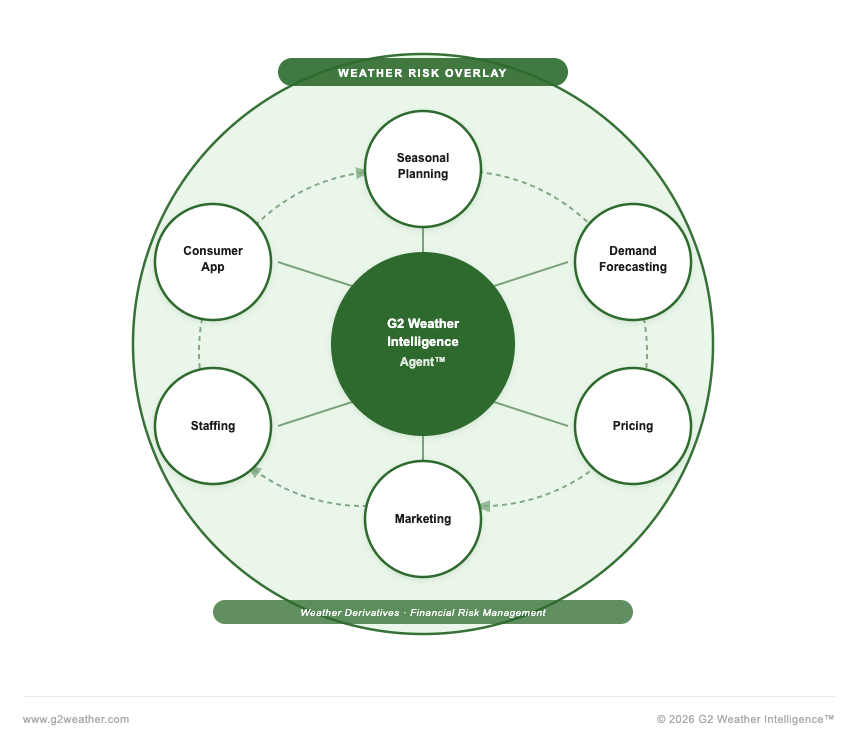
Each function in the cycle builds on the one before it:
Seasonal Planning — The weather outlook is incorporated into the process before the merchant sets the assortment. Open-to-buy budgets, inventory positions, and category priorities are shaped by the seasonal signal rather than set in advance and then adjusted after the fact.
Demand Forecasting — As the season approaches and the forecast sharpens, location-level demand signals are translated into week-by-week inventory and replenishment decisions. The weather is the leading indicator. The register is the lagging one.
Pricing — Weather-aware pricing captures margin before the markdown cycle begins. When demand is about to surge — warm weekend incoming, storm prep underway — the price signal moves first. When demand is soft — a cool, wet week, outdoor categories stalled — patience with markdowns is worth more than discounting into a headwind.
Marketing — Weather-triggered campaigns fire autonomously when conditions cross a threshold in a specific market. The Northeast runs warm and dry heading into Memorial Day — the outdoor living campaign activates. The Central Plains runs wet — hold the lawn-and-garden promotion and redirect spend.
Staffing — Labor is the highest controllable cost in retail and restaurant operations. Weather drives traffic. Traffic drives labor needs. A location-level weather signal connected to workforce management creates a staffing model that is more accurate than historical scheduling alone.
Consumer App — The last mile of the framework. A weather-aware consumer app surfaces personalized recommendations based on the individual shopper’s purchase history correlated against expected weather conditions. The retailer that knows you buy charcoal every May can tell you the first warm weekend is coming before you think to add it to your list. Over time, the recommendations get smarter. The app becomes a demand engine built on weather intelligence.
Encompassing the entire cycle is the Weather Risk Overlay — weather derivatives and financial risk management tools that backstop the enterprise against the unmanageable swings in profitability caused by weather volatility. Every function in the cycle benefits from the risk cover. The overlay is not an afterthought. It is the foundation that makes the rest of the framework defensible.
Why Now
Three things have changed, making this framework possible today in ways it wasn’t five years ago.
1. Forecast accuracy at extended range has improved materially. Private-sector AI-driven modeling promises even more useful forecast lead times. The signal that retailers need — what will the weather look like during my key selling window three weeks from now — is now a meaningful signal, not a guess.
2. The cost of acting on that signal has collapsed. Agentic AI can continuously monitor weather signals, correlate them with demand history, and autonomously trigger workflow decisions. What used to require a team of analysts and a weekly planning meeting now happens in real time without human intervention for routine decisions.
3. Weather volatility is increasing. Bloomberg’s recent analysis of spring temperature whiplash documents what retailers already feel: the swings are getting bigger, faster, and more frequent. The organizations that build weather intelligence into their operating model will absorb that volatility as a competitive advantage. The ones that don’t will keep explaining it away on earnings calls.
IBM’s Arvind Krishna put it plainly at their recent Think conference: in the next year or two, the enterprise world will sort into two camps — companies where AI runs their business, and companies where AI is still a project. The differentiator, he said, will not be the technology. It will be the operating model.
The Weather-Ready Enterprise is an operating model. This series is a roadmap for building it.
Coming in This Series
The following series takes each function in the framework and builds it out in full — the business case, the mechanics, and the practical application for retail and CPG operators.
It runs from the first decision of the season to the last line of defense against weather-driven profit erosion. The capstone brings it all together into a single, integrated example that shows what the Weather-Ready Consumer Enterprise looks like when all the pieces are running simultaneously.
Seasonal Planning — Stop Asking “What’s the Weather?” Start Asking “What Will Customers Do?”
Demand Forecasting — The Signal Was Always There. Now You Can Act on It.
Pricing — Dynamic Pricing’s Missing Variable
Marketing — The Right Message, the Right Market, the Right Moment
Staffing — Scheduling for the Weather, Not the Calendar
Consumer App — Every Retailer Is About to Become a Weather Company. Most Don’t Know It Yet.
Financial Risk Management — Weather Derivatives, Location Data, and the New Risk Market
The Capstone — What a Fully Integrated Weather-Ready Enterprise Actually Looks Like
Musical Coda
G2 Weather Intelligence translates weather signals into consumer demand intelligence for retail, CPG, and restaurant operators. Subscribe at www.g2weather.substack.com to get the full series.
*G2 Weather Intelligence Agent™ is a trademark of G2 Weather Intelligence. All rights reserved.