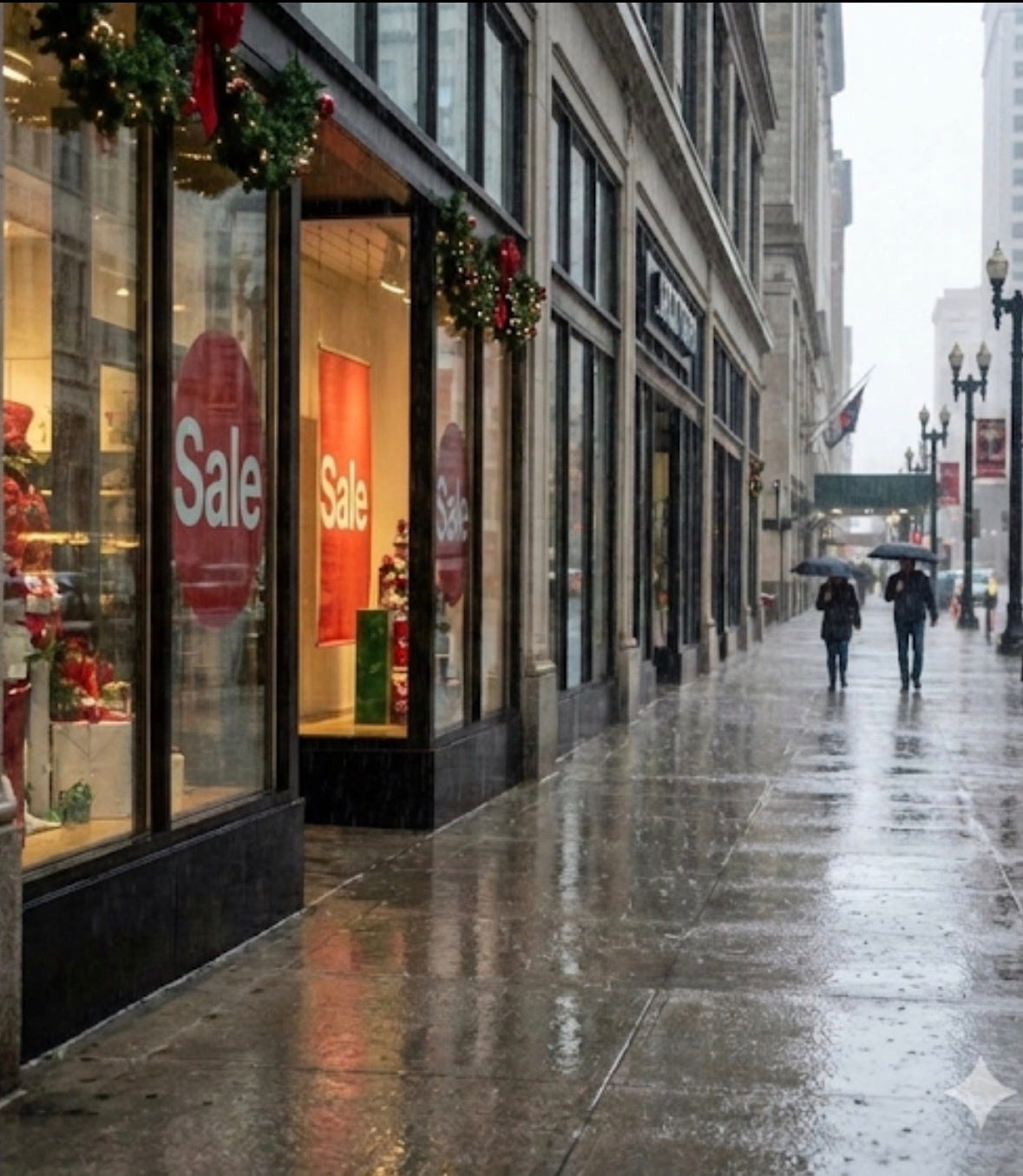
Weather Is Now a Holiday Sales Headwind in the Pacific Northwest
Friday Signal Update | Where weather reality meets retail reality
Summary
A multi-day atmospheric river hit the Pacific Northwest during the highest-conversion stretch of December, disrupting store traffic, Quick-Serve-Restaurant (QSR) routines, and holiday demand.
Research shows lost retail and QSR sales from severe weather are not recovered later or offset online — the revenue impact largely sticks.
With affordability already tight, this storm represents a material holiday drag that could surface in December comps and internal performance updates.
The Pacific Northwest isn’t just flooded — it’s flooded at the exact moment holiday spending should be peaking.
A powerful atmospheric river is drenching Washington and Oregon with relentless rain, widespread flooding, washed-out roads, power outages, and a full-scale mobility disruption that hit right as holiday spending should be accelerating.
This isn’t just bad weather — it is a regional economic event hitting at the peak of December spending.
CNN called the flooding “historic,” citing washed-out roads and widespread travel disruption. The Associated Press reported “roads turning into rivers,” and neighborhoods cut off as the atmospheric river stalled over the region, triggering evacuations and major closures across Washington.
What I see is something else entirely: A clear, measurable demand shock with retail and QSR consequences that will show up in December comps and Q4 earnings calls.
Atmospheric Rivers: When Weather Becomes a Drag on Demand
Atmospheric rivers behave differently from typical storms. They don’t blow through; they settle in — pouring inches of rain over several days and breaking the decision loops that drive everyday consumer behavior.
When the weather disrupts daily life, it disrupts commerce in real time.
Foot traffic doesn’t just soften — it collapses as shoppers abandon discretionary trips. Drive-thru volume slows. Weekend outings vanish. And the long-assumed digital backfill never materializes at the scale people expect.
Research from the San Francisco Fed shows that when weather suppresses store traffic, the losses aren’t recovered later, and they aren’t made up online either.
The hit largely sticks.
During the holidays, that reality is even more consequential. Consumers don’t defer those trips until the following week — not in an affordability-tight year.
They simply spend less, and the region’s retailers feel it immediately.
The Retail Hit: A Multi-Day Deluge Meets Peak Holiday Demand
The timing of this atmospheric river matters more than the magnitude. Mid-December is when retailers make their margins — and when a single lost weekend can ripple across the entire month.
Washington and Oregon saw:
Flooded highways and neighborhood streets
Widespread power outages
Mudslides and road closures
Conditions that made “I’ll grab it tomorrow” effectively impossible
For retail and QSR, that translates into fewer trips, softer weekend conversion, weaker QSR volume, and growing margin pressure as inventory sits longer than planned.
Here’s a clear view of who’s exposed:
Lost holiday demand rarely comes back. Shoppers don’t “double up” in week two — they just buy less.
Quick Serve Restaurant (QSR) Taking a Direct Hit
No sector feels a multi-day rain event faster than QSR — because nothing in this category works without routine. When the weather breaks the rhythm of daily life, sales fall immediately.
Across past atmospheric rivers and tropical remnants, the pattern is remarkably consistent: visits crash once a region endures several days of heavy rain.
Drive-thru lanes, normally the safety valve for bad weather, underperform. Delivery picks up a bit, but never enough to fill the hole — people don’t shift their spending, they pull back altogether. Total dining spend drops, and it drops quickly.
For real-world context, here are some quotes from Restaurant Brands International (NYSE: QSR) from their earnings call in Q1 / 2019 —
The CEO explicitly stated that severe weather across Canada resulted in a drag of approximately 1% on comparable sales growth.
He noted: “I hate using weather as an excuse, but given the nature of our high traffic and frequency business in Canada and the severity of the weather impact we experienced... we felt it was necessary to disclose in order to provide a more accurate picture of our underlying sales performance.”
And then there’s the part most investors miss: the supply chain tail risk.
Atmospheric rivers don’t just swamp city streets — they flood farmland, disrupt trucking corridors, and push up the cost of key produce inputs.
For QSR, that’s a direct hit to margins layered on top of the traffic decline. This week in the Pacific Northwest was a live demonstration of that vulnerability.
In the Pacific Northwest: Holiday Shopping Meets a Hydrological Reality Check
Atmospheric rivers don’t just cause damage — they cause economic displacement. When a storm parks over a region for days, shoppers shift from discretionary purchases to essentials.
Apparel, toys, and gifting trips aren’t postponed; they’re abandoned. Promotions lose traction. Inventory sits longer than planned. And the pressure to discount intensifies as the holiday clock keeps ticking.
Over the next several weeks, expect retail media coverage and internal company updates to circle the same coded phrases: “regional disruptions,” “non-seasonal softness,” “weather-related headwinds.”
They all point to the same outcome — fewer store trips, weaker weekend conversion, softer QSR traffic, and online gains that don’t come close to filling the gap.
This isn’t a rounding error. In a year already shaped by affordability pressure, it’s a meaningful holiday drag.
The G2 Weather Takeaway
This week’s atmospheric river is a reminder that weather doesn’t just shape mood — it shapes markets.
In the Pacific Northwest, the signal is straightforward: Less movement → less spending → holiday sales under pressure.
Retailers who planned inventory and promotions around a normal mid-December rhythm now find themselves operating in a different world — one where weather isn’t peripheral but a financial variable with immediate consequences.
📌 We’ll track the next storm pulse — and update the regional holiday outlook — in Monday’s Flash Report.


