What the CEOs Didn't Say
G2 Weather Signal | Q4 Earnings Dispatch | March 6, 2026

This morning, the Commerce Department reported that retail sales fell 0.2% in January — the biggest monthly decline since May — below economists' expectations of flat, with department store sales leading the decline at -6%. The Bureau of Labor Statistics reported that February payrolls fell by 92,000, nearly double the estimates.
Both agencies cited the same culprit: severe winter weather. The storms were real. The disruption was real. But the primary story of this retail earnings season is not the January storms.
It’s what happened before them.
What the Weather Did in Q4
November and December brought an extended cold pattern across the Northeast and Midwest — the kind of setup that quietly pulls shoppers into outerwear, fleece, and cold-weather basics ahead of plan. It doesn’t make headlines. But it shows up in the numbers.
Then, in January, significant winter storms closed hundreds of stores across the same markets that had been outperforming. The storms suppressed traffic, cost companies roughly 100 basis points of comp, and gave management teams something concrete to mention on earnings calls.
Across seven retailers this week, the pattern was identical: When the cold weather helped, management said nothing. When the storms hurt, management said so immediately.
Seven companies. Zero exceptions.
The Q4 Report Card
The G2 Weather Signal is a management benchmark — a way to measure how well a company capitalizes on, or protects against, its weather environment. Strip out what the weather did, and what remains is execution.
Signal grade reflects the weather environment each retailer faced. A = strong tailwind. B = moderate tailwind. C = neutral. D = headwind. F = severe headwind. +/- modifiers indicate the degree within each grade. The grade measures the setup — the result measures the execution.
ANF has the highest Northeast concentration in the peer group and beat. AEO has deep Northeast roots and beat. GAP, with lower storm exposure than either, missed. Mall format isn’t the answer either — AEO and ANF are both mall-based and both beat.
Geography doesn’t explain it. Format doesn’t explain it.
Gap Inc. and the January Cover
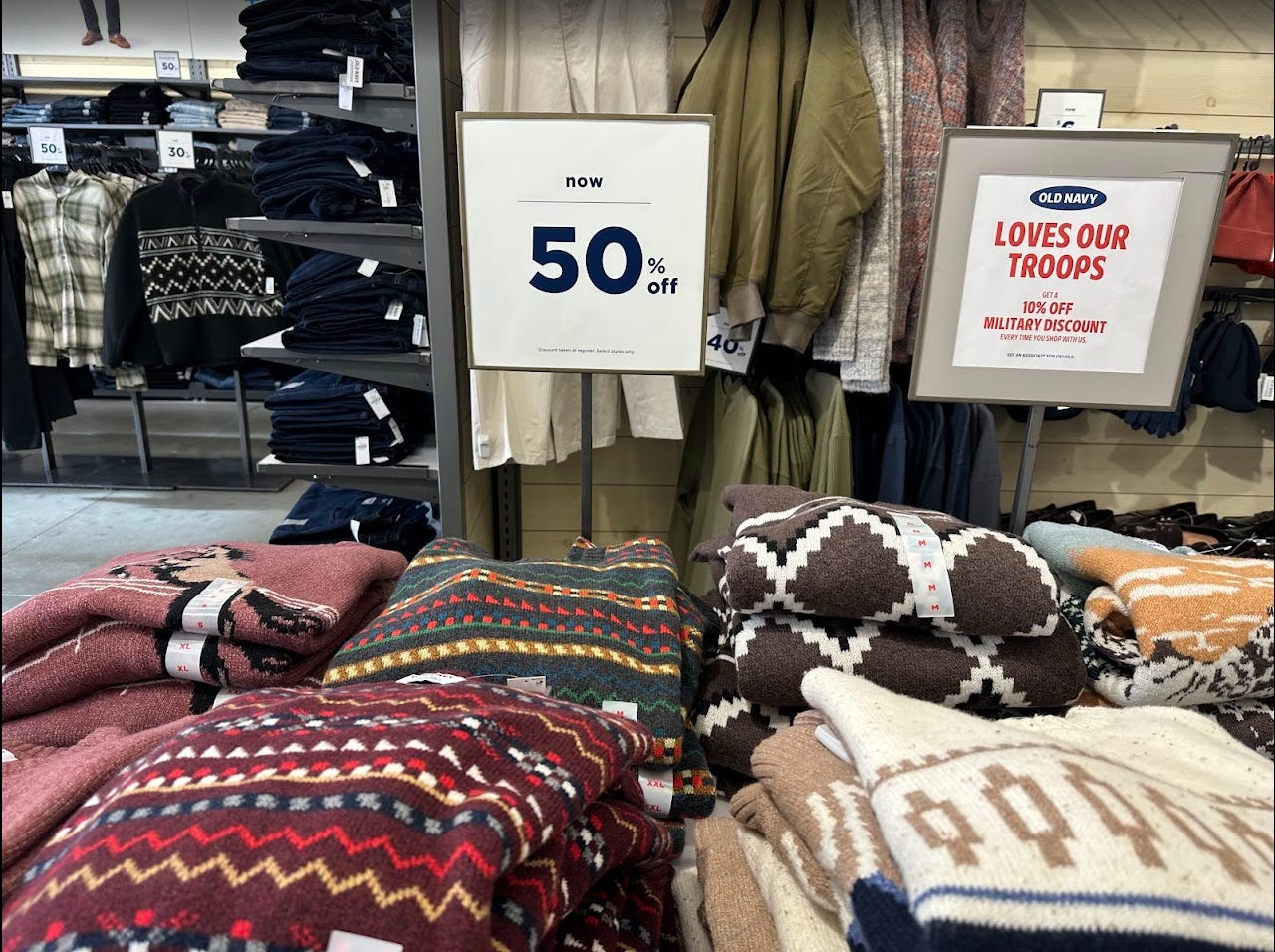
Gap Inc.’s CFO Katrina O’Connell told investors Old Navy was “actually trending better heading into that weather disruption” and “trends recovered immediately after those storms passed.”
The January storms likely cost Old Navy the $30-35 million separating a meet from a miss. That’s real. But Ross Stores absorbed $66 million in storm-suppressed revenue and still beat massively. Abercrombie & Fitch beat. American Eagle beat. Burlington delivered +21% EPS growth.
Gap Inc. was the only miss in a peer group of seven. The storms were real. They are not sufficient to explain being the sole underperformer.
The January storms didn’t cause Gap’s underperformance. They revealed it.
The Bottom Line
The cold helped everyone in November and December. Nobody said so. The storms hurt in January. Everyone said so. But only one company used them to explain a miss.
Blamed when it hurts. Silent when it helps.
That asymmetry is not random. When results disappoint, weather is a credible external factor — it protects management credibility and shifts the narrative away from execution.
When the weather helps, claiming it as a tailwind dilutes the execution story that justifies compensation, stock price, and investor confidence. Every CEO and CFO on these seven calls made the same calculation independently and arrived at the same answer.
The G2 Weather Signal is built to see through it — tracking what the weather actually did, in both directions, so the execution story underneath is visible whether management chooses to tell it or not.
Next week: The G2 Flash Report relaunches in a new format — the management benchmark framework, the Q1 forward signal tracker, and a first look at what the late March temperature pattern means for the retailers most exposed to the seasonal transition.
Musical Coda
Media & Attribution: Insights may be used with clear attribution to G2 Weather Intelligence.
© 2026 G2 Weather Intelligence. All rights reserved.


