When Execution Beats the Weather
What the Weather Told Us — And What We’re Learning
“The first principle is that you must not fool yourself — and you are the easiest person to fool." — Richard Feynman
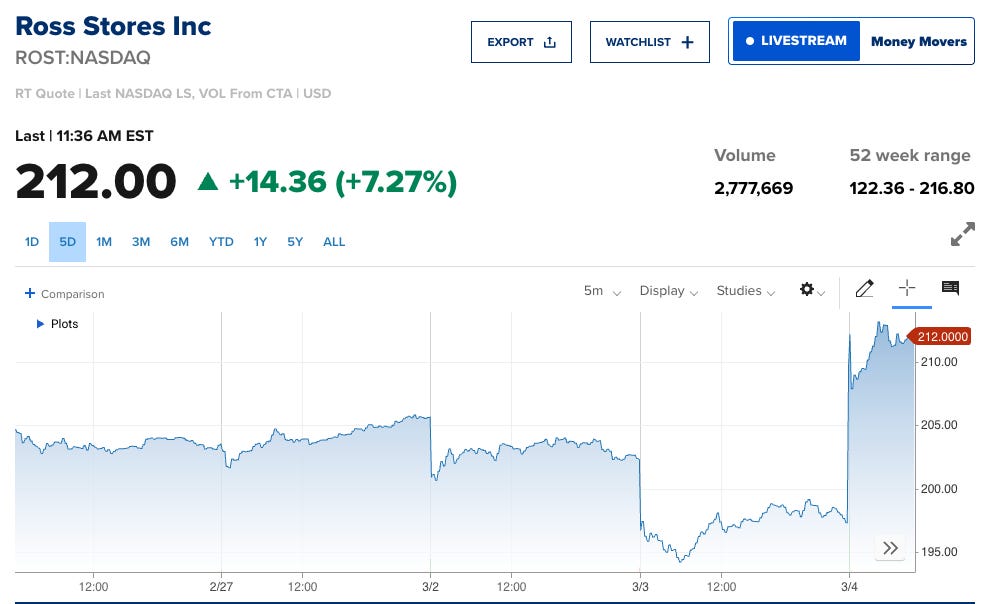
Ross Stores (ROST) and Target (TGT) reported on Tuesday. Before we look ahead to Thursday, here’s how the weather signal performed and what we’re adjusting.
Ross Stores (ROST) | Q4 Signal: D- (12/100) | Significant Headwind
The G2 signal flagged ROST as the most weather-exposed retailer heading into Q4. The signal was mostly wrong — and the transcript told us exactly why.
ROST posted a +9% comp on $6.64 billion in revenue, beating Street expectations by roughly $260 million. Management confirmed that weather cost them approximately $66 million in revenue — about 100 basis points of comp — but the culprit was January storm traffic suppression, not the California warmth the signal emphasized. Outerwear was called out as one of the strongest categories of the quarter.
The model overweighted California rain as a traffic and demand suppressor. It underweighted demand for cold-weather outerwear in the Northeast. The off-price treasure-hunt consumer comes for the value proposition, regardless of temperature. What they don’t do is brave a blizzard to get there.
The weather headwind was real, and management confirmed it. The mechanism was different than the signal identified. We’re recalibrating accordingly.
The bigger story is execution.
CEO Jim Conroy’s first full year produced record annual sales of $22.8 billion, a 10% dividend hike, and a 21% increase in the share repurchase program.
This is a best-in-class operator running a model that appears structurally resilient to weather headwinds at the demand level.
Target (TGT) | Q4 Signal: B (63/100) | Meaningful Tailwind
Target had a favorable weather setup. They still missed.
Revenue came in at $30.45 billion, down 1.5% year over year. Apparel missed estimates by $160 million, down 5.6% YoY. Food and beverage beat by $170 million — the result most consistent with the weather signal.
At Target’s scale, the B-grade environment likely cushioned a potentially deeper apparel miss. But it couldn’t overcome four consecutive quarters of structural traffic decline.
The weather did its job. The business has problems weather can’t fix.
The EPS beat — $2.44 versus $2.16 expected — reflects cost discipline, tariff cost lapping, and high-margin non-merchandise revenue growth. New CEO Michael Fiddelke, one month into the role, inherited a quarter he had no hand in shaping. February comps turned positive for the first time in several quarters. The market noticed — TGT gained 3.4% in a broadly down tape.
The key calibration for the framework: At the mega-retailer scale, the G2 Weather Signal functions as a category-level diagnostic, not a total-store predictor. That’s a meaningful distinction we’re building explicitly into the methodology going forward.
The Q4 Framework Takeaway
Two companies. Two signal grades. Two different lessons.
ROST confirmed weather was real — management said so explicitly — but the model measured the wrong variable. Storm traffic suppression, not California warmth, was the primary headwind. The signal was right about direction, wrong about mechanism.
TGT confirmed that a favorable weather signal can’t overcome structural execution problems at scale. The B-grade environment provided a floor. It couldn’t provide a ceiling.
Both results sharpen the model. Q4 was always intended as a calibration quarter. It’s delivering.
Thursday Preview: Burlington Stores (BURL), Gap Inc (GAP), BJ’s Wholesale (BJ)
BURLINGTON (BURL) | Q4 Signal: 68/100 | Grade: B+ | Meaningful Tailwind
Burlington is the purest weather play on Thursday’s calendar. Their Northeast store concentration puts them squarely in the cold December sweet spot — the region that flipped from seasonally cold in November to sustained cold in December, driving demand for full-price outerwear and cold-weather basics.
The post-ROST recalibration strengthens the cold-weather demand component of BURL's signal. Cold Northeast December is more bullish for off-price apparel than the original model captured — the value consumer shows up for the bargain regardless of temperature, and outerwear was one of ROST's strongest categories of the quarter.
Burlington's strip-mall footprint, however, adds a modest offset — open parking lots and exposed walkways during January storms suppress traffic more than enclosed-mall formats. The net result is a strong weather setup driven by December, with January storms taking a modest bite.
If ROST’s outerwear callout was genuine — and management said it was “a bigger business than it has been in the past” — Burlington should see a similar category tailwind with even greater concentration in the markets that drove it.
Watch for commentary on the outerwear and cold-weather categories. Any Northeast regional performance callout. Inventory cleanliness heading into spring — clean inventory suggests full-price sell-through rather than markdown pressure.
GAP INC. (GAP) | Q4 Signal: 54/100 | Grade: B- | Neutral to Modest Tailwind
Gap’s portfolio signal is driven overwhelmingly by Old Navy, which accounts for the majority of revenue and operates at price points closer to off-price than traditional mid-price apparel. That matters after Tuesday’s ROST result.
The original signal penalized GAP heavily for California warmth and rain given their West Coast store concentration. The ROST recalibration reduces that weight — the value-oriented Old Navy customer shows similar demand resilience to the ROST shopper.
Cold Northeast December outerwear demand partially offsets the drag from California.
The remaining headwind reflects January storm traffic suppression on their mall-heavy real estate footprint, and the drag from GAP brand and Banana Republic — both more discretionary than Old Navy but less directly weather-sensitive.
Old Navy is the most weather-sensitive banner in the portfolio and the one most likely to benefit from the cold Northeast December signal. How Old Navy specifically performs within the portfolio is the most important number to watch on Thursday.
Watch for: Old Navy comp called out separately from the portfolio. Any outerwear or cold-weather category strength. Regional performance variance between the West Coast and the Northeast markets.
BJ’S WHOLESALE (BJ) | Q4 Signal: 70/100 | Grade: B+ | Meaningful Tailwind
BJ’s is the most geographically advantaged retailer on Thursday’s calendar. With roughly 80% of stores concentrated in the Northeast corridor, their footprint sits almost perfectly in the cold December and January storm zone — the inverse of ROST’s California problem.
The warehouse club model adds a specific weather dynamic: pre-storm pantry loading. Storm Fern delivered 4-5 days of lead time across BJ’s core markets — sufficient for members to make dedicated stock-up trips. That’s a genuine bull signal unique to the warehouse club format.
Storm Gianna was the larger storm but arrived with insufficient lead time for planned warehouse trips, limiting the pre-storm loading benefit and adding some post-storm traffic suppression. That costs the signal a few points from the top end.
Cold December in the Northeast also drives bulk purchases of winter consumables, heating supplies, and seasonal food staples — all squarely in BJ’s wheelhouse.
Watch for: Comparable club sales with any regional breakdown. Food and consumables category performance. Any membership commentary tied to storm-driven traffic surges.
The G2 Weather Signal is an analytical tool — it tells you what the weather environment was, not what earnings will be. How management executes within that environment is a separate and equally valuable signal. Thursday will tell us both.
Musical Coda
Media & Attribution: Insights may be used with clear attribution to G2 Weather Intelligence.
© 2026 G2 Weather Intelligence. All rights reserved.

