When Winter Stops Selling and Starts Squeezing
Weather Stops Driving Sales — and Starts Driving Margins
G2 Weather Signal™ — Flash Report
Paul Walsh · December 15, 2025
Signal Summary
Margin Risk Confirmed
A 70–90% probability of above-normal warmth across the South and Southwest removes any late-season inventory rescue. Winter demand that doesn’t arrive now won’t arrive later, forcing earlier, margin-compressing markdowns — with the risk concentrated in structurally exposed names like ROST.Structural Risk Isolated
Using the G2 Retail Weather Exposure Index (RWEI), ROST and TGT screen as structurally exposed. Persistent, non-offsettable warmth collides directly with seasonal inventory, making this a high-probability margin event, not a timing issue or forecast debate.Traffic ≠ Conversion
Super Saturday may deliver traffic, but persistent warmth and higher household costs limit conversion, keeping the risk concentrated in mix and execution for TGT, TJX, BURL, and WMT.Investor Implication
This is a margin-and-timing setup, not a demand trade—focus on gross-margin sensitivity and inventory risk, not traffic headlines.
The Setup
I absolutely hate Christmas shopping. I’m bad at it, my feet and back hurt from carrying the goods—and, to be transparent, I’ve been known to whine a bit (… are we done yet?).
But my wife—who is, without question, the boss on matters like these—insisted we go shopping early this past Saturday morning, at the King of Prussia Mall, the largest mall on the East Coast, one week ahead of Super Saturday.
Why that day?
The forecast was calling for a snowstorm later Saturday, with a messy Sunday to follow. If we were going to shop at all, she reasoned, it had to be before the weather turned.
She was right—as usual. And we weren’t alone.
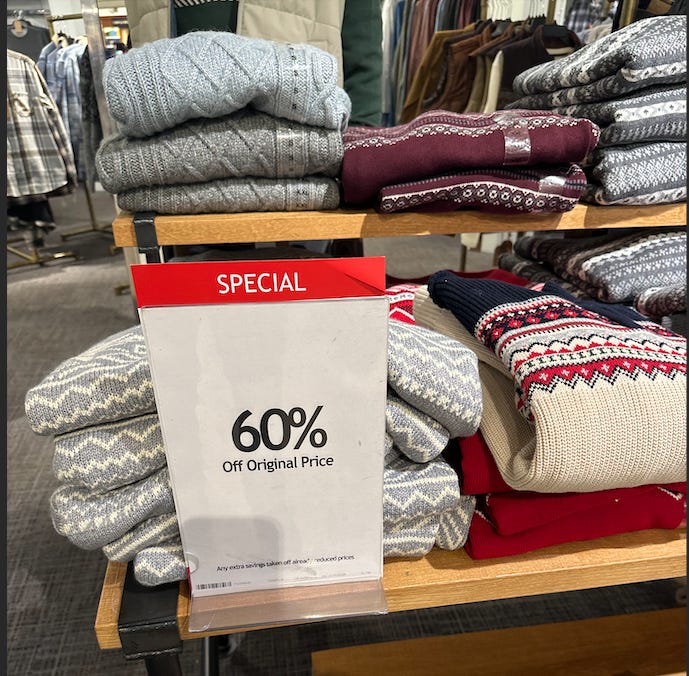
By mid-morning, the line at L.L. Bean was already snaking deep into the store, packed wall-to-wall. Later, at Macy’s, the crowd thinned noticeably. The promotions didn’t. “60% Off” signs dominated the seasonal floor.
That contrast—traffic where product meets weather, promotions where it doesn’t—captures the moment perfectly.
December weather is behaving like an old-fashioned winter across much of the eastern half of the country. But that’s no longer the question markets need to answer.
The real question is where weather still matters for earnings—and where it doesn’t.
Right now, the weather isn’t creating upside. It’s setting constraints.
Last Week (Week Ending Dec 13): Cold Delivered — Flooding Disrupted
Last week delivered meaningful, population-weighted cold across the Northeast, Upper Midwest, and Ohio Valley, pulling households into winter routines and supporting winter categories where winter actually arrived.
The outlier was the Pacific Northwest, where flooding rains forced evacuations and disrupted normal shopping patterns. That shifted spend toward essentials, cleanup, and repair—a real but non-repeatable distortion.
Ticker lens:
HD / LOW: Cold supported winter categories broadly; Northwest flooding accelerated repair/mitigation demand (pumps, tarps, drainage, cleanup).
TJX / ROST / BURL: Winter apparel improved in cold regions; flooded markets saw more functional/essential behavior than discretionary browsing.
WMT / TGT: Basket mix leaned essentials + cleanup; national impact diluted, but local mix effects were immediate.
Read: Cold drove winter demand. Flooding created localized disruption. Weather was earnings-relevant but uneven, reinforcing category and regional dispersion rather than broad upside.
From here, the analysis turns forward-looking. The whole outlook—this week, next week, and extended—is free to all subscribers through December 2025. After that, continued access will move to G2 Weather Signal™ — Premium.
This Week (Week Ending Dec 20): Snow Helps — Conversion Is the Test
This week began with weekend snow in parts of the Northeast, improving seasonal optics early and supporting winter-category conversion where weather matches assortments.
But the broader pattern remains split: cold holds in key Eastern regions while warmth persists across the West/Southwest—limiting urgency in large markets and pressuring discretionary conversion.
Ticker lens:
TJX / ROST / BURL: Northeast cold supports clean winter reads; conversion improves where weather validates the rack.
HD / LOW: Continued heating/weatherization pull in cold regions; steady project mix rather than spike demand.
TGT / WMT: Traffic may show, but the risk is conversion quality and basket mix—not footfall.
Read: Weather is *Actionable Conviction this week as a conversion and mix driver. Execution matters more than traffic.
*Actionable Conviction
Used when a weather signal is strong enough that it should meaningfully influence decisions—not just provide background context. It does not imply a specific trade or forecast certainty, but signals a measurable impact on outcomes such as margin, mix, traffic, or inventory timing.
Next Week (Week Ending Dec 27): Post-Holiday Margin Pressure Emerges
Next week is the pivot from selling to clearing. Weather stops influencing traffic and starts influencing markdown cadence and margin.
Absent a broad cold reset, winter inventory that didn’t move cleanly into Christmas moves into the post-holiday window with less pricing power.
Ticker lens:
ROST / TJX / BURL / TGT: The risk shifts quickly from “late-season opportunity” to early clearance pressure, especially in warm-leaning markets.
HD / LOW: Weather-driven demand normalizes; mix matters more than volume.
WMT: Essentials buffer revenue, but discretionary mix remains pressured.
Read: Next week is about margin defense and inventory timing, not sales recovery.As the calendar flips into the post-Christmas period, weather stops influencing traffic and starts influencing markdown cadence and margin outcomes.
Extended Outlook: Persistence Drives Earnings Relevance
Across the 6–10 day, 8–14 day, and Weeks 3–4 outlooks, the key feature is persistence, not volatility. The probability maps continue to hold a warm tilt across the South/Southwest and much of the West, while colder risk remains more concentrated in the Northern tier.
At this horizon, the signal isn’t more demand—it’s less time. A compressed winter selling window shows up in mix pressure, earlier markdowns, and tighter inventory timing.
To avoid over-weighting weather where it doesn’t matter, I apply a simple exposure filter before drawing conclusions.
That filter is the Retail Weather Exposure Index (RWEI), which I use to isolate where weather is likely to show up in earnings under a persistent probabilistic regime. Using RWEI ≥ 6 as the earnings-relevance threshold, the following exposures matter:
HD / LOW — Structural, Directionally Mixed
Weather remains earnings-relevant through category mix and project timing, not demand acceleration. Cold supports heating and weatherization, but persistent warmth caps urgency and limits upside. Sales shift back toward a more typical, lower-margin product mix after a temporary boost fades.TJX / ROST / BURL — Structural Headwind
Compressed winter windows pressure off-price margins through mix and missed sell-through, not promotional markdowns.DG — Moderate, Budget-Driven Sensitivity
Weather influences outcomes primarily through household budget trade-offs and essentials timing. Effects tend to show up in basket composition, not earnings volatility.
Retailers below the threshold (e.g., TGT as moderate, WMT as low–moderate) remain important for context, but should be treated primarily as mix stories, not weather-driven earnings stories.
Read: The probabilistic outlook confirms a margin-and-timing regime, not a demand regime—where persistence concentrates risk in the most weather-exposed names.
Takeaway
The weather isn’t setting direction this December. It’s sorting outcomes.
Retailers with structural exposure (ROST) face a margin and timing problem, not a demand opportunity. Moderate-exposure names (TJX, BURL, COST) see mix effects rather than outcome shifts. Low-exposure names (WMT) should be treated as weather-insulated.
Winter weather finally showed up. Earnings will hinge on who was built to manage it—and who wasn’t.
Appendix
G2 Retail Weather Exposure Index (RWEI) Extended Outlook
The Retail Weather Exposure Index (RWEI) is a 1–10 composite score measuring how sensitive a retailer’s near-term revenue and margin outcomes are to deviations in temperature and precipitation.
It’s a filter for analyst focus—not a trade signal.
Deterministic vs. Probabilistic Use (Why This Matters)
Short-Term Outlook (Last / This / Next Week): Conditions are sufficiently resolved to assess impacts without probabilistic framing.
Probabilistic / Extended outlook: Over longer horizons, RWEI filters the universe to the retailers where persistent weather conditions are likely to show up in earnings
The table below lists representative national retailers to illustrate how weather exposure translates into earnings relevance over the next month. These names are not exhaustive; they are selected to represent common retailers and exposure profiles during this outlook window.
How to Read This Table
RWEI ≥ 6 → Weather is earnings-relevant under persistent regimes
RWEI 3–5 → Weather affects mix and timing, not outcomes
RWEI ≤ 2 → Weather is background noise
These scores are applied explicitly in the Extended (probabilistic) Outlook to isolate earnings-relevant retailers. They do not drive headlines in the Last / This / Next Week sections.
Weather Data Tables
Weather data provided by WeatherMapping.com, a leading source of applied weather intelligence widely used across commodities, energy, and commercial risk markets.
Musical Coda
© G2 Weather Intelligence™. Proprietary analysis. Attribution requested.


