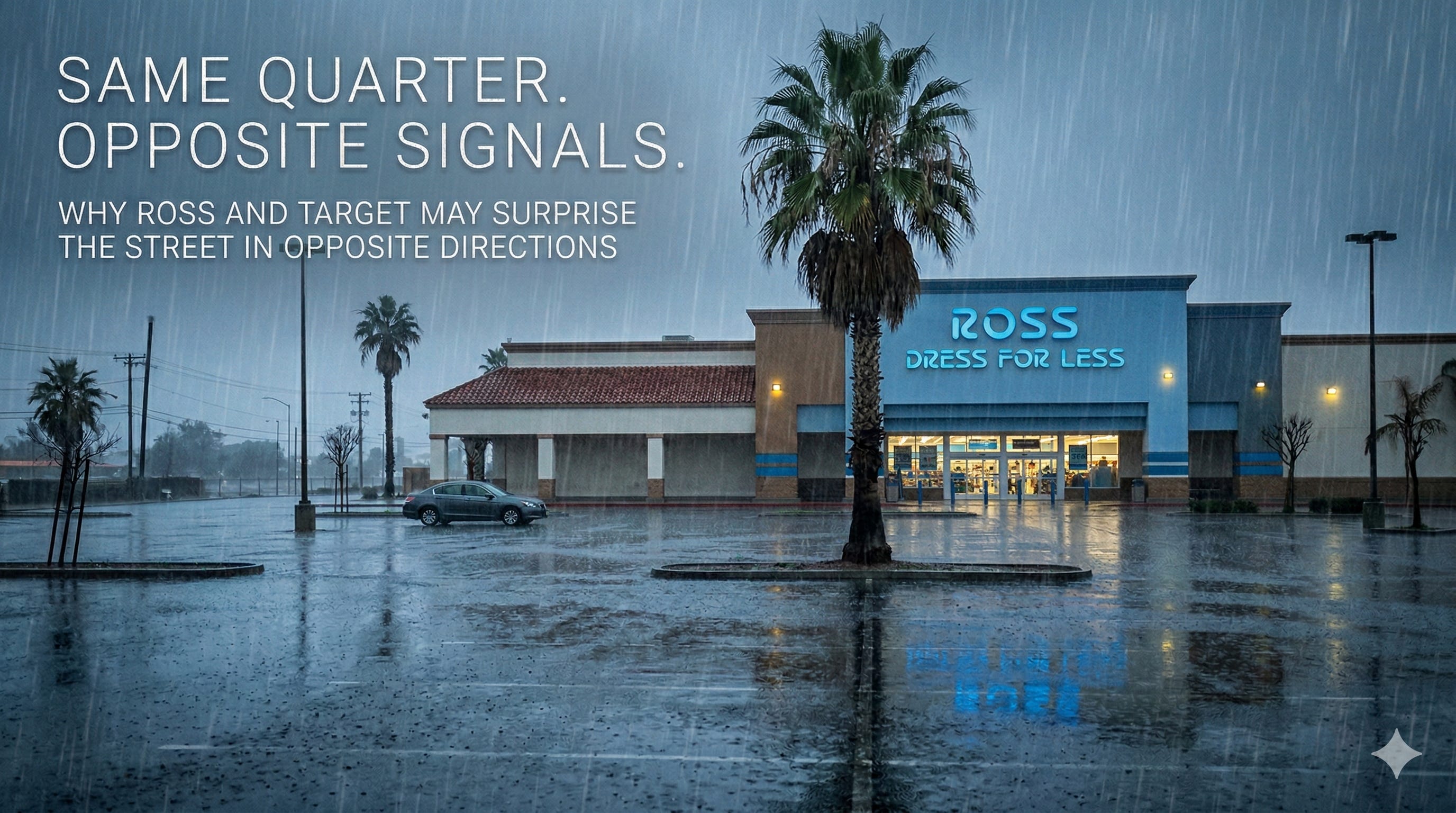
In 131 Years of Records, California Never Had a Warmer Q4. The Street Is Still Bullish on Ross Stores.
G2 Weather Intelligence | Pre-Earnings Analysis | February 27, 2026
Ross Stores and Target both report Q4 earnings on Tuesday, the critical holiday quarter. Here's what the weather data says about each, and why the Street may have them backwards.
The Signal Summary
Ross Stores (ROST — Nasdaq): 12/100 | D- | Severe headwind
California and the West — 28% of Ross's store base — faced record warmth and above-normal precipitation for the entire quarter. The Street saw a Q3 beat and raised estimates. What they missed is that the weather tailwind behind that beat became a headwind in Q4.
Target (TGT — NYSE): 63/100 | B | Meaningful tailwind
A cold Northeast December — Target’s largest region, during peak holiday — combined with dry Southeast conditions and storm-driven grocery upside in January. Target’s format and geography aligned almost perfectly with Q4’s weather patterns. The Street is cautious heading in. The weather signal says they shouldn’t be.
The Asymmetry
Here's the thing — the Street is most bullish on the retailer with the worst weather signal and most cautious on the one with the best. Same quarter. Same data. I find that interesting. Tuesday morning, we'll see why.
Two Retailers. One Quarter. Two Very Different Weather Stories.
Ross Stores and Target both report Q4 earnings on Tuesday morning. The Street is bullish on Ross and cautious on Target. Our G2 Weather Signal suggests the Street may have them backwards.
This isn’t a prediction. It’s a signal — one we’ve been building since October.
First, a Brief Track Record
On October 20, 2025, I published “Weather Tailwinds and Tariff Headwinds: How a Cooler Fall Is Rebalancing Retail.” The thesis: a cooler-than-normal fall was creating a measurable weather dividend for seasonal apparel retailers. Ross Stores was a primary beneficiary.
On November 21, 2025 — the day after Ross reported a blowout Q3 — I wrote:
“The fact that both GAP and ROST clearly benefited from weather tailwinds yet barely mentioned it tells me they may be drinking their own Kool-Aid — setting themselves up for disappointment in Q4.”
Q3 EPS of $1.58 had crushed Ross's $1.38 estimate by $0.20. The Street celebrated and raised estimates. We flagged the missing weather component and turned our attention to Q4.
Today, the Friday before both companies report, here’s what the data shows.
Understanding the Framework
The G2 Weather Signal scores quarterly weather impact on a 0-100 scale. 50 is neutral. Above 50 is a tailwind. Below 50 is a headwind. We weight each month by its revenue contribution to the quarter and adjust for year-over-year comparisons — because what matters isn’t just whether weather was good or bad in absolute terms, but whether it was better or worse than the prior year the retailer is lapping.
Two additional inputs shape this analysis:
Geography. Where a retailer’s stores are located determines which weather patterns matter. A cold December in Boston means something very different to a Northeast-heavy retailer than to one concentrated in California.
Format. What a retailer sells determines how weather affects them. A cold January storm is a pure traffic disruption for an off-price apparel retailer. For a grocer, it’s a pantry-loading surge.
Ross and Target sit at opposite ends of both dimensions — and that’s exactly what this quarter exposed.
ROSS STORES (ROST) Reports Tuesday, March 3 | G2 Signal: 12/100 | Grade: D- | Severe headwind
The Geographic Problem
Ross operates ~2,273 stores. Their store data clearly tells the story: California and the West account for 28% of their store base. The South and Texas add another 18%.
Combined, 46% of Ross’s stores sit in markets that are most sensitive to warm temperatures — and most vulnerable when warmth arrives during peak cold-weather selling season.
Ross's store concentration tells the story: California and the West at 28%, combined with the South and Texas at 18%, means nearly half their store base sits in markets where warm weather, in winter, does the most damage.
In Q4, those markets delivered the worst possible weather.
November: The Quarter Started Badly
California and the West ranked 130th out of 131 years on the temperature record, near the warmest November ever measured. Texas hit rank 131, the actual all-time record. One year prior, California was below average in temperature. That’s a roughly 90-percentile swing in the wrong direction in Ross’s most important market, in the opening month of their most important quarter.
Precipitation in California came in above average. Heavy rain in major California metros — Los Angeles, San Francisco, San Diego — behaves almost like a snowstorm in New York City. Customers stay home. Off-mall formats get hit hardest.
Warm and wet in California in November. That’s the worst possible combination for Ross, and that’s exactly what they got.
December: The Quarter Got Worse
December in California was the warmest ever recorded — warmer than all 130 Decembers that came before it. The Southwest hit the same mark. And unlike the prior year, California was also wetter than normal, compounding the damage with a traffic headwind on top of the warmth.
When it's 75 degrees in Los Angeles in December, customers don't buy heavy sweaters, outerwear, or boots. When it's raining on top of that, they don't go to the strip mall at all. Ross got both — record warmth and above-normal rain — in their most important market during their most important month.
Last December, California was warm but at least dry. This year it was warmer and wetter — worse on both dimensions simultaneously.
January: Too Little, Too Late
Some relief arrived. California dried out, which partially offset the persistent warmth. East Coast temperatures cooled, providing some seasonal activation in the Northeast and Ohio Valley — but those regions represent only ~20% of Ross’s store base.
The East Coast winter storms — Fern and Gianna — disrupted traffic in the Southeast and Northeast with no offsetting benefit. Ross doesn’t sell generators, ice melt, or emergency supplies. Storms are purely a traffic negative for off-price apparel.
January compounds the problem in a different way. A year ago, the South, Southwest, and Southeast — 44% of Ross's store base — ran much colder than normal, driving strong cold-weather sell-through and setting a high bar for this year's comparison. January 2026 in those same markets was closer to seasonal — not warm, but nowhere near as cold as last January.
The cold-weather urgency that drove sales a year ago simply wasn't there. Add the traffic disruption from winter storms Fern and Gianna, with no offsetting demand benefit, and January delivered a double headwind: a softer demand environment against a strong prior-year comp, with storms interrupting what traffic there was.
The Monthly Scorecard:
Weighted Q4 Signal: 12/100 | Grade: D-
The Street’s Setup
Goldman Sachs target: $214. Telsey: $220. Consensus EPS: $1.90, above Ross’s own guidance of $1.77-$1.85. The stock hit a 52-week high this week.
The optimism traces directly to Q3’s blowout. But Q3 ended November 1 — before any of this weather hit. The Street extrapolated execution momentum from a weather-assisted quarter into a quarter where that weather completely reversed. They’re looking in the rearview mirror.
Last year, CEO Jim Conroy called out “unseasonable weather” as a headwind, even though only late January softened. That was a partial-month disruption in a small number of markets.
Q4 2025 delivered a full-quarter reversal in their most critical region. If a small weather event was worth flagging, this one should be front and center on Tuesday’s call.
What to Watch:
Any reference to California or the West region performance
Weather language from management — its presence or notable absence
Q1 guidance tone — will they acknowledge the setup has changed?
If they miss and blame the weather, that's not reassuring — it means they're entering Q1 without a weather strategy. The problem isn't the weather. The problem is not managing what’s coming.
TARGET (TGT) Reports Tuesday, March 3 | G2 Signal: 63/100 | Grade: B | Meaningful tailwind
The Geographic Advantage
Target operates ~1,948 stores. Their concentration looks nothing like Ross Stores. The Northeast represents 18% of stores — its single largest region. Add the Ohio Valley (15%) and the Upper Midwest (13%), and 46% of Target’s store base sits in markets that align directly with winter thermal cycles.
Nearly a third of Target's stores sit in markets where winter weather doesn't hurt retail — it drives it. The Northeast and Midwest run on thermal cycles: cold activates seasonal categories, fills grocery baskets, and keeps customers shopping in enclosed or destination formats.
Q4 delivered meaningful cold across both regions. Target's format was built to capture exactly that.
The Format Multiplier
Before walking through the monthly data, it’s worth establishing why Target’s weather signal is structurally different from Ross’s — even when the underlying conditions are similar.
Target’s food and beverage business represents roughly 22% of total sales, but that understates its strategic value. Food and beverage appears in more than 55% of shopping baskets — meaning grocery isn’t just a revenue category, it’s the trip driver that fills the rest of the cart. A Northeast customer who comes in for milk and eggs in a cold December doesn’t leave without a coat, a toy, and a candle. Grocery guarantees the traffic. The rest of the store captures the basket.
For Ross, a winter storm means customers stay home. Traffic drops, sales fall, and there is no offset.
For Target, a storm triggers a pantry run. Pre-storm grocery shopping is a documented, measurable surge that Ross doesn’t participate in — and when the storm passes, customers return to restock.
Cold December weather compounds this further. A holiday grocery run in the Northeast becomes a multi-category trip — food plus kids’ outerwear, seasonal gifts, and household supplies all in a single basket. Cold weather, grocery traffic, and broad category conversion happen simultaneously. That’s not just a weather tailwind. That’s a format advantage that amplifies the impact of every degree of cold in Target’s most important markets.
November: Warm but Manageable
November was warmer than normal across most of the country — a headwind for seasonal apparel. But Target’s geographic and format diversification softened the blow considerably.
The Northeast was near normal in November — seasonally appropriate and a dramatic improvement over the prior year, when the region ranked near the warmest November on record. That YoY swing matters: cold-weather categories were activating meaningfully earlier than a year ago, when unseasonable warmth had suppressed them entirely.
The Southeast had one of its driest Novembers in over a century of records — frictionless holiday foot traffic for 16% of Target’s stores during the weeks leading into peak selling season. The Midwest was warm, a real drag on apparel, but dry conditions kept traffic flowing. And grocery volume was largely unaffected throughout — customers shop for food regardless of the temperature.
November was a mild headwind for apparel in warm markets, offset by near-normal Northeast conditions, a significant YoY improvement in cold-weather sell-through, and the format resilience that grocery provides.
December: This Is Where the Story Turns
December is disproportionately the largest revenue month of Q4 — Black Friday weekend, the full holiday shopping season, and Christmas week compressed into a single calendar month. Getting December right matters more than November and January combined. For Target, a cold December in the right markets doesn’t just sell coats — it fills grocery baskets for holiday meals, moves gifts off seasonal displays, and drives household restocking runs, all in a single trip.
Target got December right.
The Northeast — their largest region at 18% of stores — turned meaningfully colder than normal during peak holiday selling season, a significant swing from the prior year when it was warmer than normal. Coats and sweaters are sold at full price. Holiday gifting categories saw stronger basket sizes. Grocery surged around holiday meal planning and entertaining.
The Southeast added to the strength, with much drier-than-normal conditions and strong traffic across 16% of stores during peak holiday weeks. The Ohio Valley trended cooler than normal — an improvement for another 9% of stores.
The offsets were real. California recorded its warmest December in 131 years — every prior December on record was cooler. The Upper Midwest was warm and notably wetter than normal. Together, that’s 17% of stores facing difficult conditions. But they don’t override the Northeast cold story.
January: The Storm Benefit
January brought colder than normal temperatures to the Northeast — rank 48 out of 131 years, colder than roughly two-thirds of all Januaries on record — plus winter storms Fern on the East Coast corridor and Gianna in the Carolinas on January 30.
For Ross, both were pure negatives. For Target, the calculus is different.
Pre-storm grocery loading is real and measurable. Customers making emergency pantry runs don’t leave without batteries, flashlights, bottled water, and ice melt — all Target categories. The storm that empties Ross’s parking lot fills Target’s.
January’s cold wasn’t about dramatic single-day drops — it was duration.
The New York City metro, for example, ran 2 to 4 degrees below normal all month, dropping below freezing on January 24 and staying there for over a week. Over 10 days, temperatures ran 10 degrees or more below normal. Sustained cold kept streets icy longer, reducing foot traffic — but also kept customers in the market for cold-weather apparel well past the holiday window, sustaining late-season sell-through and reducing clearance pressure into Q1.
Gianna disrupted traffic across the Southeast — a negative for 16% of stores, but one Target's grocery format partially absorbs. Ross has no equivalent buffer.
The South and Southwest remained warmer than normal, a persistent headwind for seasonal categories. But at roughly 25% of the store base combined, they don’t drive the quarterly result the way California does for Ross.
Weighted Q4 Signal: 63/100 | Grade: B
The Street’s Setup
Target has been the retail sector’s problem child. A difficult Q3, cautious guidance, ongoing concerns about discretionary spending pressure, and competition from Walmart and Amazon. Analyst sentiment is guarded. Expectations are modest.
That’s a very different setup than Ross — and potentially a much more favorable one if the weather signal is right. A B-grade weather quarter coming into a low-expectation print is exactly the setup where positive surprises happen.
Target’s grocery business provides a demand floor that pure apparel retailers don’t have. Cold December and January weather activate multiple categories simultaneously. And the storm activity that hurt Ross may have provided meaningful upside in the Northeast — Target’s largest region.
What to Watch:
Northeast and Midwest regional commentary — did cold December drive holiday outperformance?
Grocery comps — any storm-driven demand acknowledgment in January?
Apparel sell-through — did cold weather reduce markdown pressure vs. prior year?
Q1 guidance tone — spring weather setup will be the next signal
That last column is the asymmetry. The Street is most bullish on the retailer with the worst weather signal and most cautious on the retailer with the best. Same quarter. Same weather data. Opposite signals. Opposite Street positioning. Tuesday morning is the test.
The Broader Point
We called Ross’s Q3 beat in October — before it happened — because the weather signal was clearly positive. We flagged Q4 risk in November, the day after the blowout, because the signal had already flipped. Now the data confirms what the signal predicted three months ago.
That’s not luck. It’s a framework.
Weather isn’t background noise. It isn’t an excuse. It’s a (hidden) demand driver that quietly decides winners and exposes pretenders — and it moves in measurable, predictable, and actionable patterns before they show up in earnings prints.
The retailers who understand this will keep outperforming expectations. The ones who don’t will keep being surprised by them.
Tuesday afternoon isn't a verdict on the weather. It's a verdict on management. A Ross beat means they're built to withstand weather shocks. A Target miss means execution is the problem. The signal benchmarks the environment. Earnings benchmark the team.
G2 Weather Intelligence publishes pre-earnings weather signal analysis for select weather-sensitive retailers and restaurants. Premium subscribers receive full regional signal breakdowns, YoY weather comparisons, and forward signals before each earnings print.
Media & Attribution: Insights may be used with clear attribution to G2 Weather Intelligence.
© 2025 G2 Weather Intelligence. All rights reserved.


