

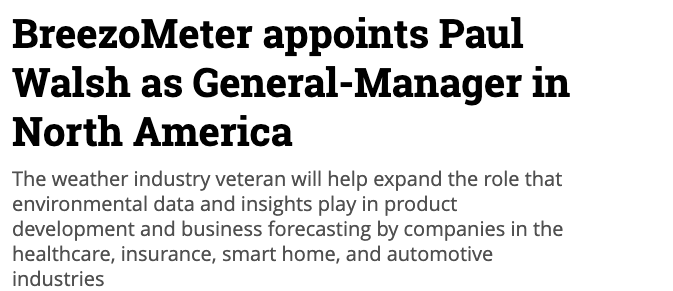
After IBM and The Weather Company, I joined BreezoMeter as General Manager for North America in late 2021 — helping bring what I believed was the world’s most precise air quality intelligence platform to the US market.
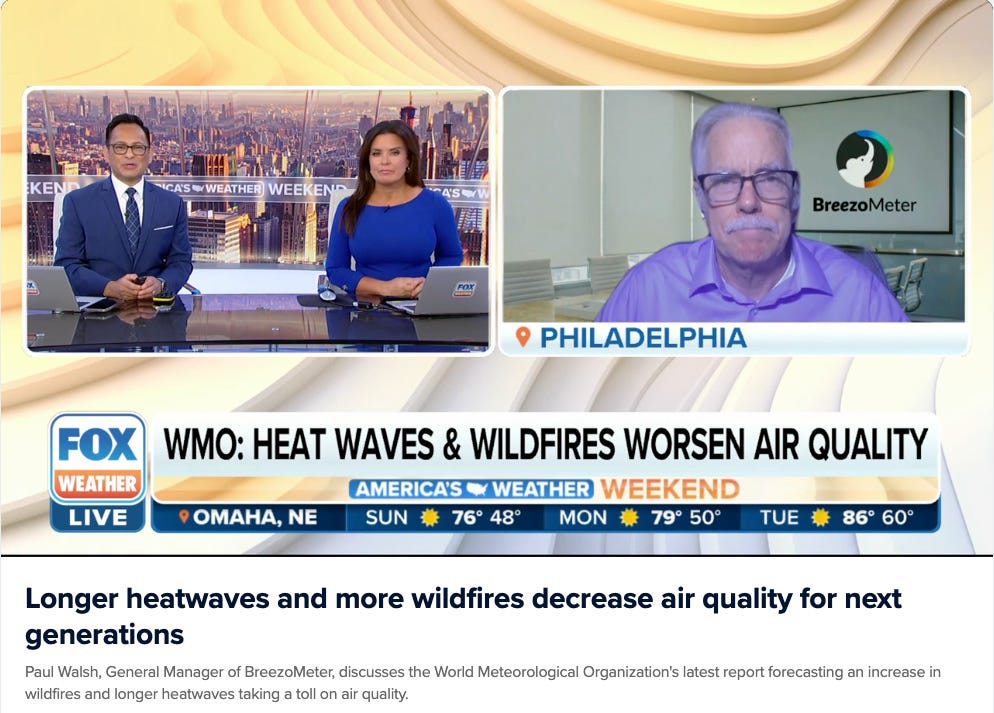
We were out front on this story.
I spent much of my time at BreezoMeter making the case publicly — in media appearances, industry conferences, and briefings with healthcare and insurance executives — that air quality was a business intelligence problem, not just a public health advisory. The data existed. The forecast capability existed. What was missing was the organizational infrastructure to act on it before the emergency room filled up.
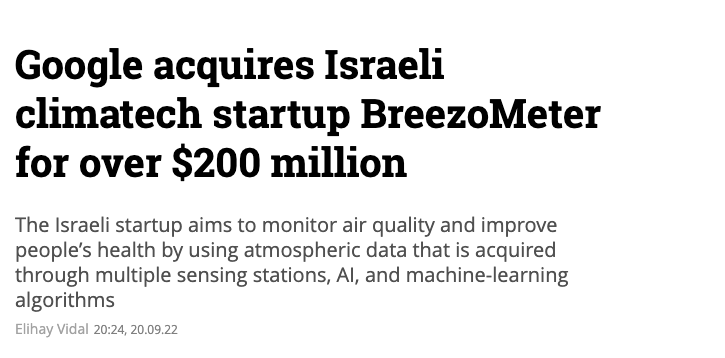
That argument felt urgent in late 2021. It feels existential in July 2026. A year after I joined, Google acquired BreezoMeter. The thesis was validated at the highest possible level.
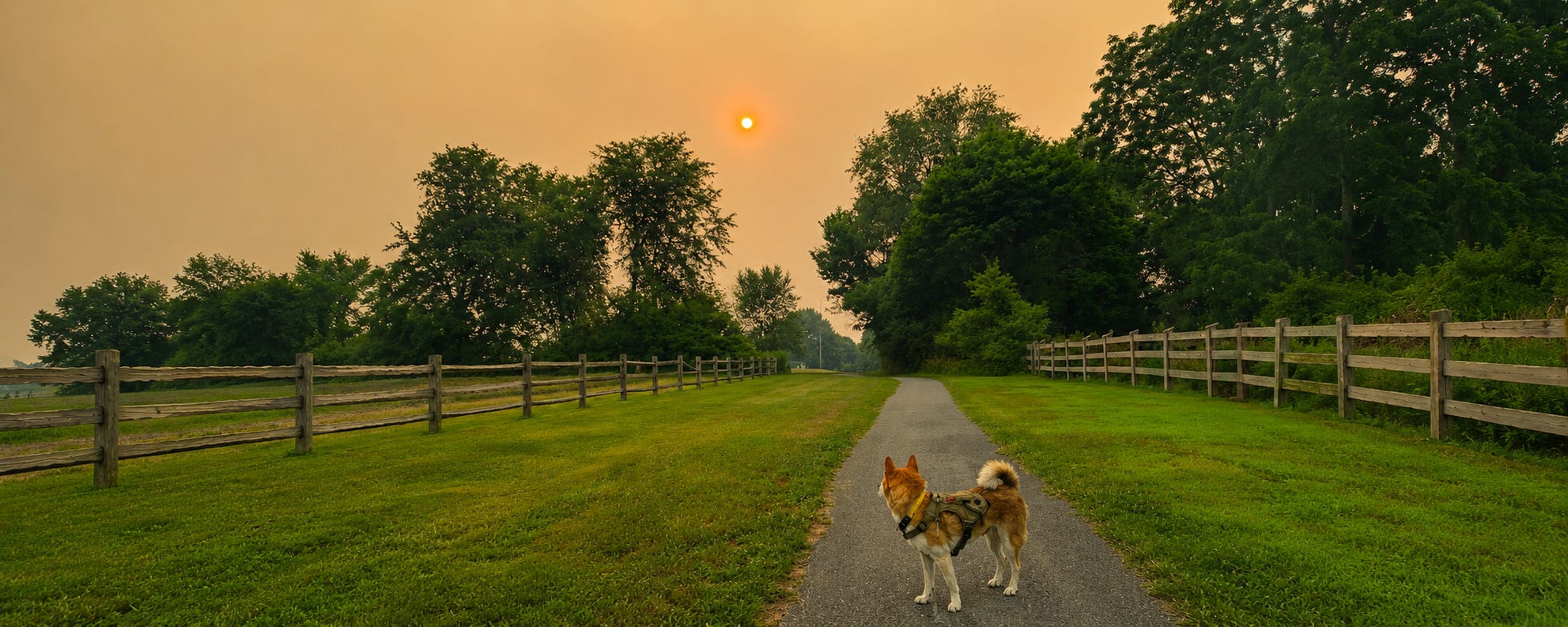
Walking Benji this morning, the smoke was visible before we’d gone a block. You could smell it. The sun hung orange and small in a gray-brown sky. It felt like Mars.
Déjà vu. All over again. The Canadian wildfires are back, the smoke is here, and the forecast that made this entirely predictable was available 48 hours ago.
This Is Not a Surprise. It’s a Pattern.
The 2023 Canadian wildfire season burned 15 million hectares — more than doubling the previous record and turning New York City’s sky orange in an event that made international headlines.
In 2026, close to 40,000 fires have already torn through more than 3.6 million acres across the US — almost 10,000 more fires and nearly a million more acres burned than the 10-year average for mid-July. Roughly 850 fires are burning across Canada right now, including more than 100 in Ontario. An enormous heat dome over the upper Midwest has created a clockwise air rotation, scooping up smoke from Canada and Minnesota and carrying it eastward across the most densely populated corridor in the country.
The science of smoke transport is well established. When wildfires burn in specific Canadian provinces under specific wind patterns, the smoke follows predictable atmospheric pathways southward into the US. NOAA’s Air Quality Forecast Guidance and commercial air quality platforms can model that transport with meaningful accuracy 24-72 hours in advance.
The event is not unpredictable. The response should not be reactive.
The data on the trend is unambiguous. Per-person annual exposure to wildfire smoke in the US was four times higher on average between 2020 and 2024 than during the prior fourteen years, according to Stanford University’s Environmental Change and Human Outcomes Lab.
Climate change is the driver — research published in 2025 found that anthropogenic climate change contributed 33 to 82% of the observed increase in burned area in the western United States from 1992 to 2020, and accounts for nearly half of the increase in surface smoke PM2.5 concentrations.
This is not a weather story. It is a climate story. And it’s accelerating.
The Health Stakes Are Not Subtle
The academic literature on wildfire smoke and human health has been accumulating rapidly, and the findings are consistent. A systematic review and meta-analysis of over 124 million patients published in 2025 found that for every 10 μg/m3 increase in PM2.5 exposure, wildfire smoke drives a 4% increase in emergency department visits, a 4% increase in hospital admissions, and a 2% increase in all-cause mortality.
The pattern holds hardest at the edges of the population.
Pediatric asthma-related ED visits may increase by over 30% during wildfire events. Elderly COPD patients face heightened hospitalization and mortality risk. Between 2019 and 2024, wildfire smoke caused an estimated 24,000 to 62,000 asthma emergency department visits in the US alone.
The smoke blanketing the Eastern US today is not just an acute health event. It’s a chronic health risk that accumulates with every exposure.
The New York event during the June 2023 Canadian wildfire smoke episode remains the most documented US case study. A CDC field report analyzing all 134 emergency departments in New York State outside New York City found that asthma-associated ED visits increased markedly when air quality reached its poorest levels during the event.
What BreezoMeter Taught Me — and What Comes Next
When I was working to develop BreezoMeter’s North American business, the core insight was that air quality data was everywhere, but actionable air quality intelligence was almost nowhere to be found.
The same Color Code system that had been telling people “it’s a red air quality day, sensitive groups should limit outdoor activity” since the 1990s was still the primary public health communication tool for a risk that had grown four times more severe in the preceding decade.
Google bought BreezoMeter because they understood that environmental intelligence embedded in products people already use — Maps, Search, Android — reaches people at the moment of relevance rather than in a general advisory that most people ignore.
The next step in that thesis is what ERaaS Health and Hippocratic.ai are building — environmental intelligence embedded in health-intervention infrastructure rather than in consumer apps.
Not "it's a red air quality day" sent to everyone. But a message from a conversational (and multilingual) weather intelligence agent, in this case, Rachel, sent directly to a specific member with COPD in zip code 10025:
“The air in your neighborhood is expected to turn very unhealthy within 24 hours; here's what that means for you today; make sure your rescue inhaler is refilled”
That is not a public announcement. That is a specific health intervention—enabled by AI. The difference between those two things is measurable in fewer emergency room visits, fewer hospitalizations, and, ultimately, lives saved.
From Instinct to Infrastructure
BreezoMeter’s thesis was that air quality data should be as accessible and actionable as a weather forecast. Google paid for that thesis.
ERaaS Health and Hippocratic.ai are building the next one — health intelligence as proactive and precise as the environmental data that predicts it.
Wildfire smoke events affecting the Eastern US are no longer rare. They’re a predictable feature of every summer — more frequent, more intense, and more foreseeable than the public health response currently reflects.
Benji and I cut the walk short this morning. I closed the windows. I checked the AQI. Individual protective action is instinctive. Organizational proactive response — identifying at-risk members, initiating outreach, closing the gap before the ER fills up — requires infrastructure that matches the speed of the forecast.
That infrastructure exists. That’s the mission ERaaS Health and Hippocratic.ai are built around: actionable intelligence that saves lives.
Musical Coda
© 2026 G2 Weather Intelligence. All rights reserved.