

“Quiet seasons don't guarantee quiet outcomes.”
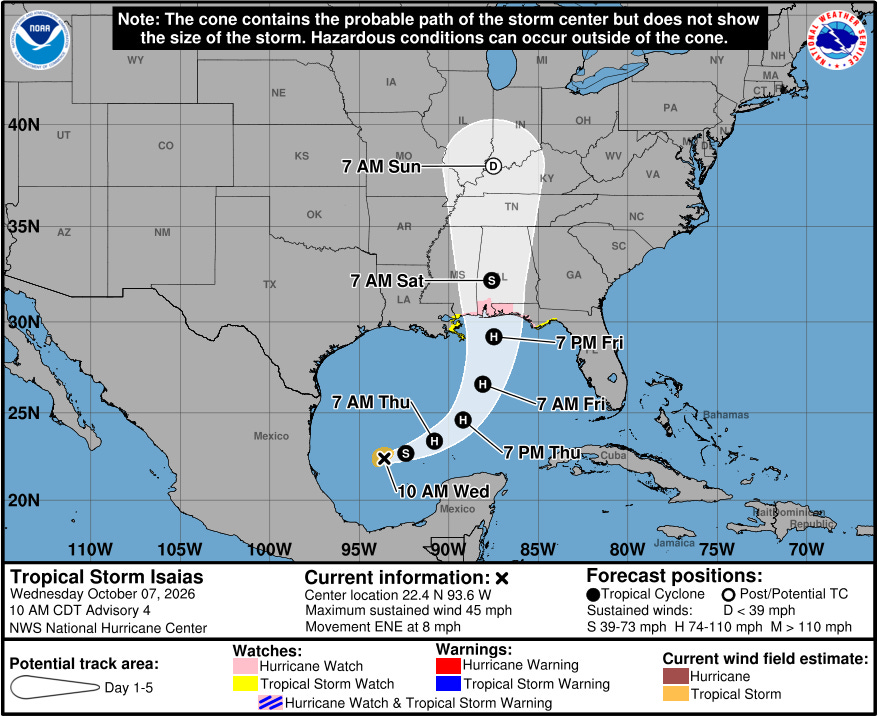
Twenty-seven days before the midterm elections, the first hurricane of 2026 is bearing down on the Gulf Coast.
Tropical Storm Isaias formed in the southwestern Gulf overnight. As of the 11 a.m. EDT advisory, the National Hurricane Center expects it to become a hurricane by Thursday morning and to peak near 110 mph on Friday, the top of Category 2.
The forecast track brings the center ashore Friday night near the Alabama-Florida line. A Hurricane Watch is up from Bay St. Louis, Mississippi, to Indian Pass, Florida. Florida has already declared a state of emergency in 25 counties.
The storm follows a September with no Atlantic hurricanes, the first in 32 years. And in my experience, the first storm of a season has the biggest impact on how people respond … no matter how strong it is.
What I Wrote in September
In The Quiet Season Trap, I argued that a quiet hurricane season doesn’t lower the risk of a damaging landfall. It just lowers people’s guard.
Two points from that post matter this week.
Fewer people forecasting. NOAA has lost roughly 20% of its workforce since February 2025, including about 600 National Weather Service staff. Twice-daily weather balloon launches were reduced or suspended at forecast offices from Alaska to New England.
Fewer people responding. FEMA cut more than 4,300 employees, about 17% of its workforce, in fiscal 2025. The GAO found it did so without assessing what that would do to its ability to respond to a disaster. The Senate did not confirm an Administrator, Cameron Hamilton, until August 7.
None of this is a knock on the professionals (heroes!) doing the work. There are just fewer of them … with fewer resources.
Read the full post here: The Quiet Season Trap
The Political Clock
The midterms are November 3. If Isaias comes ashore Friday night, that’s about three and a half weeks before Election Day.
Katrina is the cautionary tale.
In 2005, four days after the storm hit and with most of New Orleans still underwater, President George W. Bush praised his FEMA director, Michael Brown, on camera: "And Brownie, you're doing a heck of a job."
Brown was out within two weeks, and the line became shorthand for a failed federal response.
Even a perceived poor federal response this time would add to what are already gale-force headwinds for the Republican majority. As of this morning, traders on Kalshi put Democrats’ odds of winning the House at about 91% and the Senate at about 65%.
The response itself would fall to the National Weather Service and FEMA, the same short-staffed agencies I described above.
There’s an interesting analog —
Hurricane Michael hit the Florida Panhandle on October 10, 2018, exactly 27 days before that year’s midterms. The National Hurricane Center’s first forecast had it peaking at 70 mph. It came ashore near Mexico Beach as a Category 5 with 160 mph winds.
Then, as now, Republicans held the White House and both chambers of Congress. On Election Day, Democrats gained 41 seats and took the House. Republicans held the Senate and added two seats.
It’s not a like-for-like comparison, of course. Nobody credits Michael with flipping the House, and the 2018 result had many causes.
But the setup? Well, it rhymes — a Gulf hurricane hitting the same stretch of coast at the same point on the election calendar.
Retail Winners and Losers
As always with a hurricane, retail will have winners and losers. This year the gap between them will be wider.
Retailers measure results against the same weeks a year earlier, and no hurricane made landfall in the U.S. last year. So there’s no storm in last year’s numbers.
Every dollar of storm-driven sales this week shows up as growth, and every day a store is closed shows up as a decline.
Winners: storm demand on top of an easy comparison
Home centers. Prep sales now, repair and rebuild later. Home Depot booked about $282 million in hurricane-related sales in a single quarter after Harvey and Irma in 2017.
Grocery. Stock-up buying ahead of the storm. Circana measured a 13% week-over-week jump in food and beverage sales during last January’s winter storm.
Losers: lost business against a clean base
Specialty retail. Closed stores and discretionary purchases that get skipped, measured against a year when those stores stayed open. Circana found general merchandise store sales fell 15% to 20% in the markets hit by Winter Storm Enzo.
Restaurants. A meal that isn’t served on Friday doesn’t get served twice on Monday.
How big is the footprint?
Here's my rough estimate of stores in the path for select retailers, based on the 11 a.m. forecast.
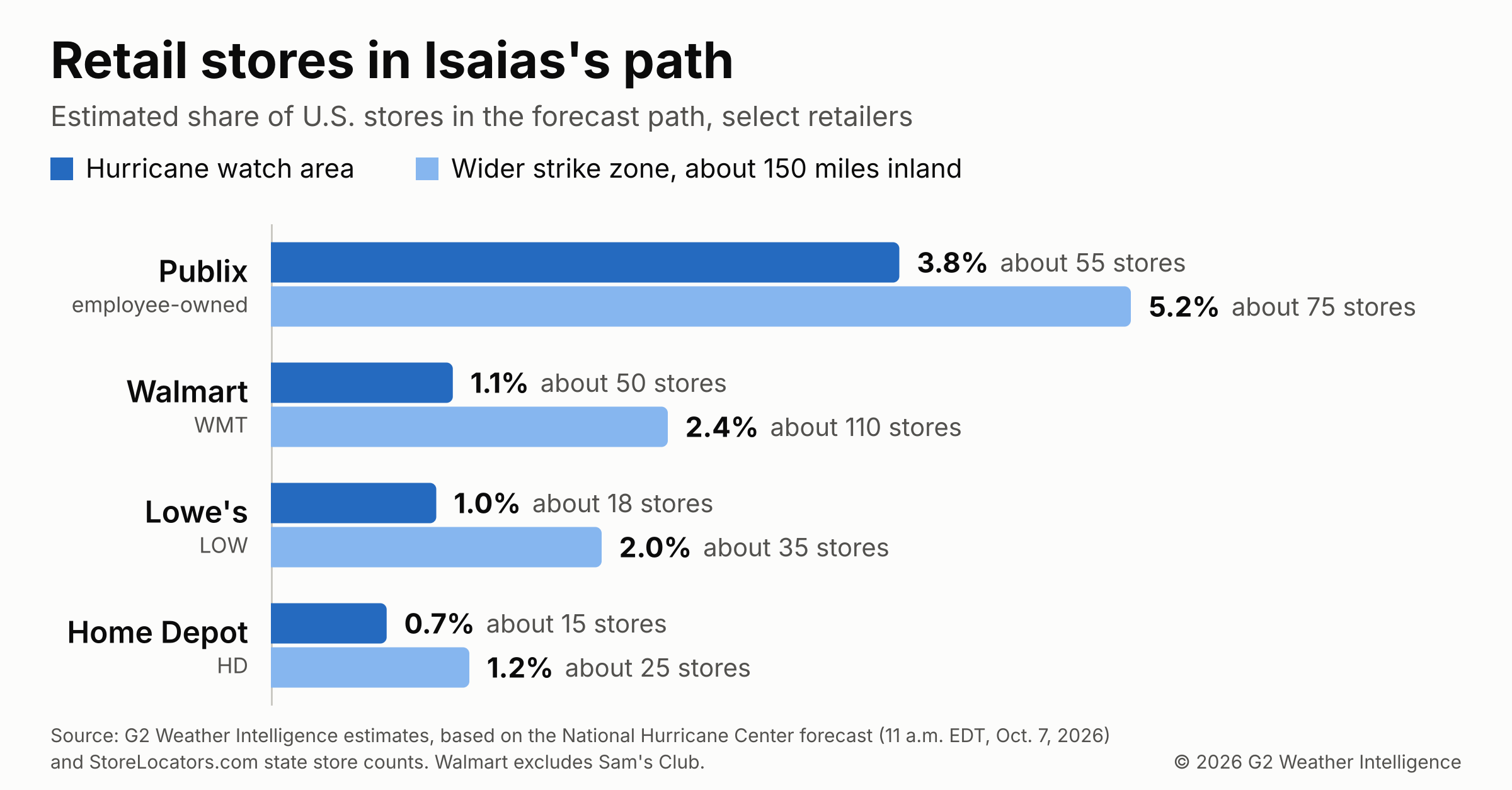
The winners will be the organizations that had an effective (!) weather strategy in place before this week. The losers? The ones that didn’t.
The quiet season lowered our guard. On Friday night, we'll find out by how much.
Musical Coda
The analysis and writing here are mine. I use Claude (mostly) as an editor, for fact-checking and line edits, not as a source of ideas or content.
© 2026 G2 Weather Intelligence. All rights reserved.