

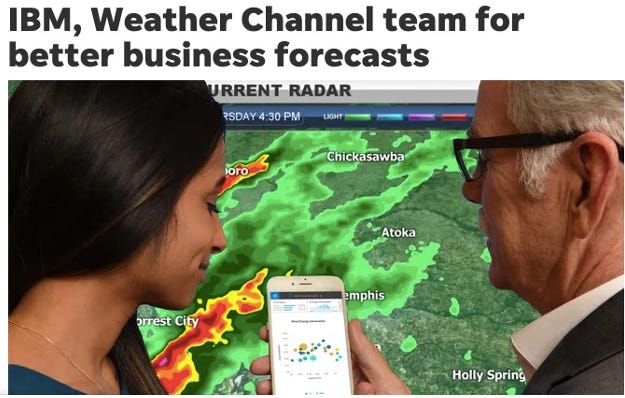
I spent five years at IBM Consulting after the company acquired The Weather Company and saw firsthand what happened when a retailer or CPG company sought to build an integrated weather strategy.
The business case was clear. The data was available — and relatively inexpensive. The financial opportunity was real and measurable. But the consulting financial model made the math not work.
Billable hours. Utilization targets. Multi-million dollar engagement economics. A large team of consultants required to connect weather intelligence across seasonal planning, demand forecasting, pricing, marketing, staffing, and financial risk management. A multi-year transformation timeline before the ROI showed up in the P&L.
Most retailers looked at that equation and made a rational decision: pass. Or pilot. A demand forecasting experiment here. A weather-triggered marketing campaign there. Point solutions that never connect to the integrated system that delivers real value.
Weather intelligence stayed tactical. Not because the opportunity wasn’t real. Because the consulting model made it too expensive to justify.
The WSJ Story This Morning
This morning, the Wall Street Journal reported that consulting firms are in what one industry observer called “an existential scramble” to find a new pricing model as AI upends traditional revenue streams.
A Deloitte executive told consultants at a town hall that traditional labor-based hourly work is expected to shrink to a sliver of the total market by 2035. AI agents are expected to grow exponentially to become a majority of the professional services market.
One Deloitte consultant’s takeaway: “They heavily implied our model is toast.”
Pat Petitti, CEO of AI-based consulting platform Catalant, was more direct: “AI is destroying their business model.”
While this represents a financial risk for the consulting industry, it is a structural opportunity for retailers, CPG companies, and healthcare organizations with weather-sensitive operations — to build an integrated weather strategy that the old consulting model made too expensive to justify, at a cost and speed previously unimaginable.
What AI Agents Change
AI agents change the value equation in two fundamental ways.
First, they dramatically reduce the human labor required to build and operate the integration layer. The work that previously required a large consulting team — correlating historical weather data against point-of-sale data by category, geography, and time window; building triggering mechanisms; connecting the forecast to the operational response across every enterprise function — can now be done by AI agents at a fraction of the cost and in a fraction of the time.
Second, they make outcome-based pricing — which the WSJ identifies as consulting’s only viable future — actually work for weather intelligence engagements. When the system can demonstrate a measurable reduction in markdown depth, a measurable improvement in full-price sell-through, or a measurable lift in weather-driven category revenue, the value is quantifiable before the engagement ends. That changes the risk calculus for the buyer entirely.
As noted, that shift represents a financial risk for the large consulting firms built around the old model — and a significant opportunity for the consumer-facing organizations they have historically served.
Retailers, CPG companies, and healthcare organizations can now access the same integrated weather intelligence capability that previously required a multi-million-dollar engagement with a handful of strategy consultants or a small internal staff, at a fraction of the cost and timeline.
The barrier was never the data. The barrier was never the technology. The barrier was the cost and complexity of the integration layer that connected them.
AI agents are removing that barrier—and it’s happening now.
Great News for Retailers, CPGs, and Healthcare. Not Great News for Large Consulting Firms.
The companies that move first — with a small team, a clear framework, and the right data — will build a capability that their competitors can’t easily replicate. Not because the weather data is proprietary or expensive. It isn’t. The data is table stakes.
The competitive advantage is the organizational integration — every function responding to the same weather signal simultaneously. That is genuinely hard to build. And genuinely valuable once it exists..
The large consulting firms that built their business around the old model face a structural challenge the WSJ describes clearly: “Many are being forced to cut prices before they themselves have actually realized the cost-saving gains from the technology.”
The transition is slow and painful for organizations built around utilization and billable hours.
For retailers and CPG companies, that transition is an opportunity. The expensive barrier is coming down. The playbook for building an integrated weather strategy without a multi-million dollar consulting engagement is available right now.
The same principle applies in healthcare — where weather intelligence is increasingly being used to identify at-risk populations before a heat emergency peaks rather than after the emergency room fills up. A separate but parallel opportunity, and one that is equally underserved by the old consulting model.
The Brainstorm Series Is That Playbook — For Retail and CPG
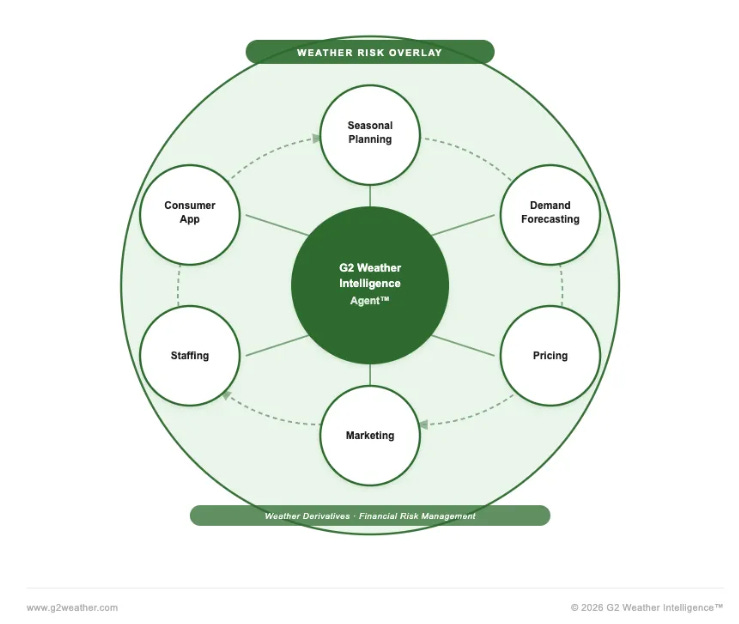
The G2 Weather Intelligence Brainstorm series is built specifically around retail and CPG — the categories where the weather-to-demand relationship is most documented, most measurable, and most directly connected to earnings performance.
Each post is a module in a framework designed for exactly this new model. Not a science experiment. Not a multi-year transformation program. A connected framework that a small, focused team can implement systematically.
Seasonal planning sets the buy. Demand forecasting optimizes the distribution. Pricing manages the margin. Marketing activates the demand. Staffing schedules for the forecast. Financial risk management closes the loop.
The capstone post will show what it looks like when it all runs simultaneously — in a fictional retailer set in the near future, looking back at how they built the capability that their competitors were still piloting.
The consulting model that kept weather strategy on the shelf is breaking down. The AI agents that replace it are being built right now. The framework is here. The barrier is gone.
It’s time to move on.
Musical Coda
© 2026 G2 Weather Intelligence. All rights reserved.