

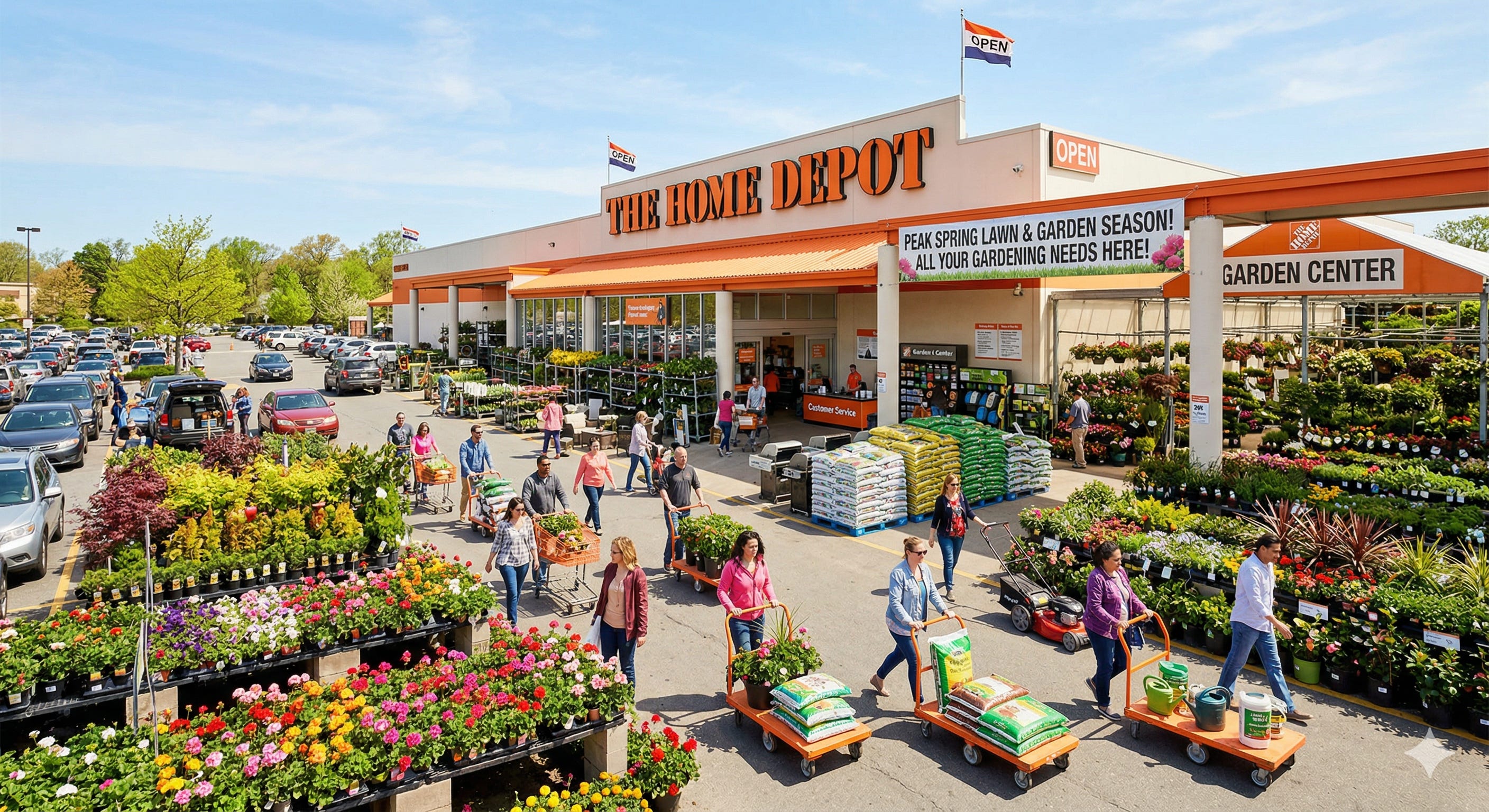
Last week, I laid out the tension defining Q1 retail: a historically strong weather signal colliding head-on with a macro headwind nobody asked for. Today, NOAA released the March data. The verdict is in — on both counts.
The weather delivered. The football moved again.
What NOAA Confirmed This Morning
March 2026 was the second-warmest March in 132 years of U.S. climate records, nationally. But the national number understates what happened at the state level.
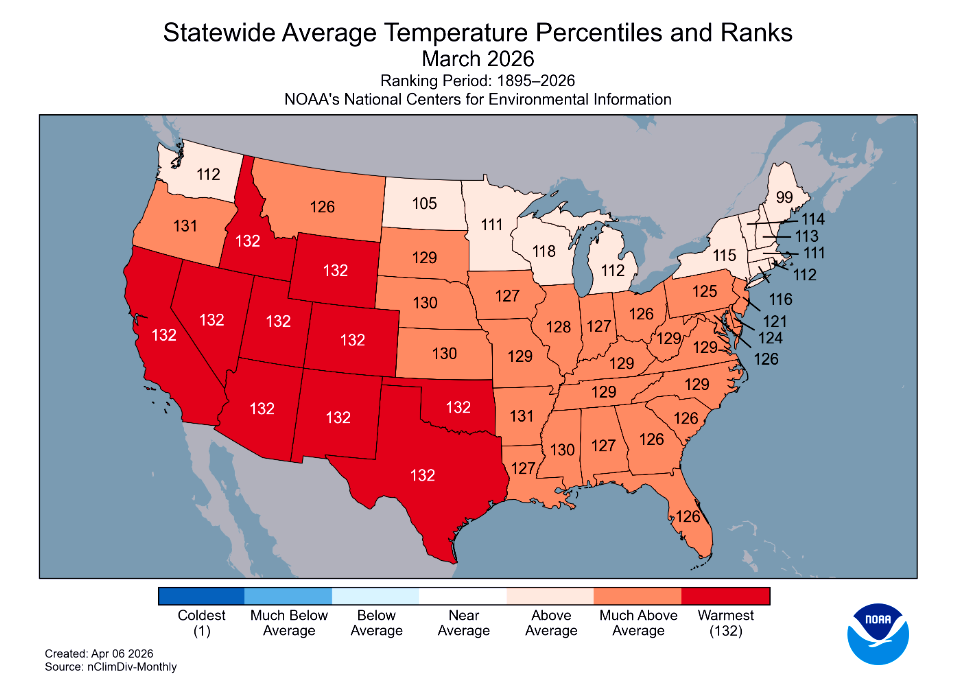
For example, California recorded its warmest March on record — +10.6°F above the 30-year normal — and simultaneously its driest, at just 0.19 inches of precipitation against a normal of 3.25 inches. That is not a weather event. That is a demand activation event of historic proportions.
The pattern was consistent across the Sun Belt, Southeast, and West: record or near-record warmth, combined with well-below-normal precipitation. Warm and dry. The combination that moves product … but for trade wars and shooting wars.
The Home Sector Signal: #1 in 132 Years
Using 132 years of NOAA state-level climate data, weighted by estimated store footprint, March 2026 ranks as the most favorable March on record for Home Depot’s geographic exposure — edging out March 2012, the previous high-water mark, the quarter when HD posted +6.1% U.S. comp.
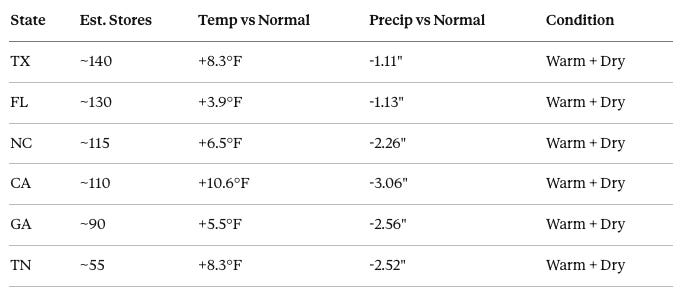
Lowe’s ranks second, trailing only March 2012. Lowe’s heavier concentration in the Southeast and the Carolinas — both warm and dry in 2026 — gives it a near-identical signal. The slight gap reflects exposure to Ohio and Pennsylvania, where March was warm but wet.
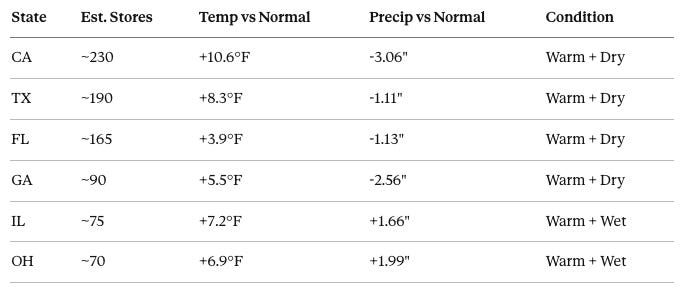
The state-level detail tells the story:
Home Depot — approximately 2,000 U.S. locations
Lowe's — approximately 1,800 U.S. locations
California, Texas, Florida, and Georgia — the four largest states in HD’s estimated store footprint — were all warm and dry. Together, they represent roughly half of HD’s top-10 state concentration. Each experienced either record or near-record warmth alongside well-below-normal precipitation, simultaneously.
The 2012 analog is instructive.
In the quarter following March 2012, HD posted +27.5% profit growth and +6.1% U.S. comp. CEO Frank Blake called it “a stronger-than-expected start to the year, driven by record warm weather.” March was warm nationally but near-normal in precipitation.
March 2026 was warmer in the key markets and dramatically drier. On the weather signal alone, the setup exceeds 2012.
Lucy and the Football
Here is where it gets complicated.
Last week, I wrote about the macro tension — gas prices, geopolitical uncertainty, and tariff-driven inflation. This week, that tension sharpened. The Iran conflict is no longer a background risk. It is a front-page tax on the consumer. Moody’s Analytics estimates that a sustained 20% rise in gasoline prices costs U.S. households an extra $6.3 billion per month. Morning Consult’s Consumer Health Index fell to a one-year low in March even as the weather set records.
The consumer was set up for a breakout quarter. Then the football moved.
This is the structural frustration for anyone trying to read the Q1 signal clearly. The weather backstop is real and historically strong. The macro headwind is also real. They are running simultaneously, in opposite directions, across the same consumer base.
What the data tells us is this: where weather matters most — home improvement, outdoor categories, seasonal apparel, spring dining — the conditions are the strongest in modern records. That does not guarantee a breakout. But it does set a floor.
The retailers most likely to feel that floor are the most weather-sensitive, with the heaviest concentration in the markets where March delivered.
Home Depot and Lowe’s are at the top of that list.
What to Watch
Home Depot and Lowe’s report Q1 earnings in May. Lower your expectations for the headline number. The trade war, the real war, and $4 gas are doing real damage to the consumer.
But don’t expect a disaster either.
March 2026 just handed the home sector the strongest weather tailwind ever recorded. That doesn’t guarantee a breakout. What it does is set a floor. In a quarter where the macro is working against retailers, weather-driven demand in CA, TX, FL, GA, and the Carolinas is quietly filling carts that sentiment surveys say should be empty.
Better than feared is the call. Not great. Not a breakout. But less bad than the macro would suggest — and the weather is why.
When results come in May, watch the language. If numbers surprise to the upside, you’ll hear about execution, strategy, and associate engagement. You won’t hear about the warmest March in 132 years.
Sometimes the simplest explanation is the right one.
Musical Coda
Source: NOAA nClimDiv state-level data 1895–2026. Store concentration based on estimated store counts by state. 30-year normal = 1991–2020 climatological baseline.
G2 Weather Intelligence™ | g2weather.com | © 2026 G2 Weather Intelligence™. All rights reserved.