

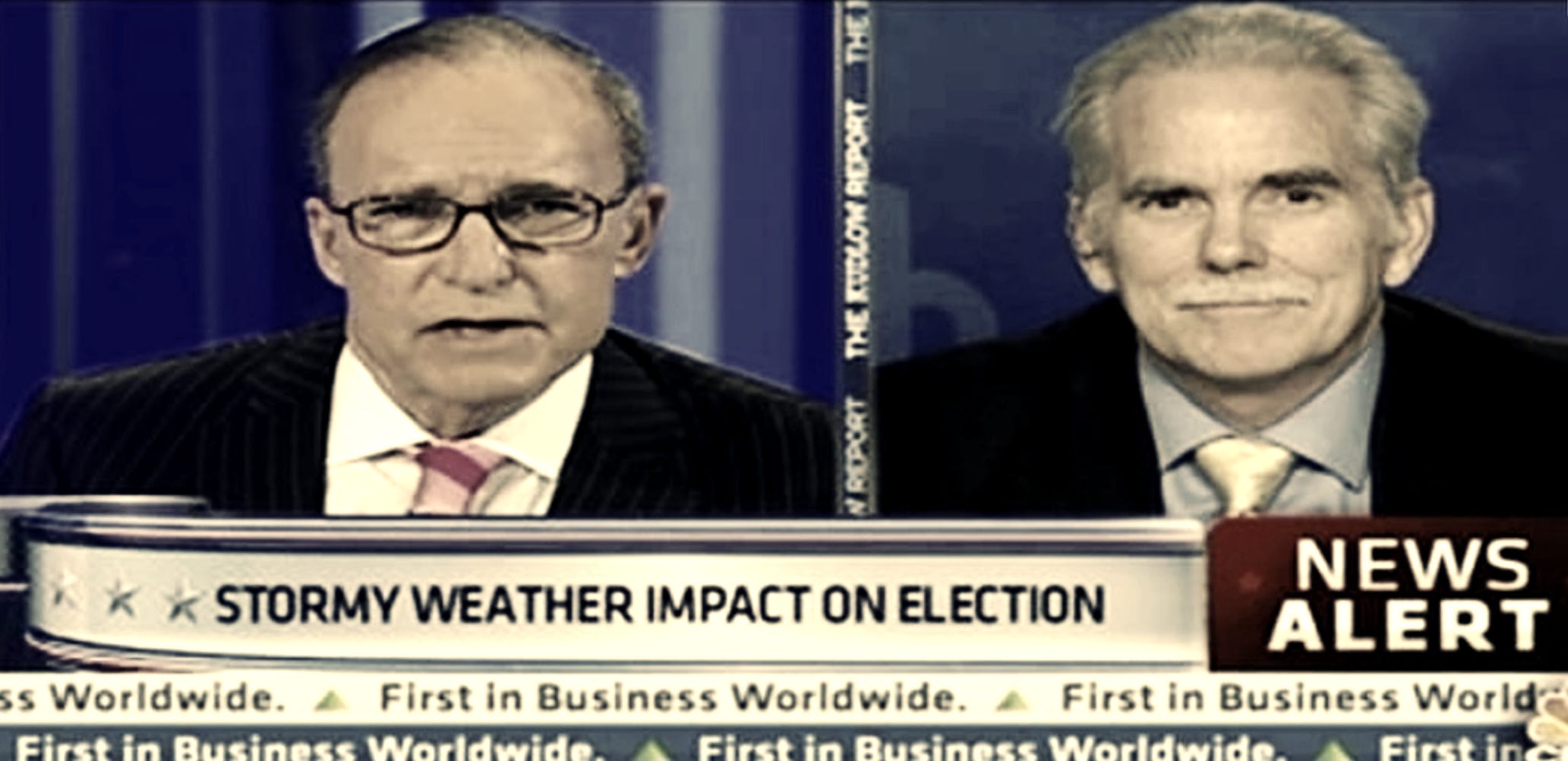
In November 2012, days before the presidential election, I sat across from Larry Kudlow on CNBC to talk about how the weather could swing it. Our research said Election Day weather would favor President Obama.
Larry wasn’t buying it.
At the time, I worked at The Weather Channel Companies, now The Weather Company, where I helped build a data business from the media platform. We paired our weather data with consumer data to predict how the weather (and, importantly, the forecast) would shape what consumers want, need, and even feel.
Mostly that meant shopping. But voting is a decision too. Do I go to the polls today or not? The weather weighs on that choice the same way it weighs on a trip to the mall.
Fourteen years later, the question is back. With Election Day a week away, the Senate may come down to Michigan … and Michigan may come down to Detroit.
What voters told us
In August 2012, with Obama and Romney locked in a tight race, we commissioned Ipsos to survey voters in 10 battleground states: Colorado, Florida, Iowa, Michigan, Nevada, New Hampshire, North Carolina, Ohio, Virginia and Wisconsin.
We asked a simple question. Would bad weather affect whether you vote?
The answers split along party lines. 27% of Democrats said bad weather would have a moderate or significant impact on whether they voted, compared with 20% of Republicans. Undecided voters were the most sensitive of all, at 35%.
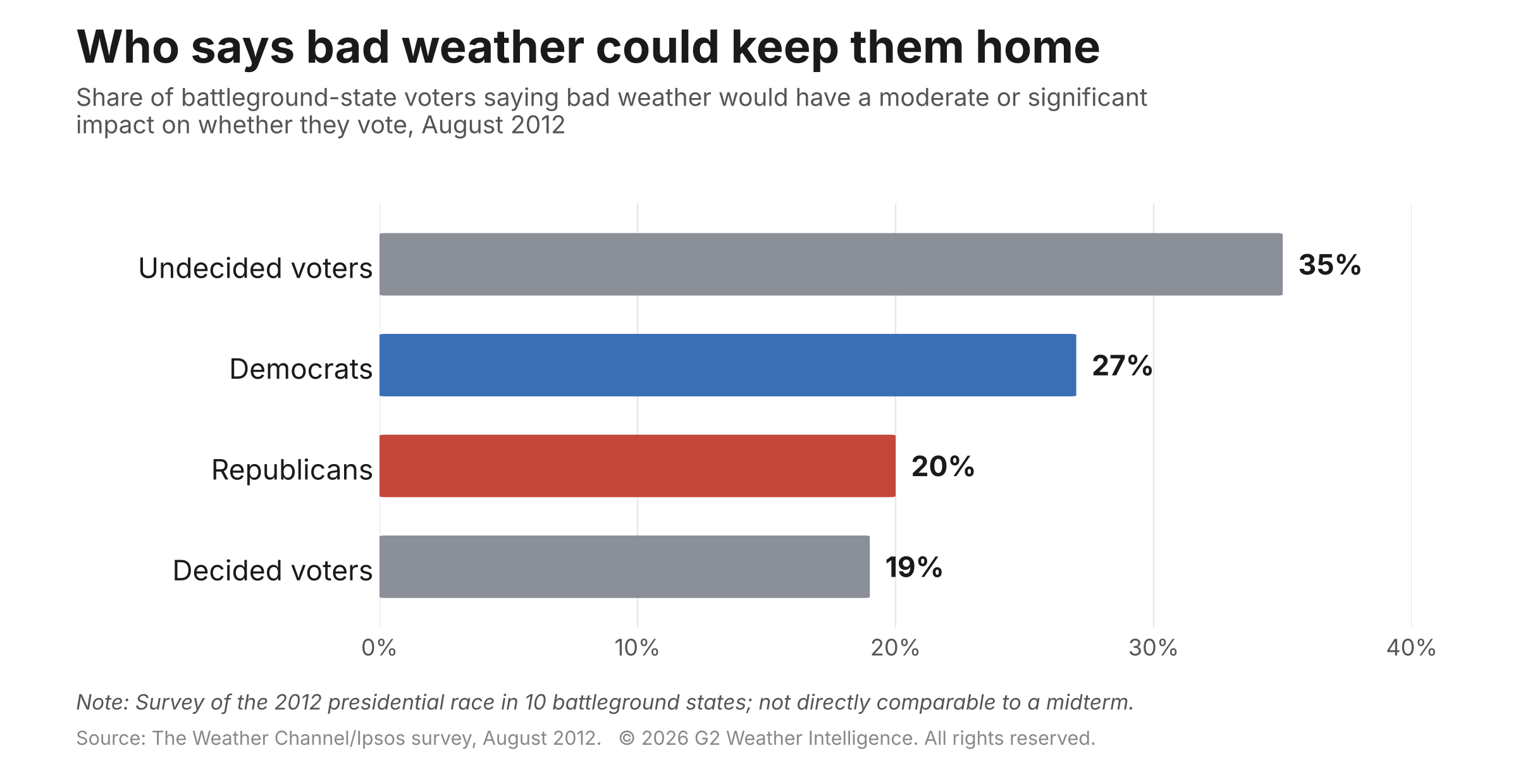
That survey covered a presidential race, so it isn’t apples-to-apples with a midterm. But the pattern is consistent with the best-known academic research: the voters most likely to let bad weather keep them home leaned Democratic.
At the time I told reporters that every vote would count, “and ultimately weather could be a big factor.”
Republicans should pray for rain
In 1960, clear skies across much of the country may have put John F. Kennedy in the White House. Researchers found that normal rain and snow could have flipped close states, including Illinois, enough to elect Richard Nixon.
Our results lined up with the academic work.
The best-known study, by Gomez, Hansford and Krause, looked at presidential elections from 1948 to 2000. Each inch of rain cut turnout by about 1 point; each inch of snow by about half a point.
Bad weather helped Republicans, and the authors suggest it may have swung Florida in 2000. The Wilson Quarterly summed it up with a nod to the paper’s title: Republicans should pray for rain.
Not everyone agrees on the partisan tilt. A 2016 study by Fujiwara, Meng and Vogl confirmed that rain keeps people home, and that the effect lingers into the next election because voting is a habit. But they found no clear advantage for either party.
One (big) thing has changed since 2012. Far more people vote early or by mail now. Those ballots are cast before anyone knows the Election Day forecast, which likely shrinks the weather effect.
The campaign playbook
Retailers and consumer brands have used weather to time their marketing for years. A cold snap switches on coat ads. A heat wave switches on ads for fans and cold drinks. The ads run where the weather is, when it’s happening.
Campaigns have the same tools. Digital ads can be turned on by ZIP code within hours. If the forecast shows rain over a swing state on Election Day, a campaign can push early voting the weekend before. Or it can buy last-minute ads reminding its voters the polls are open until 8 and offering a ride.
The ground-game version isn’t new. Facing a rainy primary in 2011, Philadelphia campaigns shifted to giving voters rides to the polls, a consultant told WHYY. When Sandy hit a week before the 2012 election, campaigns moved phone banks into storm-hit battlegrounds and rewrote their scripts, Campaigns & Elections reported.
What I haven’t seen is a campaign say publicly that it uses forecasts to trigger online ads. My bet is the smart ones do.
Hail to the Victors
On April 28, 2007, my wife and I sat in Michigan Stadium for our oldest son’s graduation. Bill Clinton gave the commencement address.
The student commencement speaker was our son’s classmate and a fellow Phi Beta Kappa. He told the graduates to “have the audacity to believe we can change the world.”
His name was Abdul El-Sayed.
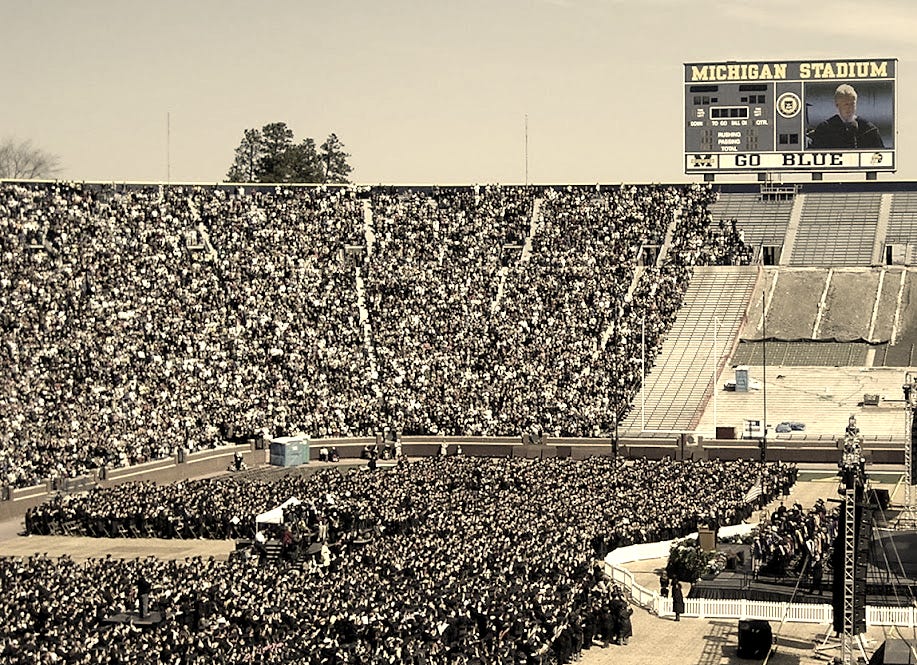
Nineteen years later, El-Sayed is running for the Senate seat Gary Peters is leaving. His opponent is Republican Mike Rogers, a former congressman and House Intelligence Committee chairman. Rogers lost Michigan’s other Senate race to Elissa Slotkin in 2024 by about 19,000 votes, or 0.34 points.
It’s a toss-up again.
Michigan is one of seven Senate toss-ups in the Cook Political Report’s latest ratings, and the only one Democrats are defending. Democrats need a net gain of four seats to take the Senate.
Lose Michigan, and they need five.
CNN reported last week that Democrats are worried about turnout among Black voters in Detroit, Flint, and Pontiac. “If even a sliver of people don’t turn out, you run into a huge challenge,” the Rev. Charles Williams II told CNN.
A sliver is exactly what weather moves.
The Detroit forecast
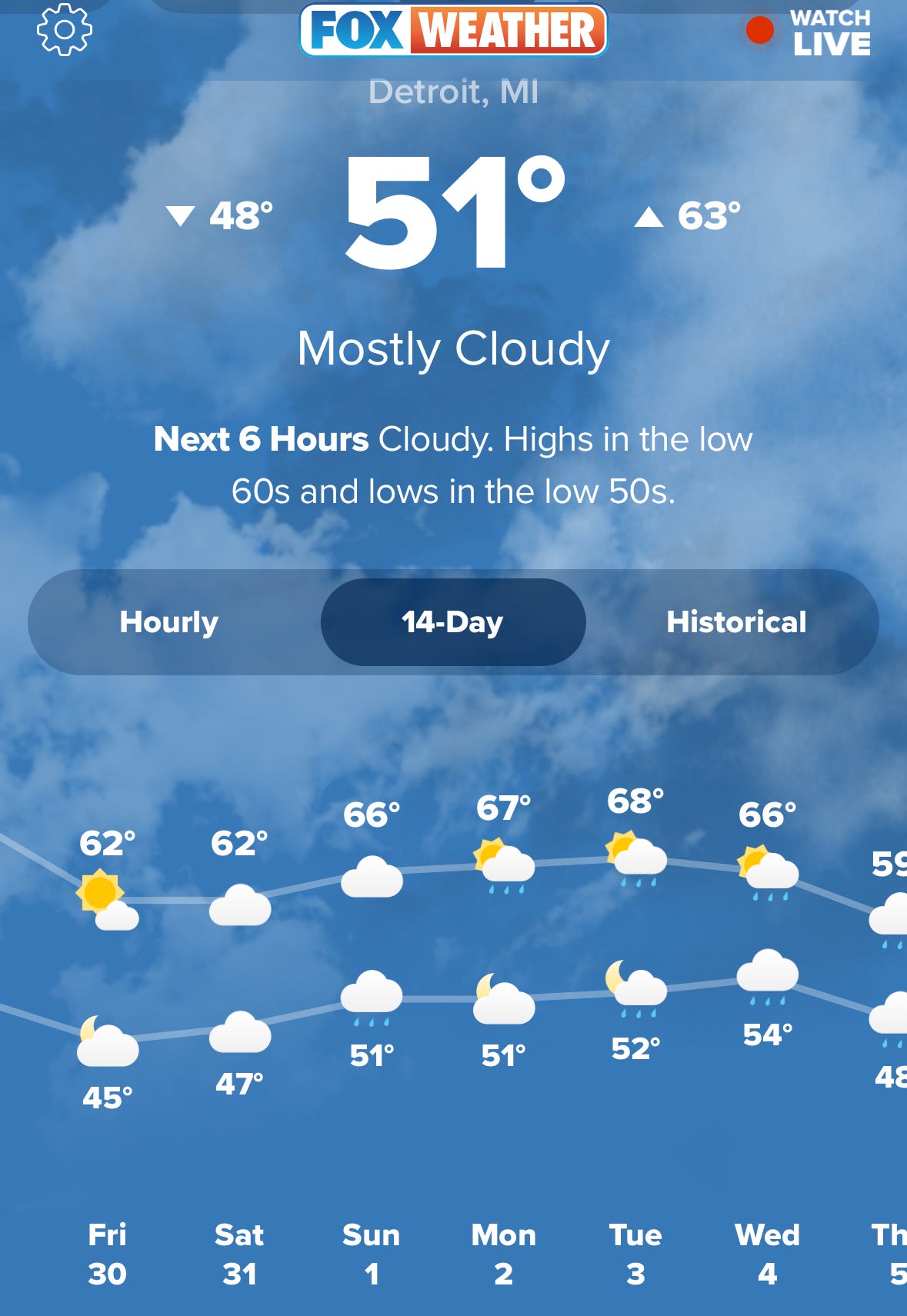
According to FOX Weather’s 14-day forecast, Detroit will see a high of 68° on Election Day and a low of 52°, with a chance of a passing shower. That’s about 13 degrees warmer than normal for the date.
Cold won’t keep anyone home.
NOAA’s longer-range outlook backs that up. The Climate Prediction Center’s 8–14 day outlook, issued Oct. 26 for Nov. 3–9, gives the Detroit area a 60–70% chance of above-normal temperatures.
That leaves less than a 1-in-10 chance of a colder-than-normal week. The same outlook leans slightly wet for Michigan, with 33–40% odds of above-normal precipitation, so a few showers wouldn’t be a surprise.
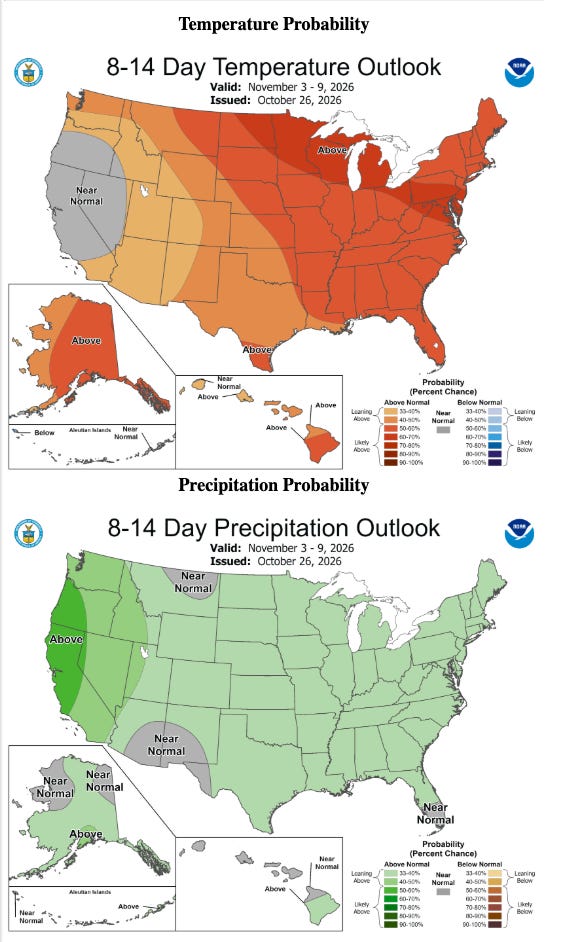
Warm Election Days are becoming a Midwest habit. Two years ago, Detroit and Columbus were forecast to challenge their records for the date. This year, the super El Niño I’ve been tracking since September is tilting early November warm again.
Detroiters are hardy. In my experience, a raw, rainy day in the 40s won’t keep many of them from the polls. A day in the high 60s with only a slight chance of morning showers takes the weather off the table.
If the forecast holds (and it likely will), the research says a mild, mostly dry day lifts turnout, and higher turnout has historically helped Democrats. Put the forecasts together with the research, and Detroit’s Election Day weather is a tailwind for Democratic candidates, El-Sayed included.
It isn’t their only one.
Enthusiasm
Bad weather mostly keeps home the voters who weren’t sure they’d go anyway. Enthusiasm shrinks that group. A voter who’s fired up goes out in the rain.
Brazil showed it on Sunday. Despite torrential rain and flooding in parts of the country, nearly three million more Brazilians voted in the presidential runoff than in the first round. Lula da Silva came from behind to win a fourth term, picking up 10.4 million votes between rounds, The Wall Street Journal reported. Voting is compulsory there, but the fine for skipping it is less than a dollar.
This year, that cuts toward the Democrats.
A Reuters/Ipsos poll published Oct. 8 found 48% of voters who backed the Democratic ticket in 2024 were “very enthusiastic” about voting in the midterms, compared with 30% of those who backed the Republican ticket. (Same polling firm we used in 2012.)
Back to 2012
Our research said good weather would help Obama, and Election Day mostly delivered: fair skies and mild temperatures across much of the country, except in the storm-battered Northeast.
To Larry’s chagrin, President Obama won re-election (bigly!) on Nov. 6, 2012, with 332 electoral votes to Mitt Romney’s 206, and 51.1% of the popular vote to 47.2%.
Did the weather help materially in 2012? Probably not. But it certainly didn’t hurt. In a race decided by a third of a point, like Michigan’s last Senate race, it could.
Musical Coda
The analysis and writing here are mine. I use Claude as an editor — for fact-checking and line edits — not as a source of ideas or content.
© 2026 G2 Weather Intelligence. All rights reserved.