

This is the third post in the G2 Weather Intelligence Brainstorm series on building an integrated retail weather strategy.
The first post covered seasonal planning — how much to buy. The second covered demand forecasting and distribution — where to send it. This post covers pricing — specifically, markdown pricing — and the weather variable that most optimization systems still don’t fully exploit.
A Story From the Field
Years ago, I worked directly with a senior executive at one of the country’s largest women’s specialty apparel retailers. The company had invested in a sophisticated price optimization system — it analyzed sell-through rates, weeks of supply, calendar position, and historical markdown performance.
State of the art in every respect except one: it had no way to see the weather coming.
That gap is where I came in. I provided her with ad hoc weather intelligence the old-fashioned way, directly from my brain, and she used it to override the system’s recommendations whenever the forecast told a different story than the sell-through data.
The results were striking. One particular spring stands out. It started cooler than normal; inventory turns slowed, and the optimization system reviewed the sell-through data and recommended a 40% markdown to clear seasonal product.
The weather forecast told a different story. Temperatures were about to shift. A warmer pattern was building. She hedged — took a 20% markdown instead of the system’s recommended 40%.
When the weather turned and demand returned, the inventory cleared. At 20% more margin than the system would have surrendered.
That is not a rounding error. On a seasonal buy of any size, a 20-point difference in markdown depth is real money. And it was being left on the table — every season — because the pricing model was optimizing against incomplete information.
Weather Changes What Consumers Will Pay
The umbrella example is the simplest illustration. A rainy day in New York City sharply increases demand for umbrellas. Supply is fixed. The consumer who needs an umbrella right now is not price sensitive — demand is inelastic.
The same umbrella on a sunny day in the same store is a discretionary purchase. The consumer can wait, shop around, or simply not buy. Demand is elastic. Price sensitivity is high.
Same product. Same store. Different weather. Completely different pricing power.
The apparel example works in reverse. A cool April makes spring dresses optional — consumers don’t need them yet. She can wait. Demand is elastic, and price sensitivity is high. A warm April makes the same dress feel urgent. Pent-up seasonal demand releases. The consumer converts at higher prices.
Academic research confirms the relationship directly. During periods of extreme heat, consumers have low price elasticity for cooling products due to rigid demand — price sensitivity drops and margin opportunity rises. When temperatures moderate, the same products become highly elastic — consumers will wait, shop around, or simply not buy.
Weather doesn’t just change how much consumers buy. It changes how much they will pay — and how sensitive they are to price changes. That is the definition of price elasticity. And weather is one of the most powerful real-time drivers of elasticity that most markdown optimization systems don’t fully account for.
Coca-Cola Understood This in 1999
In 1999, Coca-Cola quietly began testing a vending machine that could automatically raise prices for its drinks in hot weather. CEO M. Douglas Ivester described the logic plainly: “Desire for a cold drink increases during a sports championship final held in the summer heat. So it is fair that it should be more expensive.”
The concept was economically sound. The machine was withdrawn after significant customer backlash — consumers understood the logic and rejected it anyway. But the underlying principle has never been wrong.
The Harvard Business School published a case study on the episode in 2000. It’s been taught in business schools for 25 years. Weather-driven price elasticity is real, measurable, and exploitable. The question is how to apply it in a way that optimizes margin without triggering the Coca-Cola backlash.
The answer for retail is not raising prices in a heat wave. It is avoiding unnecessary markdowns when a weather-driven demand recovery is forecast. That is the women’s apparel executive’s insight applied at scale.
Where the Industry Actually Is
The leading retailers are moving in the right direction. Walmart has begun incorporating weather forecasts into pricing decisions — adjusting seasonal product prices earlier than historical calendar-based approaches would have dictated, based on regional weather outlook data.
The academic case for why this matters is striking.
A 2024 peer-reviewed study looked at how much of the week-to-week swing in retail sales a standard forecasting model — one built on past sales, day of week, and promotions — simply couldn’t explain. When weather data was added to the same model, it accounted for up to an additional 47% of the unexplained variation for individual products and up to 56% for entire product categories.
In plain terms, weather isn’t a minor adjustment to a forecast. For some products, it explains nearly half of the swings in demand that a non-weather model has no way to see coming. That is the difference between a forecast that is roughly right and one precise enough to drive real inventory and pricing decisions.
But implementation is uneven. And the gap between claiming to use weather and using it precisely is significant.
Consider this: a major home improvement retailer’s CFO cited “cold, wet weather in May” as the reason for weaker sales in a recent quarter. Independent weather data showed May was wet but not cold. The retailer was using weather as a narrative — not as a signal.
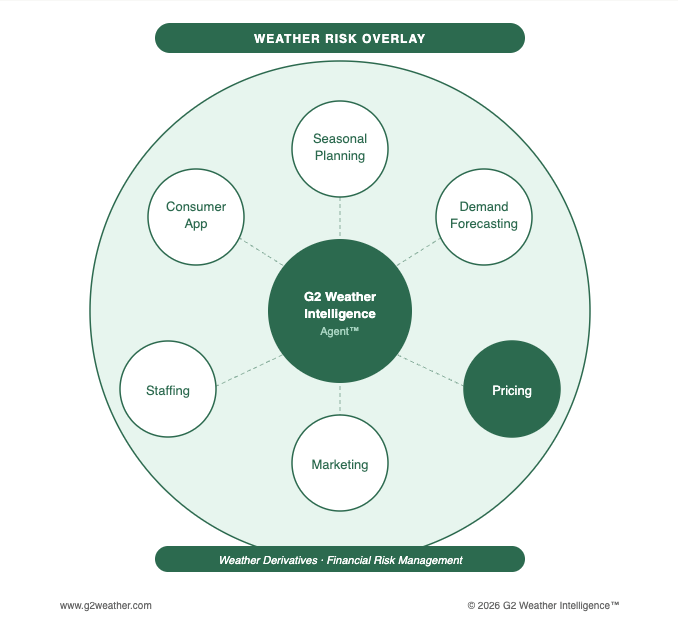
That is the real problem. Weather intelligence is not a single capability. It is a connected system — seasonal planning, demand forecasting, distribution, pricing, marketing — each layer informed by the same forecast signal, each layer building on the one before it.
A retailer who uses weather for inventory planning but not pricing is leaving margin on the table. A retailer who uses weather for pricing but not marketing is missing the demand activation window. A retailer who uses weather for all of it — systematically, end-to-end — is building something closer to a weather-proof earnings model.
Why Most Markdown Systems Still Get This Wrong
Current markdown optimization systems have improved significantly. Leading platforms now list weather as a factor in their models. But listing weather as a variable and systematically integrating the forward forecast into real-time markdown decisions are different things.
The gap is not awareness. It is precision and integration. A system that incorporates historical weather patterns is not the same as one that compares the current inventory position to the 10-day forecast and adjusts the markdown recommendation in real time as the forecast evolves.
The women’s apparel executive was doing the latter — manually, in her head, one season at a time.
The Weather-Informed Markdown Framework
Three inputs the markdown model needs to use the weather signal effectively:
Current weather anomaly. What has the weather done to demand velocity in recent weeks? Is inventory turning slower because of a weather headwind or because of a product problem? These are different diagnoses that require different responses. A weather-driven slowdown is temporary. A product problem is not.
Forward forecast. What does the next 6-30 days look like for the categories with excess inventory? Is the demand headwind temporary or persistent? A cool week followed by a warm pattern is a hold-the-markdown signal. A cool month with no recovery in the forecast is a mark-it-down signal.
Elasticity by weather regime. How price-sensitive are consumers in this category under current and forecast conditions? A heat wave makes cooling products inelastic — hold price, maximize margin. A cool June makes them elastic — mark down earlier and deeper to move product before the season closes. The markdown depth should reflect the elasticity regime, not just weeks of supply.
The Digital Price Tag Enabler
Electronic shelf labels and digital price tags make weather-responsive pricing operationally feasible at scale for the first time. Price changes that once required manual intervention across thousands of SKUs and hundreds of stores can now be executed automatically — in minutes, not days.
The technology infrastructure for weather-driven dynamic pricing exists today. The missing ingredient is connecting the weather forecast to the pricing engine in real time.
Agentic AI as the Execution Layer
The markdown decision requires holding three variables simultaneously — current inventory position, forward weather forecast, and real-time elasticity estimate — and updating the response as each variable changes.
That is exactly the multi-variable, continuously updated optimization problem that agentic AI was built to solve.
The agent monitors the forecast. When the signal changes — a warming pattern arriving sooner than expected, a cold snap extending further than forecast — it adjusts markdown recommendations before the demand window opens or closes. No manual override required.
What the women’s apparel executive did in her head, one season at a time, the agent does automatically — across every category, every store, every week — at the speed the forecast window requires.
From Override to Automation
The women’s apparel executive was doing manually what the system should have been doing automatically. She had the weather intelligence. She had the inventory position. She made the call — and recovered 20 margin points the system would have surrendered.
The difference between her approach and the fully integrated framework is not the insight. It is scale and speed. One executive can override one system for one season. An agentic AI holds the weather signal, the inventory position, and the elasticity estimate simultaneously — and executes before the opportunity closes.
The markdown model without weather is optimizing against incomplete information. That is not a pricing problem.
The tools exist. The data is publicly available. The gap is the absence of an end-to-end weather strategy — one that connects seasonal planning, demand forecasting, distribution, pricing, and marketing into a single integrated system, each layer informed by the same forecast signal, each decision building on the one before it.
That is what separates a retailer that occasionally benefits from favorable weather from one that has built weather intelligence into the foundation of its operations — and earnings.
Next in the series: weather-driven marketing activation — timing campaigns to the forecast rather than the calendar.
© 2026 G2 Weather Intelligence. All rights reserved.