

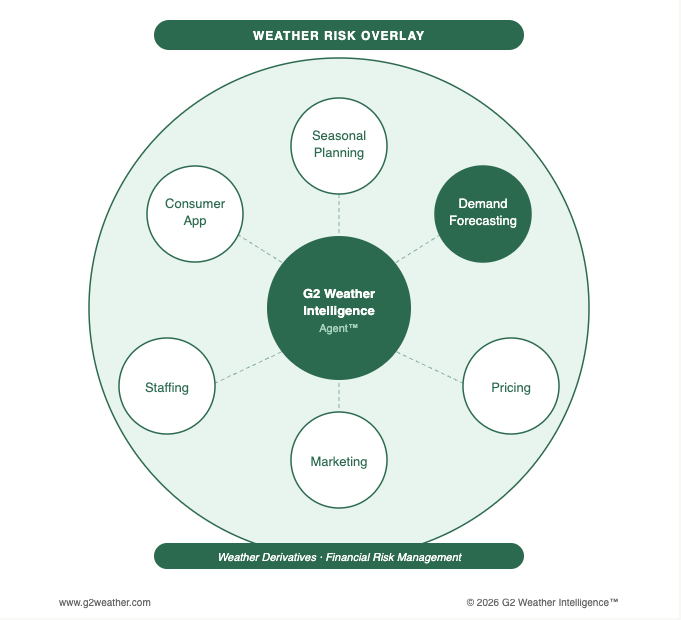
This is the second post in the G2 Weather Intelligence Brainstorm series on using weather intelligence across the retail planning cycle.
The first post covered seasonal planning — using long-range weather outlooks to set the strategic foundation before the season begins.
This post covers the next step: demand forecasting and inventory optimization. If the first post was about strategy, this one is about money.
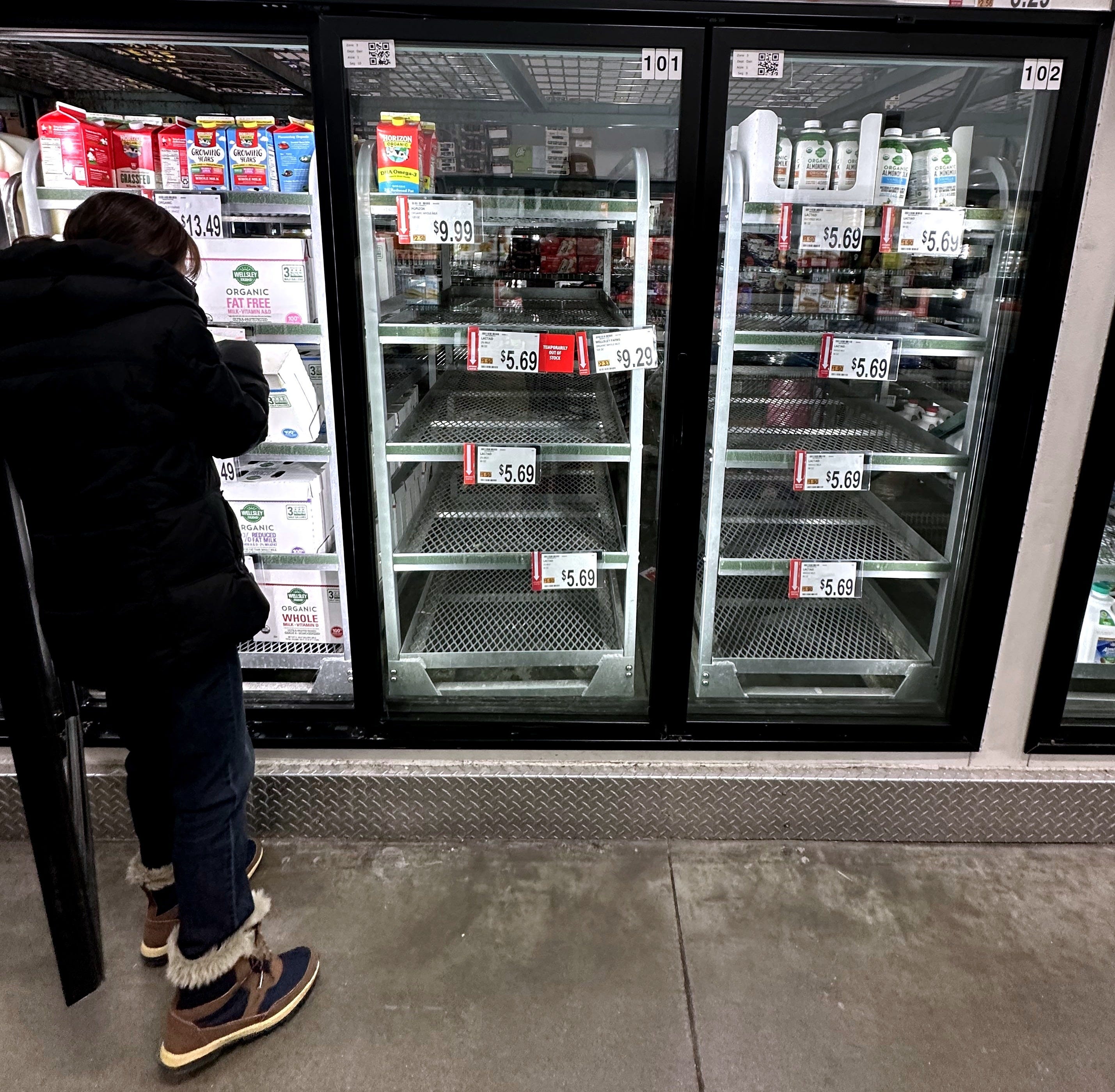
Let’s start with a thought experiment.
The academic and industry research is unambiguous. Incorporating weather data into demand forecasting models reduces forecasting error by up to 45% for seasonal product categories.
AI-driven demand forecasting delivers average inventory reductions of 20-30%, generating working capital improvements of $15-20 million per $1 billion in revenue annually.
Better weather-aligned inventory positioning delivers a 20-70 basis point profit lift through higher full-price sell-through, lower inventory costs, and optimized markdown timing.
And the baseline math is unforgiving — inventory carrying costs run 20-30% of inventory value per year, meaning excess seasonal inventory is not just a markdown problem. It is a capital problem.
Now apply those numbers to three retailers I’ve been covering all earnings season:
Home Depot generates approximately $160 billion in annual revenue. Roughly 40-50% is weather-sensitive — lawn and garden, outdoor living, cooling, heating, building materials. At $15-20 million in annual working capital improvement per billion in weather-sensitive revenue, the potential annual benefit for Home Depot alone is nearly $1 billion to $1.6 billion.
Lowe’s generates approximately $83 billion in annual revenue with a similar category mix — roughly $33-42 billion in weather-sensitive revenue. Annual working capital improvement potential: $495 million to $840 million.
Walmart’s seasonal category exposure — apparel, lawn and garden, outdoor living, holiday, automotive — conservatively represents $100 billion in weather-sensitive revenue. Annual working capital improvement potential: $1.5 billion to $2 billion.
Combined, these three retailers represent a potential $3 to $4.4 billion in annual benefit from a publicly available data source accessible to any competent data science team today.
This is a thought experiment, not a guarantee. The research establishes the range. The actual outcome depends on execution, category mix, and the degree to which the weather signal is integrated into planning systems.
But the order of magnitude? Not in dispute
Obvious in Theory. Hard in Practice.
If it were easy, everyone would be doing it. The reason most retailers are not capturing this value is not a lack of awareness. It is the genuine complexity of the weather-to-demand relationship.
Weather doesn’t drive demand in a simple, linear way. To use the signal effectively, you have to resolve several problems that are harder than they sound:
What actually happened? Before you can forecast weather-driven demand deviation, you need to accurately measure what the weather has historically driven. That means isolating the weather component from all other variables — promotions, price changes, competitive activity, calendar shifts, consumer sentiment — at the category and SKU levels.
Lag effects. This is one of the biggest complexities in weather-driven demand modeling. Weather doesn’t always drive demand in the same week it occurs — and the lag structure varies dramatically by category.
A cold snap in April immediately suppresses spring apparel sales. But that demand doesn’t disappear — it defers. When temperatures normalize, pent-up demand is released, often in a concentrated burst that can be mistaken for an execution win rather than a weather catch-up.
A sustained heat wave drives air conditioner and fan sales in week one. That same heat places stress on vehicle batteries, belts, and cooling systems — and that stress shows up as automotive parts and repair demand two to three weeks later, after the damage has accumulated.
Get the lag structure wrong, and the model is right about what will happen but wrong about when — triggering inventory responses too early or too late, leaving you understocked when demand peaks and overstocked when it doesn't.
Weather forecast-driven demand. Consumers don’t just respond to weather. They respond to weather forecasts. A heat wave widely forecast three days out drives air conditioner sales before the heat arrives. The model has to account for the demand the forecast generates, not just the demand the weather event itself drives. These are different signals.
Calendar context. A 5-degree above-normal temperature anomaly in early June drives a materially different demand response than the same anomaly in late July. July heat feels normal. June heat feels early — and early heat drives a disproportionate demand response because pent-up seasonal demand is still building. The model has to understand where it is in the seasonal calendar, not just what the temperature is doing.
Geography and microclimate. A national average temperature anomaly is nearly useless for store-level inventory decisions. A heat dome in the Northeast is irrelevant to a store in Phoenix, where it is always hot in June. The signal has to be specific to the store’s local climate, the consumer’s local baseline, and the category’s local demand profile.
This is why the problem has been discussed for decades and solved by very few.
The Data Is Already Available — Free
Here is what most retail analytics teams may not fully appreciate. NOAA’s Climate Prediction Center publishes probabilistic forecasts at no cost that extend a full year out, quarter by quarter.
These are scientifically grounded probability signals — not gut calls or rough estimates — updated monthly and precise enough to inform meaningful planning decisions at every horizon from near-term promotions to long-range seasonal buys.
Commodity traders, energy companies, and agricultural planners invest heavily in proprietary weather intelligence — specialized ensemble models and commercial vendor enhancements that provide incremental forecasting edges worth billions in trading profits.
Retailers don’t need that level of precision or investment. The NOAA probabilistic forecast data is more than sufficient for retail planning purposes — and it’s free.
The forecast hierarchy covers every planning horizon a retailer needs:
6-10 days: High confidence. Actionable for near-term promotional and staffing decisions.
8-14 days: Directional confidence. Actionable for inventory reallocation and reorder decisions.
30-day: Monthly outlook. Actionable for buy optimization and category-level positioning.
Seasonal outlooks: Quarterly probability forecasts updated monthly, extending a full year forward. Actionable for long-range buy decisions and financial risk management.
Any data scientist worth their salt can access and integrate all of these data streams at no cost today. The monthly updates to the seasonal outlooks are particularly underutilized — each update is a signal to revisit buy quantities, adjust inventory positions, and reshape promotional calendars for the quarter ahead.
Most retailers treat the seasonal buy as a fixed decision. The probabilistic forecast treats it as a continuously updated signal. The gap between those two approaches is where the margin is lost.
There are also many commercial weather data vendors who provide this data in more accessible formats with additional value-added services. But the foundational data is free, publicly available, and ready to use.
Why Agentic AI Is the Unlock
Machine learning resolves the complexity of the weather-to-demand relationship. It can identify lag structures, calendar sensitivities, forecast-driven demand components, and geographic specificity simultaneously — and update those relationships continuously as new data arrives.
Machine learning alone produces a better model—agentic AI turns that model into operational action. The distinction is critical.
A model that tells a merchant “cooling category demand will be 15% above normal next week in the Northeast” is useful.
An agent that automatically triggers the reorder, adjusts the promotional plan, reallocates inventory from weaker-signal markets, and updates the markdown calendar — without waiting for a human to interpret the output and make a decision — is transformational.
The forecast window is too short and the store footprint too large for human decision-making to keep up. Agentic AI is the lever that finally makes this solvable at scale. The technology exists today. The forecast data is available and free. The constraint is building the system that connects them.
The Throttle — Inventory as the Constraint
The signal tells you what demand will do. The inventory position tells you what you can do about it. The system has to hold both simultaneously.
A warm June signal with strong inventory depth in cooling categories is an opportunity — accelerate promotions, pull forward demand, maximize sell-through at full price.
A warm June signal with thin cooling inventory is a different problem — reorder immediately, reallocate from weaker-signal markets to stronger ones.
A cool June signal with heavy cooling inventory is the worst case — markdown acceleration, reorder suppression, promotional investment to move product before it ages.
AutoZone’s comp deceleration in the final two weeks of Q3 was not just a weather story. It was an inventory response story. The demand signal was visible in the temperature data two weeks before it showed up in the numbers. The system to act on it wasn’t in place.
The End State — Store-Level Intelligence at Scale
The ultimate expression of this framework is not a regional signal applied uniformly across a store fleet. It’s a store-level demand forecast — specific to the microclimate, the local inventory position, and the category mix of each individual location — updated continuously as the forecast evolves and as the monthly seasonal outlooks are revised.
Consider what that looks like in practice:
A distribution center receives a reallocation signal because the 8-14 day outlook indicates a heat dome building in the Northeast.
A store in Boston gets a promotional activation trigger for cooling categories three days before the heat arrives.
A store in Chicago with excess spring apparel inventory receives a markdown signal because the 6-10 day outlook indicates below-normal temperatures through the week.
The monthly seasonal update triggers a revision to the Q3 outdoor living buy before the purchase order is placed.
One weather data source. One model. Store-level precision at every planning horizon — from the distribution center to the shelf. Demand forecasting informs the decision. Inventory optimization shapes the response. Agentic AI executes before the opportunity closes or the markdown clock starts running.
From Signal to Action
The weather forecast signaled that AutoZone’s comps would soften two weeks before they did. The signal was visible. The system to act on it wasn’t in place.
Turning that signal into a store-level inventory and promotional response — automatically, at scale, accounting for lag effects, calendar context, forecast-driven demand, and local microclimate — is a hard problem. It has been discussed for decades. Agentic AI is what finally makes it solvable.
Demand forecasting and inventory optimization are one layer of a broader end-to-end weather strategy that spans seasonal planning, pricing, marketing, staffing, and financial risk management. Each layer builds on the one before it. Each one is powered by the same publicly available data source.
The question is not whether the signal exists. It is whether the system is built to act on it.
© 2026 G2 Weather Intelligence. All rights reserved.