

This is the fourth post in the G2 Weather Intelligence Brainstorm series on building an integrated retail weather strategy.
Post 1 — How to Use NOAA Data to Build a Weather-Adjusted Seasonal Plan
Post 2 — Weather-Optimized Demand Forecasting Could Recover Billions in Lost Margin
Post 3 — Your Markdown System Doesn’t See the Weather Coming
One analytics foundation powers it all.
The weather-to-demand relationships established in seasonal planning — the historical correlations between temperature, precipitation, geography, and consumer behavior — are the same relationships that inform demand forecasting, inventory distribution, markdown pricing, and marketing activation. Build the analytics layer once. Every function draws from it.
The sum is far greater than the parts.
A retailer running weather-optimized marketing on top of weather-optimized inventory is compounding the signal. The demand is there because the forecast predicted it. The inventory is there because the distribution responded to it. The consumer shows up because the marketing was activated at exactly the right moment. That is the integrated system. That is the competitive advantage.
Fort Campbell, Kentucky. Early 1990s.
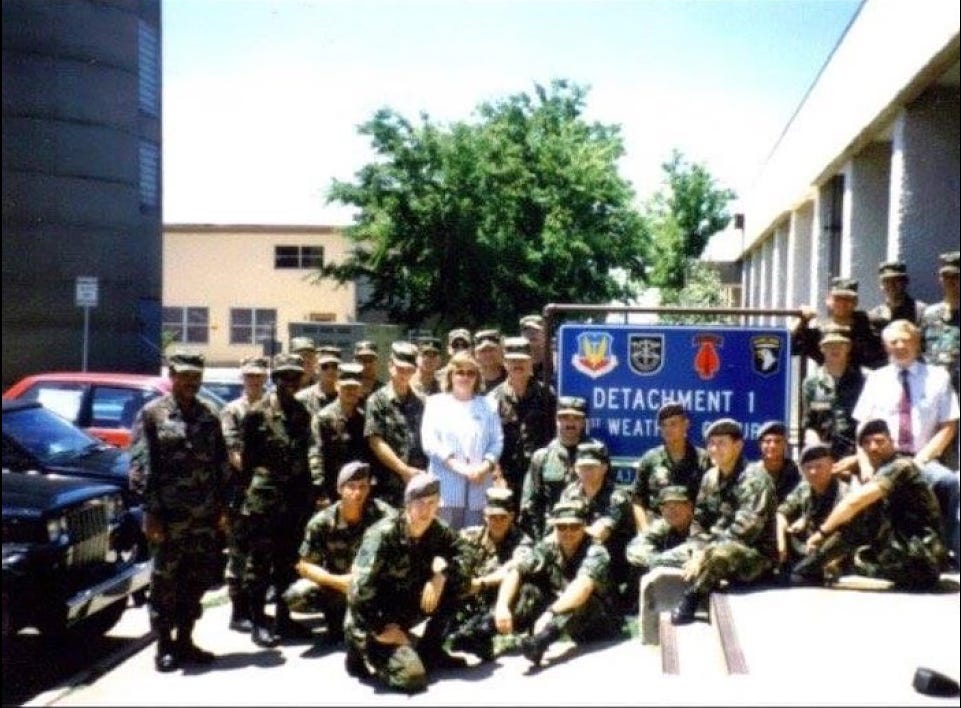
We had just returned from Operation Desert Storm — one of the most decisive military victories in American history. One hundred hours of ground combat. Coalition forces overwhelmed a battle-hardened Iraqi army with precision and speed the world had never seen.
I was the weather operations chief at Fort Campbell, Kentucky — deployed alongside the 101st Airborne Division, the 5th Special Forces Group, and the 160th Special Operations Aviation Regiment. The Night Stalkers.
Also see: How Desert Storm reshaped my understanding of weather, risk, and decision-making.
My original account of Detachment 9, 1690th Weather Group (Provisional)—the Air Force weather team embedded with the 101st Airborne during Desert Shield and Desert Storm.
A record of service and of innovation when the stakes were real. And it marks the beginning of a mission I’ve been pursuing ever since.
If you know the US Army, you know what that means. These are not ordinary units. They’re among the most elite combat units in the American military — the ones that go first, go deep, and go where no one else can. The tip of the spear. Literally.
Our customers didn’t ask about the weather out of curiosity. They asked because lives depended on the answer. Go or no-go. Route selection. Insertion timing. The difference between a successful mission and a catastrophic one could be a single weather decision made hours in advance with incomplete information. We provided the intelligence. The warfighters made the call.
Back at Fort Campbell, in those days — before the internet, before digital everything — the weather station was still powered by teletype machines for data and fax machines for weather maps. It was all paper.
The only full-color satellite and radar loops we had came from The Weather Channel, on the TV mounted above the forecast counter. Functional between commercial breaks and, of course, Weather on the 8s.
The same Weather Channel that, twenty years later, would hire me to help transform it from a media company into a data and analytics platform.
I never imagined that one day I’d work there. But the question that Desert Storm planted never left me: What is weather intelligence actually worth if it doesn’t improve operational outcomes?
In 2011, The Weather Channel Company hired me to find out.
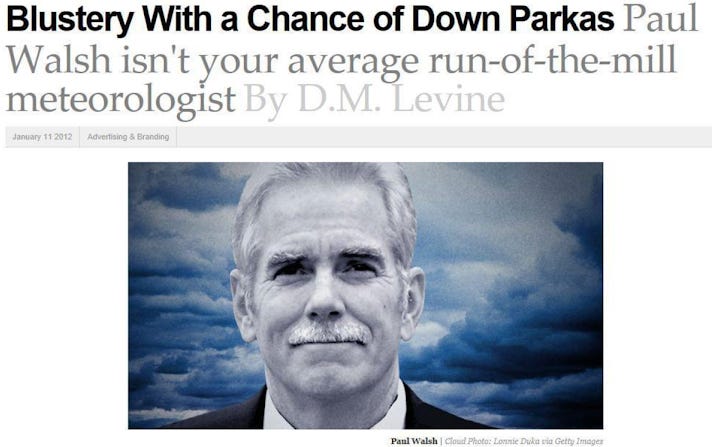
Paul Walsh, a former meteorologist with the U.S. Air Force who spent a little more than a decade in the private sector helping companies predict how weather patterns might affect their businesses, was tapped as the cable network’s vp of weather analytics. In the newly created role, Walsh will head up a nascent initiative to sell highly targeted weather predictions to the channel’s advertisers.
Source: ADWEEK
The Mission
My mandate in 2011 was to lead the development of a Weather Analytics function — and, with it, the transformation of The Weather Channel Company from a media company with data to a data-and-analytics company that was also a media company.
That distinction matters. A media company with data uses weather to attract an audience. A data and analytics company uses weather to change how businesses make decisions.
The forecast wasn’t the product. What you could do with it was the product.
Tampa, 2012
Not quite a year into the role, we ran our first live test of what would eventually become a new ad targeting system called WEATHERfx.
The Republican National Convention was about to begin in Tampa, and inside the newsroom, there was growing concern that a tropical system (nascent Hurricane Issac) developing in the Gulf could disrupt the event.
Producers were preparing contingency plans. Talent was standing by. If confidence in Tampa's potential impact increased, they would send an on-air team into the city days before landfall.
One of our first advertising partners was Duracell. Instead of waiting for the National Weather Service to issue official warnings, we asked a different question: what if we used the forecast — not the weather itself — to decide when to begin advertising?
As confidence increased that Tampa could be affected, we triggered the Duracell campaign days before official warnings were issued. Consumers hadn’t started preparing yet — but they would. Batteries would be one of the first things they bought when they did.
The campaign dramatically outperformed expectations and, as I recall, led to a significantly larger Duracell commitment going forward.
But the bigger lesson wasn’t about batteries. We hadn’t just run a better ad. We’d answered a question that most marketing organizations never ask: when is the consumer most likely to need this product — and how far in advance can we see it coming?
Weather wasn’t just something to forecast. It was a marketing signal.
The Four Questions Every Company Is Trying to Answer
Every retailer, brand, and consumer-facing business is trying to answer the same four questions — usually independently, rarely simultaneously.
How much do I need? Seasonal planning. The weather predicts demand deviation from baseline before the season begins. The seasonal buy is a fixed decision — but it should be a probability-weighted one, informed by the best available long-range forecast at the time of the buy. Get this wrong and every downstream decision is fighting an uphill battle.
Where should I put it? Distribution. The right inventory in the right stores at the right time. A heat signal building in the Northeast is a reallocation trigger for cooling categories — before the heat arrives, not after.
What should I charge for it? Markdown pricing. The same weather signal that drove the inventory decision should inform the pricing decision.
A cool April with a warm pattern building in the 10-day forecast is a hold-the-markdown signal for spring apparel — the demand is coming, don't surrender the margin early.
A cool April with no recovery in the forecast is a mark-it-down signal — move the inventory before the season closes. The consumer's price sensitivity shifts with the weather. The pricing model has to see the same forecast as the inventory model.
When should I tell customers — and what should I say? Marketing activation and creative are two sides of the same decision, and the weather signal drives both.
Timing first. Don’t advertise umbrellas after it starts raining. Activate when forecast confidence crosses the threshold that drives consumer preparation behavior. The Duracell campaign worked because we acted on the forecast — not the event. By the time the NWS issued warnings, every competitor was running the same message. We were already three days ahead.
Message second. Cold weather, heat wave, storm prep, backyard weekend, holiday travel — different context, different mindset, different message.
A consumer in Boston during a heat wave and a consumer in Phoenix during the same event have completely different baseline experiences. The Boston consumer is caught off guard. The Phoenix consumer is in their normal summer.
Same temperature signal. Completely different creative brief. The forecast tells you when to activate. The weather regime tells you what to say. Both inputs come from the same signal.
The Big Idea
None of these decisions should happen independently.
A markdown system that doesn’t see the same forecast as the marketing team is working against itself. A marketing campaign that activates on a calendar date while the inventory system is responding to a weather signal is firing blind. A demand forecast that updates weekly while the promotional calendar updates monthly is leaving money on the table.
The weather signal connects all four. Inventory. Distribution. Pricing. Marketing. One signal. One system. Every function responds to the same forecast at the same time.
That signal today is the weather. Tomorrow, it’ll be AI-generated demand intelligence that incorporates weather and a dozen other real-time variables. The principle remains exactly the same: the value isn’t in having better data. It’s in getting every function to act on the same data at the right time.
The Research Confirms It
Two studies make the case — one from academia, one from the organization I helped build.
A peer-reviewed study published in the INFORMS journal Marketing Science — drawing on field experiment data from over six million mobile users across 344 cities — found that consumer response to mobile promotions was 1.2 times higher and 73% faster in sunny weather than in cloudy weather.
More importantly, people responded especially well when actual weather was better than forecast — reinforcing that forecast context matters more than current conditions. You are not marketing to the weather. You are marketing to the consumer’s expectation of the weather.
In 2025, The Weather Company took that finding further. Working with Neuro-Insight, a global leader in brain-based marketing research, they conducted a neuroscience study — “Wired for Weather” — that measured subconscious brain responses in 182 participants exposed to weather conditions and paired advertisements. Key findings:
Overall:
Ads aligned with weather-driven emotional states lifted ROI by up to 18%
Ads served immediately after a consumer checks the weather tap into fresh emotional responses — a more powerful moment of influence than calendar-based or demographic-targeted campaigns
Sunny days:
+10% Engagement
+12% Detail Memory — a key predictor of purchase intent
+19% Global Memory — brand storytelling retention
Rainy days:
+29% Engagement
+22% Detail Memory
+25% Global Memory
Gen Z:
Up to +13% higher memory encoding
+12% increased engagement on sunny days compared to the general population
The Weather Company built the capability I helped start into a precision advertising platform backed by neuroscience. The Duracell campaign in Tampa was the proof of concept. The “Wired for Weather” study is the scientific validation.
Weather isn’t just a backdrop. It is an emotional and cognitive signal that shapes how people process and remember brand messages. The forecast changes the consumer’s mindset. The right message in the right weather regime doesn’t just reach the consumer — it reaches them when they are most neurologically receptive to it.
Where This Fits
Marketing is the fourth post in this series for a reason. It is not the first lever you pull. It is the demand activation layer — the mechanism that ensures that when inventory is in the right place and priced correctly, the consumer actually shows up to buy it.
Seasonal planning sets the buy. Demand forecasting optimizes the distribution. Pricing manages the margin. Marketing activates the demand. The four are not four separate decisions. They are one decision made at four levels of the planning hierarchy — and the same weather signal connects all of them.
A retailer running weather-optimized marketing on top of weather-optimized inventory is compounding the signal. That compounding effect is where the real competitive advantage lives. Not in any single capability — in the integration of all of them.
The Forecast Was Never the Product
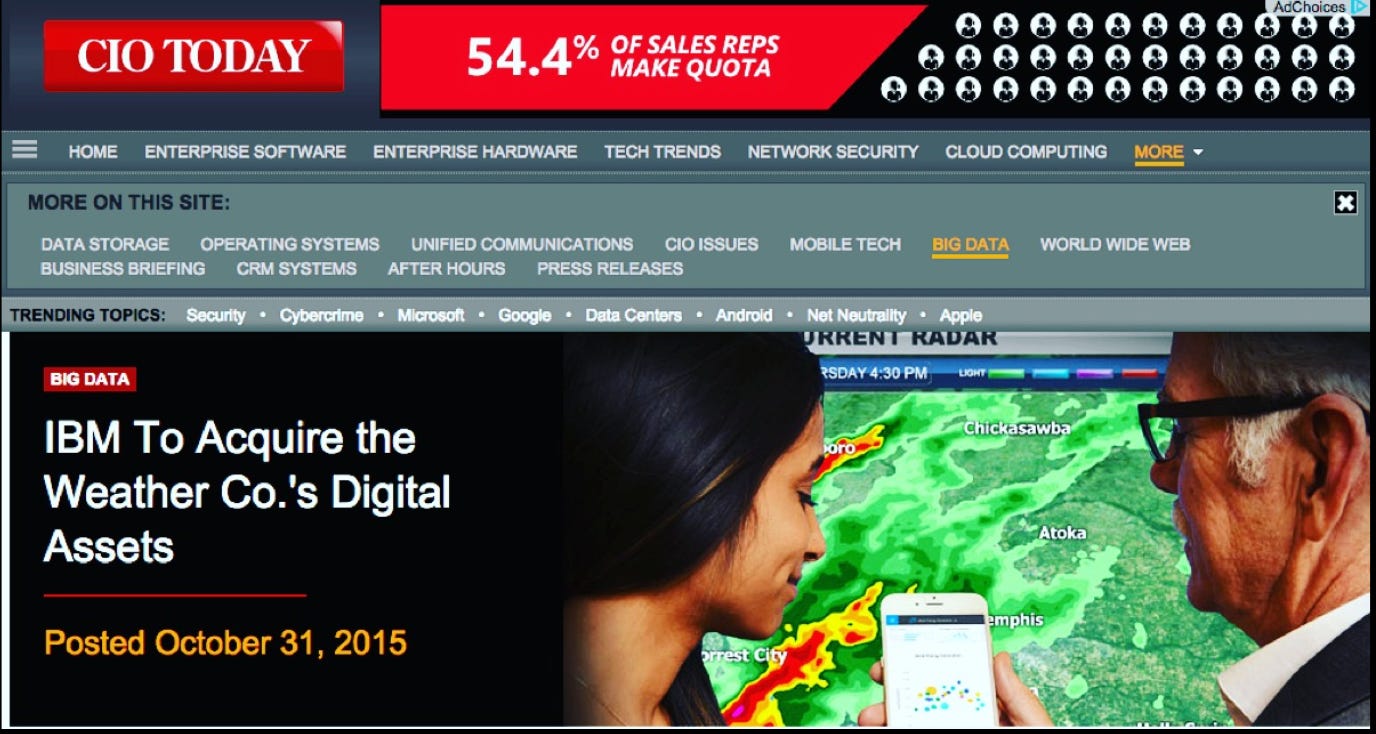
In 2015, IBM announced the acquisition of The Weather Company for a reported $2 billion.
Not for the television network. Not for the consumer app. For the data, the analytics, and the enterprise intelligence platform built on the thesis that weather was a business signal — and that the companies that could act on it faster and more precisely than their competitors had a structural advantage.
At Fort Campbell, we called that advantage decision superiority. The force with the best weather intelligence didn’t just have a better forecast — it had better timing, better positioning, and better coordination across every function of the mission.
The forecast was the input. Synchronized action was the output.
WEATHERfx applied the same principle to marketing. The Duracell campaign wasn’t remarkable because we had better weather data than our competitors. It was remarkable because we connected the forecast to the activation decision faster than anyone else — and marketing responded to the signal before consumers even knew they needed the product.
IBM paid $2 billion in part for that vision. The full realization of it — every function of a retail or consumer enterprise responding to the same weather signal simultaneously — remains, frankly, a work in progress across the industry.
That gap is precisely what this series is about.
Next in the series: weather-driven staffing optimization — scheduling for the forecast, not the calendar.
Watch the Conversation
How Weather Influences Retail, Marketing, and Human Behavior — I joined David G. Ewing on Content Kingdom to talk through the ideas behind this post: weather intelligence, consumer behavior, predictive marketing, and where AI takes it next. From strawberry Pop-Tarts before hurricanes to the future of weather-driven advertising.
© 2026 G2 Weather Intelligence. All rights reserved.